Axios AI+

April 04, 2024
Ryan here. Today's AI+ is 1,056 words, a 4-minute read.
We're Webby Award finalists in the science and education category for our video series AI: The new information superhighway. Please vote for us.
Join me and Axios' Hope King Wednesday, April 10 in NYC for an evening event discussing the skills needed for an AI-ready workforce, featuring Etsy CEO Josh Silverman, Greenhouse president and co-founder Jon Stross and more. Register here.
1 big thing: AI isn't ready to run grocery stores
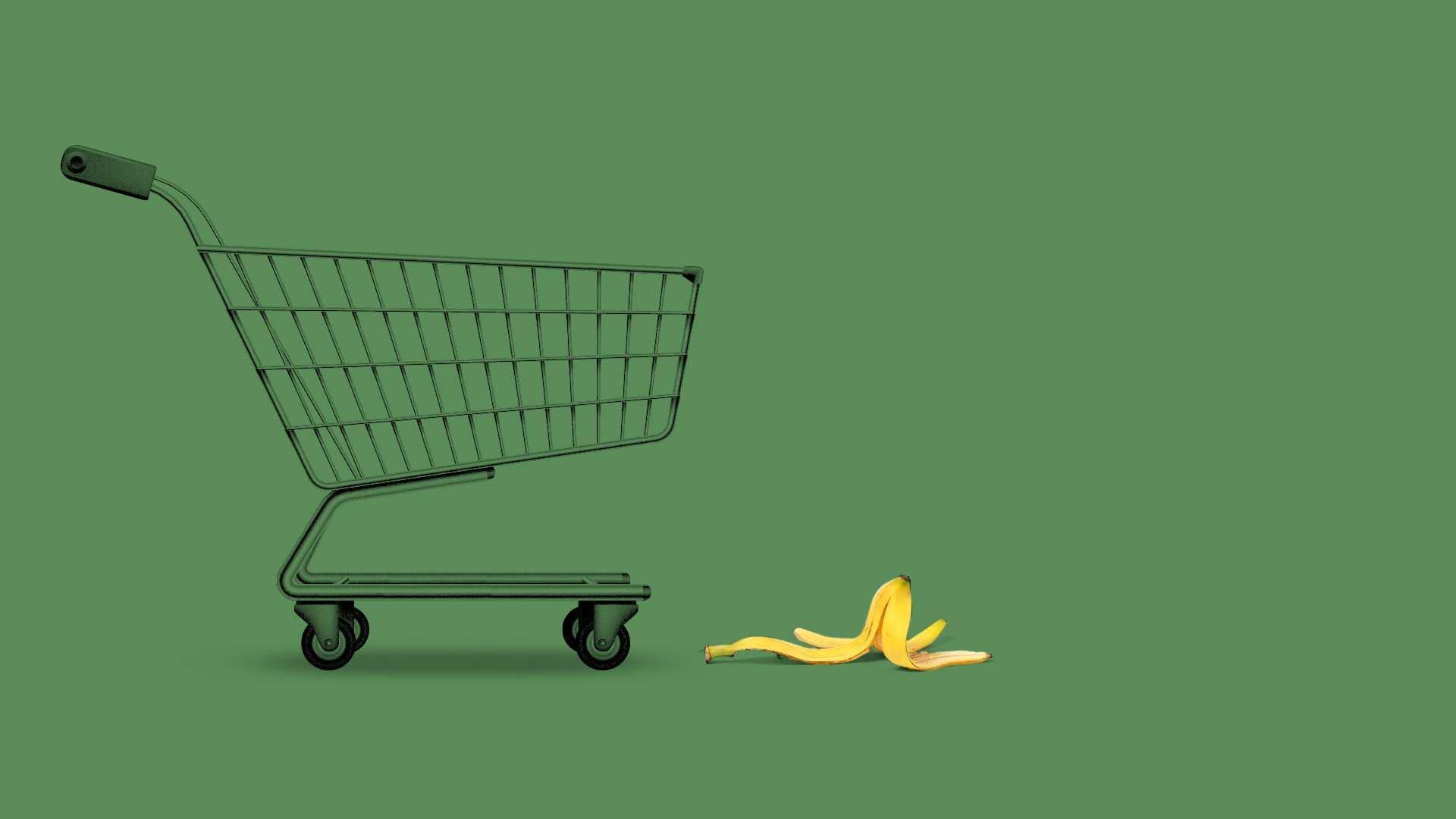
Illustration: Rebecca Zisser/Axios
Amazon's decision to shut down its grocery stores' flashy Just Walk Out technology was a slap in the face both to AI's biggest cheerleaders and its direst doomsayers, reports Scott Rosenberg.
Why it matters: AI is still not ready to operate on its own in complex physical environments full of people, like grocery stores or roads.
Driving the news: Amazon is phasing out the Just Walk Out system in its full-size Amazon Fresh grocery stores. That's the tech that lets shoppers bypass checkout lines by tracking their purchases with cameras and sensors.
- Instead, shoppers will use a "smart" cart that scans and registers each item as it's added.
- The Information first reported the news. Just Walk Out will continue to operate in Amazon Go convenience stores.
Between the lines: The experiment in cashier-free stores offered convenience, but the data-obsessed tech giant seems to have concluded that it wasn't improving at a fast-enough rate to make it cost-effective, experts suggest.
How it worked: Just Walk Out — like many AI systems — relied a lot on old-school human labor.
- Amazon used workers in India to label the data that trained its object-recognition AI. They also served as backup reviewers for problem transactions.
Zoom out: Reinforced learning from human feedback, or RLHF, is an AI technique used in most large systems today.
- Human reviewers rate AI responses, and those ratings are fed back to the system so it can "improve" — or at least better hit the targets its developers have chosen.
- This technique requires a lot of humans at the start. The system is supposed to keep improving until it no longer needs human feedback.
The AI industry relies heavily on cheap labor, often in developing countries, for the data labeling and response-rating tasks required to train models.
- These jobs, which resemble the content-moderation work social media companies outsourced to overseas workers, can be grueling and even traumatic.
AI experts regularly argue that most of today's systems won't work accurately and safely without a human being in the loop.
- This has played out most prominently in the autonomous-vehicle industry, which has burned through enormous investments while making only incremental progress toward broad deployment.
What we're watching: AI may not be ready to make supermarket checkouts obsolete, but there's a silver lining: If it's not capable of tabulating a grocery bill on its own, it's also not able to destroy humanity.
2. AI is upending the patent process

Silicon Valley continues to hold the title for most patents awarded overall in the U.S., but the rise of AI is forcing the government to design new rules around patent applications, Axios' Shawna Chen, Alex Fitzpatrick and Kavya Beheraj report.
Why it matters: Use of AI systems like ChatGPT has highlighted existing ambiguity about what qualifies for a patent.
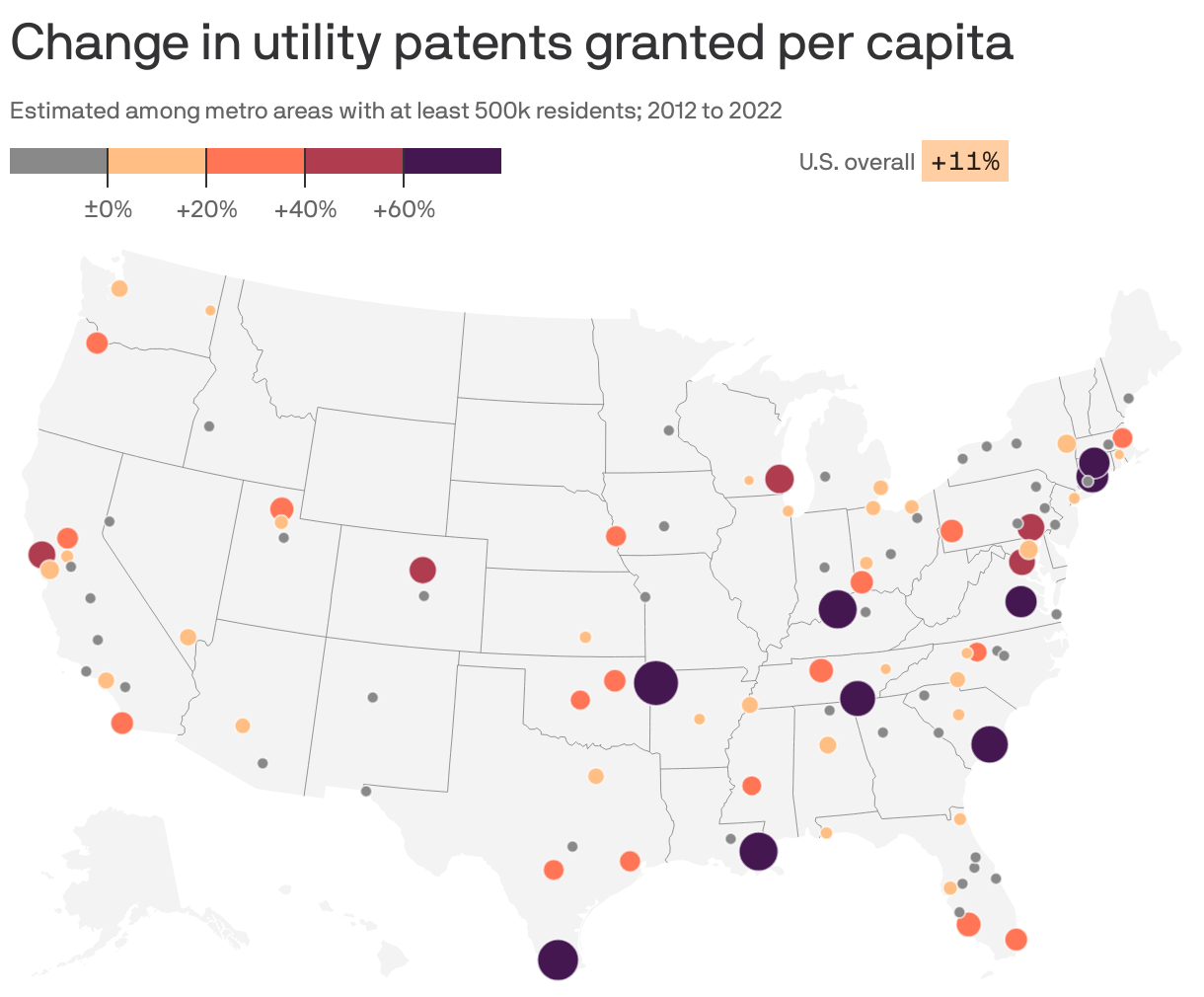
Context: Almost 248 utility patents per 100,000 residents were granted in the San Francisco-Oakland-Fremont metro area in 2022 — up 52% from 2012, according to U.S. Patent and Trademark Office data.
- Utility patents may be granted for inventing or discovering a new and useful process, machine or composition of matter, among other things.
- Computer technology saw the largest share of new utility patents, at about 28%.
- Digital communication came in second, followed by digital communication and medical technology.
State of play: Guidance from the USPTO, issued in February, states that a person's use of an AI system does not necessarily preclude them from qualifying as the inventor in a patent application.
- This would be evaluated on a claim-by-claim and case-by-case basis, per the USPTO.
- A federal appeals court ruled in 2022, however, that an inventor must be a "natural person" and not an AI system.
What they're saying: The American Intellectual Property Law Association wrote in a 2023 letter to USPTO that "AI should be regarded as a sophisticated tool assisting human innovation, analogous to any other instrument used in the creative process."
- The association also warned against the potential for inconsistencies caused by adding AI-related queries to patent applications.
Caveat: Getting a patent is one thing; actually creating the proposed product or service is another.
- That said, the number of patents granted is still a useful proxy for measuring something as quantitatively slippery as "innovation."
The big picture: In terms of raw numbers, the San José and San Francisco metros blew the rest of the country out of the water in 2022, with 14,089 and 11,346 patents granted. respectively.
- New York took third place, at 6,979.
What to watch: Northwest Arkansas, Louisville, Kentucky and New Orleans are emerging as America's new innovation hotspots, as measured by the change in utility patents granted over time per 100,000 residents.
3. ChatGPT paid users can use AI to edit DALL-E images
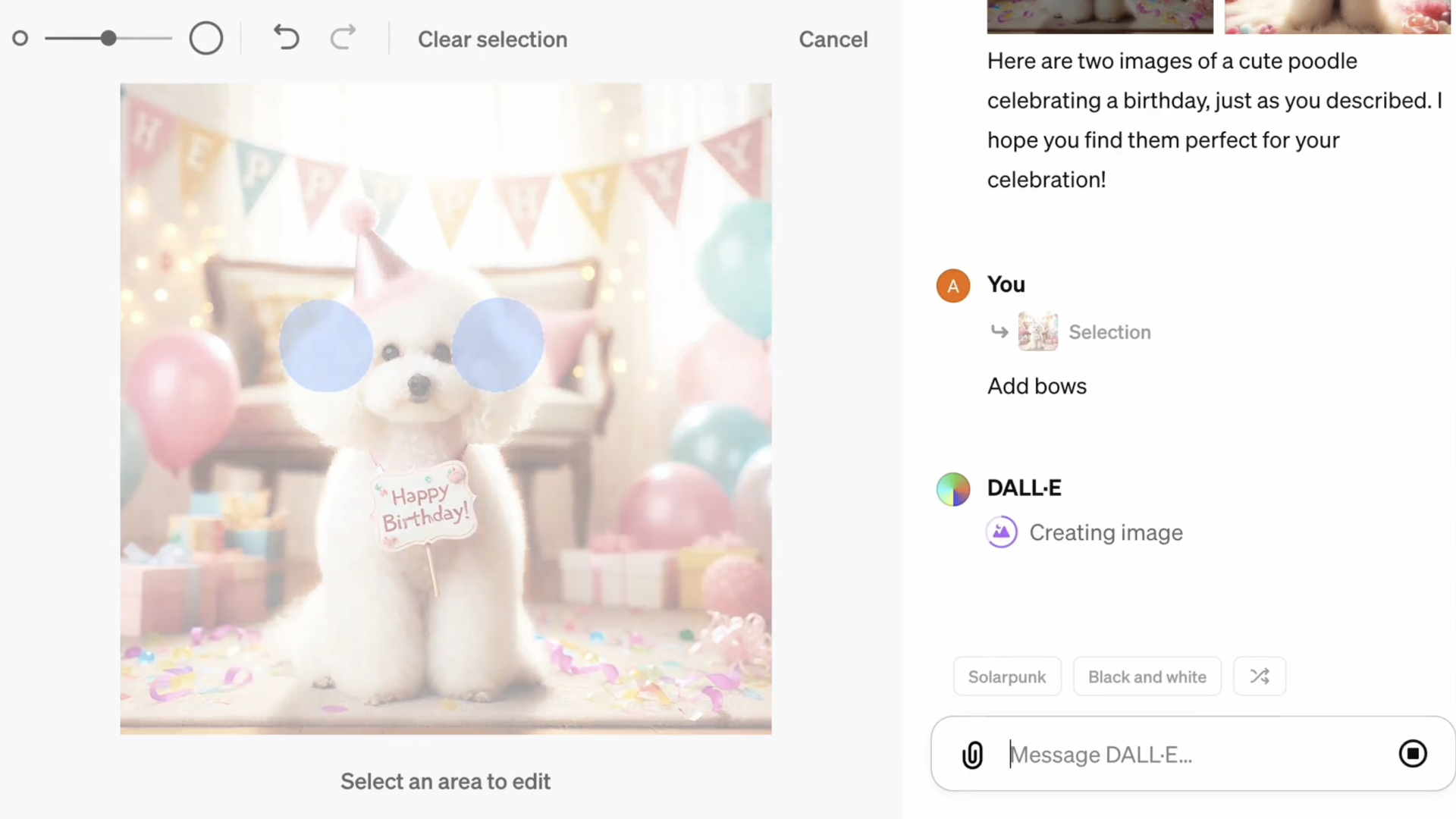
A screenshot from an OpenAI video showing the new image editing options within ChatGPT. Screenshot: Axios
OpenAI announced yesterday that paid users can now edit AI-generated images using text prompts from within ChatGPT, Ina writes.
Why it matters: It's been relatively difficult to refine the images created by DALL-E, but now OpenAI is harnessing ChatGPT's language power to make editing as easy as describing the change you want to make.
In a demo shared on X, formerly known as Twitter, OpenAI showed off the new capability, using it to add bows to a poodle's ears in an image created by DALL-E.
- DALL-E will also begin letting people choose the aspect ratio of the desired image as well as add styles such as "motion blur" or "solarpunk."
Yes, but: For now at least, the new capabilities are limited to businesses and customers using OpenAI's paid service.
The big picture: Using language to describe desired changes could offer a powerful shift to a broad array of software, including video, audio and image editing tools.
4. Training data
- Google is considering charging for AI-powered search. (Financial Times)
- AT&T says it plans to spend $3 billion by 2030 to help close the digital divide in the U.S. (Axios)
- The U.S. and the EU are using AI to find replacements for "forever chemicals" in semiconductor manufacturing. (Bloomberg)
- Meta is facing an AI brain drain after a string of high-level departures. (Fortune)
- Apple is exploring home robots after killing off its car project. (Bloomberg)
- Brands want to know how they're presented by ChatGPT and other AI services. (Fast Company)
- The FDA approved AI software that diagnoses sepsis. (CNBC)
5. + This
Know your audience: One of the AI companies at Y Combinator demo day presented a pitch that was AI generated, complete with an "AI clone" of the co-founder.
Thanks to Scott Rosenberg and Megan Morrone for editing this newsletter and to Caitlin Wolper for copy editing it.
Sign up for Axios AI+

Scoops on the AI revolution and transformative tech, from Ina Fried, Madison Mills, Ashley Gold and Maria Curi.