Axios AI+

November 22, 2024

Who else is excited for "Wicked" to debut?
Today's AI+ is 1,010 words, a 4-minute read.
1 big thing: France stakes its place as an AI hub
/2024/11/22/1732246403874.gif?w=3840)
France is looking to a gathering of world leaders in February to cement its place among the global centers for AI development.
Why it matters: The February event will likely be the first test of how — or whether — the new Trump administration engages globally on AI policy.
The big picture: France, home to Mistral and a large number of Hugging Face employees, aims to parlay its early successes into a sustained leadership position.
- "We believe we are well-positioned to develop AI technology in France," Clara Chappaz, France's minister for AI and digital affairs, said during a breakfast with journalists yesterday.
- Chappaz was in San Francisco to meet with Bay Area tech firms and attend events surrounding this week's inaugural meeting of the International Network of AI Safety Institutes.
Zoom in: Chappaz and her colleagues are looking to build momentum for the AI Action Summit that will take place Feb. 10-11 in Paris.
- Previous gatherings — in the U.K.'s Bletchley Park and Seoul — focused on safety.
- But Chappaz said a key goal of next year's event is to expand the discussion to cover other areas, including ensuring equitable access to technology and making AI more environmentally sustainable.
- "If we gather government heads and only talk about safety, we're missing the point of how to really discuss a way we can build this technology for common good," she said.
- The event is expected to host dozens of world leaders, along with representatives of top AI companies, academia and the nonprofit sector.
Yes, but: Unclear is whether President Trump will attend, three weeks after his inauguration.
- "We truly believe that everyone needs to be around the table and so everyone will be invited," Chappaz said. "I can't really predict how things will evolve."
The summit comes as officials point to a growing sense that France is a key AI hub.
- OpenAI recently opened an office in Paris.
- The country is home to one of the top universities for mathematics in the world, as well as nine government-backed research institutes focused on various aspects of AI development.
- France's use of nuclear power also helps the country deal with the technology's massive energy demands, Chappaz said.
Between the lines: Funding its ambitions remains among France's challenges as it looks to compete with the U.S. and its vast access to venture capital.
- "We are doing a lot of work to also attract capital to those companies," Chappaz said.
- She pointed to efforts to encourage investment from French pensions and insurers, as well as to provide government investment and recruit foreign money.
2. The next great digital divide

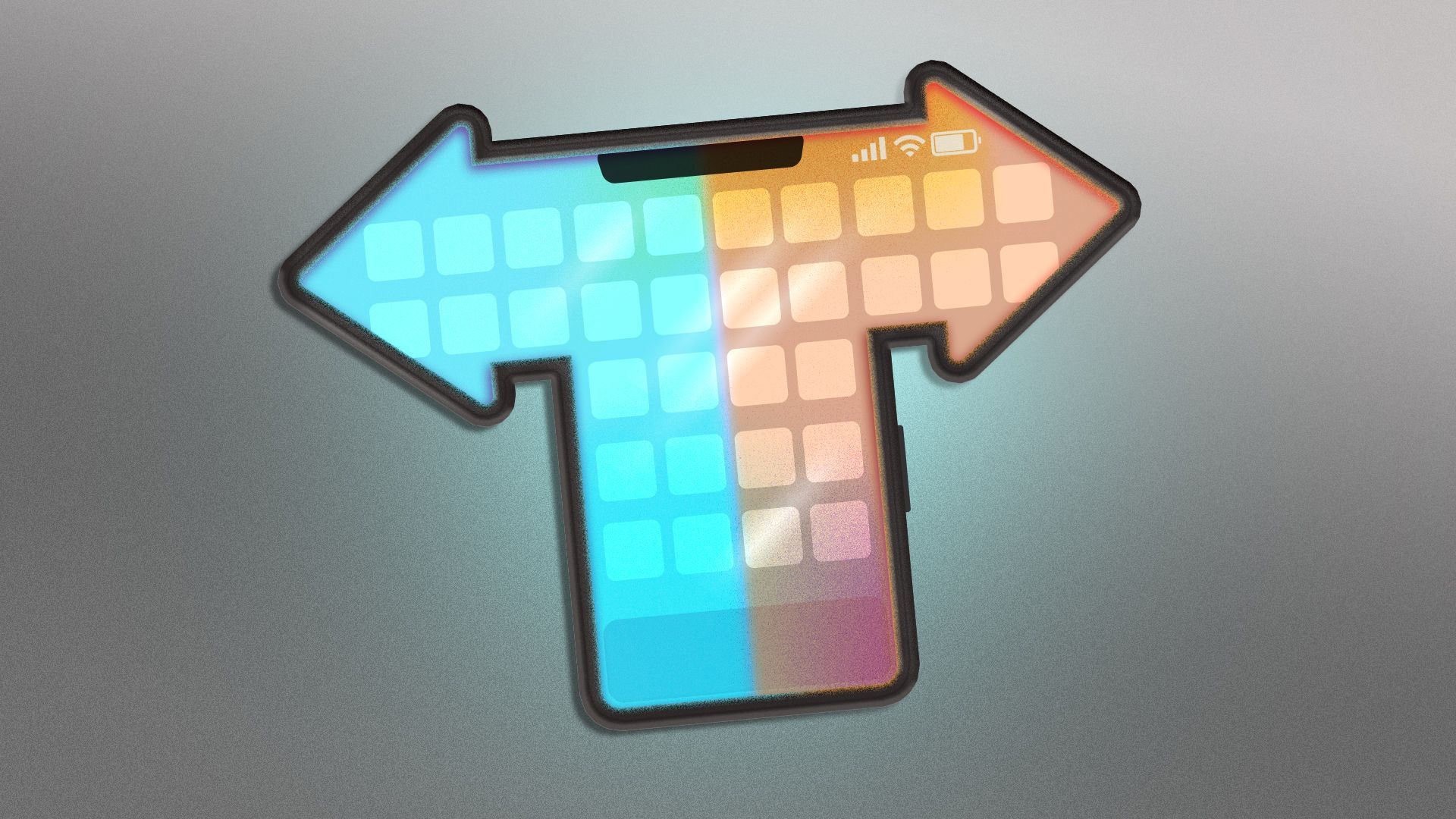
Left-leaning apps, news websites and social networks are experiencing a spike in engagement following Donald Trump's election win, further dividing the internet along political lines.
Why it matters: It's not unusual for resistance media to rise in response to contentious elections. But the internet itself is becoming more politically divided than ever, driving Americans further into echo chambers.
Driving the news: Usage of the Bluesky app in the U.S. grew by 519% in the weeks after the election, compared to the first 10 months of the year, per Similarweb.
- The social network's growth is linked to users "either leaving X or investing more time in exploring a promising alternative," Similarweb's editor of insights news and research, David Carr, noted.
Between the lines: Lefty, a dating app for progressives, has experienced a 453% surge in downloads in the two weeks since the election, founder and CEO Alex Felipelli told Axios.
- "The surge in downloads since the recent Trump victory underscores a profound shift among progressives who are seeking like-minded partners in a deeply polarized political climate," he said.
Zoom in: New data from CivicScience, a polling firm, found that people who voted for Vice President Harris are more active than Trump voters on Threads, Instagram, LinkedIn and TikTok, while Trump voters are much much more likely to be active on X.
- Certain streaming apps, such as Disney+, Hulu and Amazon Prime Video, are also much more popular among Harris voters than Trump voters.
State of play: Some progressive news outlets are leaning even heavier into resistance coverage — a business move that proved effective in 2016.
- Slate said daily subscription sign-ups were seven times higher than normal on the day after the election.
- The Guardian raised $2.4 million in two days after the Los Angeles Times and the Washington Post pulled their Harris endorsements at the last minute.
Zoom out: Conservatives tried to build an alternate internet ecosystem toward the end of the Trump administration, particularly after Jan. 6, 2020, when most of the internet's biggest platforms de-platformed then-President Trump.
- Musk bought X. Peter Thiel and Vice President-elect J.D. Vance invested in Rumble, a YouTube alternative for conservatives, which has since gone public. Trump launched Truth Social, which is now public.
- Thiel backed the creation of The Right Stuff, a conservative dating app that now has 3.4 million followers on TikTok.
The big picture: For platforms and media outlets seeking to display neutrality, playing to everyone's interests may present business challenges.
- CNN's election night ratings fell below MSNBC's for the first time this year amid a broader pivot to more centric coverage.
- Ratings for MSNBC's "Morning Joe" plummeted after co-hosts Joe Scarborough and Mika Brzezinski told viewers they visited Trump.
- The Washington Post and Los Angeles Times both saw subscribers flee in response to orders from their owners Jeff Bezos and Patrick Soon-Shiong to axe Harris endorsements.
What's next: All signs point to online tribalism increasing as the barrier to entry for new digital products lowers, challenging mainstream institutions.
3. Training data
- Apple is reportedly developing an "LLM Siri" that will hold ChatGPT-like back-and-forth conversations with users. (Bloomberg)
- OpenAI has considered releasing its own browser. (The Information)
- The United States leads the world when it comes to "AI vibrancy," according to a new Stanford study, which ranks China No. 2, followed by the U.K., India and the United Arab Emirates. (AP)
4. + This
For those who really, really like McRib sauce: McDonald's plans to sell it by the gallon jug when it brings the sandwich back next month.
Thanks to Megan Morrone and Scott Rosenberg for editing this newsletter and to Caitlin Wolper for copy editing it.
Sign up for Axios AI+
