

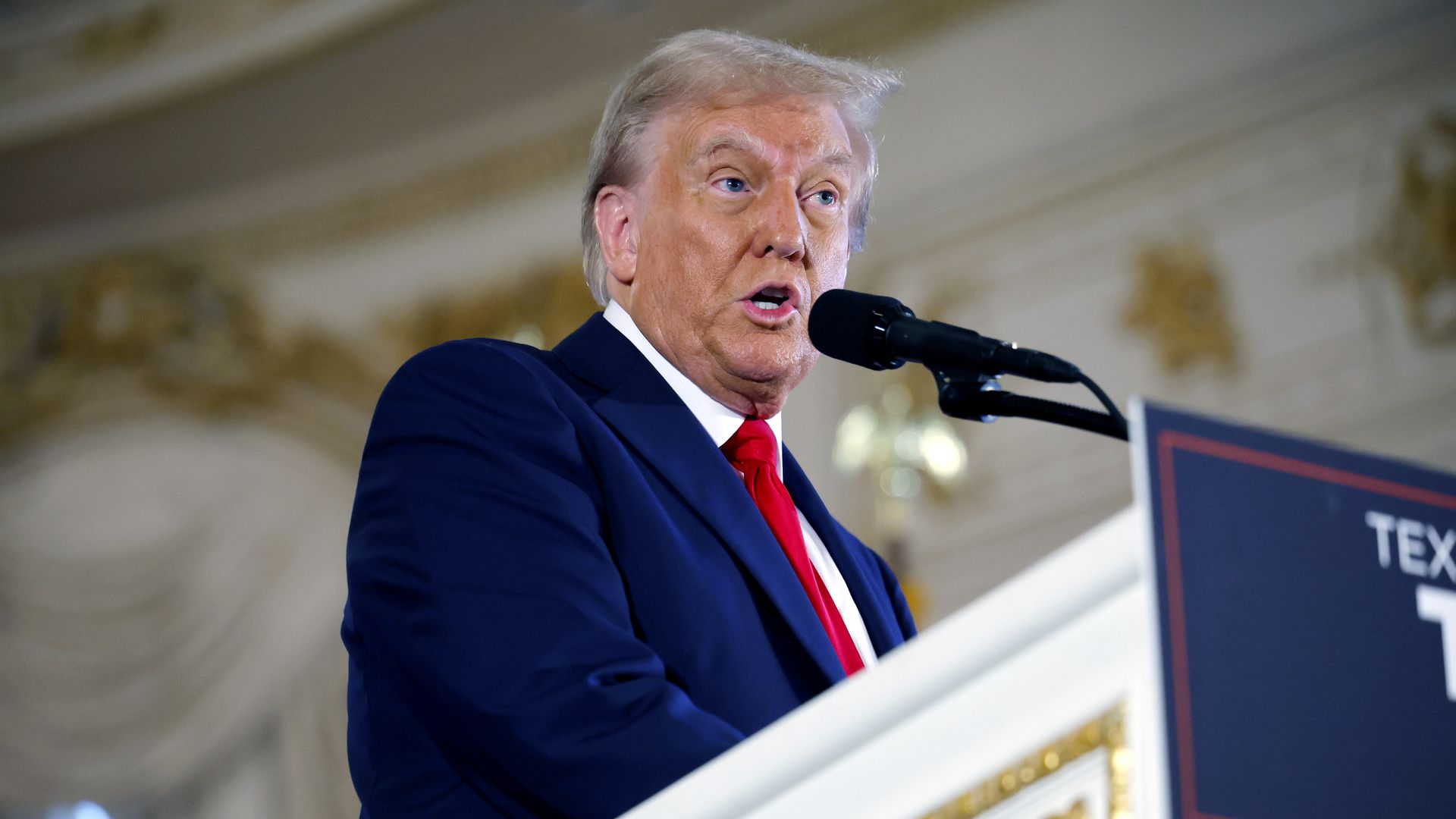
Trump on Oct. 29 in Palm Beach, Florida. Photo: Chip Somodevilla/Getty Images
With Donald Trump's second administration, anti-Big Tech rhetoric will ramp up and champions of AI deregulation will dominate, but expect any policy positions to quickly shift depending on the president's whims.
The big picture: Trump often flip-flops and changes his mind, bringing uncertainty to the tech policy space for the next four years. Who has his ear — and when — will determine much of his time in the White House, rather than any stated policies.
- Vice President-elect JD Vance does, however, bring along a more defined view of tech to the administration, embracing populism and skepticism of the Big Tech behemoths.
Here's what the Trump-Vance win could mean for tech policy.
AI regulation: Deregulation is the name of the game now. Talk of AI safety, risk mitigation and regulating the industry will be replaced by a focus on rolling back regulations to unleash the industry and compete with China.
- The AI EO is now a year old, and many of the instructions and reporting requirements are well underway, so any repeal effort would be largely moot. But the Trump administration could still remove the reporting requirements for companies with dual-use foundation models.
- Expect much of the conversation on AI to revolve around national security, competition with Beijing and avoiding burdensome regulation of the industry, rather than implementing safety standards or guardrails.
- One of Trump's most enthusiastic backers — Elon Musk — would have a lot to gain with a friendly White House as he raises billions for his xAI startups and navigates a host of government contracts and lawsuits.
Antitrust: Many of the Big Tech cases that continue today began under the first Trump administration.
- Personnel picks will determine how aggressive the approach under the next administration will be, but both Trump and Vance have blasted Big Tech consolidation and power.
Broadband: Vance backed the now-expired Affordable Connectivity Program, an internet discount program that more than 23 million Americans had come to rely on. But Republicans on the Hill won't be changing their tune on spending money in the next administration for this program or others like it.
- Expect the FCC's Title II reclassification of internet as an essential service, a move to boost regulation over the industry, to be reversed under a Trump administration.
- The FCC could also push for Big Tech companies to pay into the Universal Service Fund, an idea backed by the likely chair, Brendan Carr.
Section 230 and content moderation: Trump and Republicans frequently complained about Section 230 of the Communications Decency Act and accused social media companies of bias during and after his first stint in the White House.
- Any overhaul of Section 230 will be hard to come by in light of recent Supreme Court cases around content moderation.
- Trump could back off on all of that talk as his Truth Social relies on Section 230 to operate.
- But Section 230 makes Big Tech an easy target, and lawmakers on the Hill like to talk about repealing it.
Industrial policy: Export controls will be a focus during the Trump administration, and managing where sensitive technologies like AI and quantum go will likely continue over the next four years. But there's major uncertainty ahead, especially for the semiconductor industry.
- Trump panned the CHIPS and Science Act as "so bad" and said that the subsidies are only going to "rich companies" during an interview on "The Joe Rogan Experience" podcast last month.
- He instead proposed imposing high tariffs to make chip manufacturers build factories in the U.S: "You tariff it so high that they will come and build their chip companies for nothing."
- In short, expect the president to continue his obsession with tariffs while in office.
TikTok: TikTok is now facing a ban in the U.S. if it doesn't divest from its Chinese owner ByteDance, pending its court challenge.
- Trump may have started the process that led TikTok to where it is today, but he's said on the campaign trail that he no longer wants to ban TikTok.
- The DOJ and TikTok have asked the court for a ruling by early December in order to seek a review from the Supreme Court before the law's mid-January deadline to sell.
- Lawmakers passed the sale-or-ban law on a bipartisan basis earlier this year with strong Republican support, despite Trump's newfound opposition.
Privacy: The push to pass a federal privacy bill remains at a standstill after efforts blew up in the House.
- If nothing shifts in the lame duck, expect a renewed effort from pro-business interests and advocacy groups for a federal standard next year. That would be the case no matter who ended up in the White House.
