Axios AI+
November 26, 2024

Read to the end for my best turkey recipe.
Situational awareness: Instagram's X rival Threads adds 35 million new signups this month, a Meta spokesperson first tells Axios.
Today's AI+ is 1,223 words, a 4.5-minute read.
1 big thing: Scoop — Trump eyes AI czar


President-elect Trump is considering naming an AI czar in the White House to coordinate federal policy and governmental use of the emerging technology, Trump transition sources told Axios.
Why it matters: Elon Musk won't be the AI czar, but is expected to be intimately involved in shaping the future of the debate and use cases, the sources said.
Behind the scenes: We're told the role is likely but not certain.
- Musk and Vivek Ramaswamy — who are leading Trump's new outside-government group, the Department of Government Efficiency (DOGE) — will have significant input into who gets the role.
- Musk — who owns a leading AI company, xAI — has feuded publicly with rival CEOs, including OpenAI's Sam Altman and Google's Sundar Pichai. Rivals worry Musk could leverage his Trump relationship to favor his companies.
The big picture: Trump, partly in response to the enlarged coalition that fueled his victory, plans to be super attentive to emerging technologies.
- Trump's transition has vetted cryptocurrency executives for a potential role as the first-ever White House crypto czar, Bloomberg reported last week.
Zoom in: The AI czar will be charged with focusing both public and private resources to keep America in the AI forefront.
- The federal government has a tremendous need for AI technology, and the new czar would likely work with agency chief AI officers (which were established in President Biden's AI executive order, and could survive Trump).
- The person also would work with DOGE to use AI to root out waste, fraud and abuse, including entitlement fraud.
- The office would spur the massive private investment needed to expand the energy supply to keep the U.S. on the cutting edge.
The backstory: The idea has been kicking around Trumpworld for several months, as the transition considered structural changes at the White House to prioritize staffing for Trump's priorities.
- The model is similar to the National Energy Council that Trump said will be chaired by his designee for Interior secretary, North Dakota Gov. Doug Burgum. His Energy nominee, fracking executive Chris Wright, will be a member of the council.
- Trump's announcement said the council "will consist of all Departments and Agencies involved in the permitting, production, generation, distribution, regulation, transportation, of ALL forms of American Energy."
- "This Council will oversee the path to U.S. ENERGY DOMINANCE by cutting red tape, enhancing private sector investments across all sectors of the Economy, and by focusing on INNOVATION over longstanding, but totally unnecessary, regulation."
Our thought bubble: An AI czar wouldn't require Senate consent, allowing the person to get to work on the administration's goals faster, according to Axios technology policy reporter Maria Curi.
- The Biden administration, facing a slim majority in the Senate and a tough confirmation battle, never filled the role of U.S. chief technology officer, created by President Barack Obama.
- Instead, other senior officials at the White House Office of Science and Technology Policy took the lead. Vice President Harris played a key ambassador-like role on AI.
2. AI's scientific path to trust


Top researchers say scientific discoveries using AI — like new drugs or better disaster forecasting — offer a way to win people's trust in the technology, but they also cautioned against moving too fast.
Why it matters: Public trust in AI is eroding, putting the technology's wide adoption and potential benefits at risk.
Driving the news: At a forum in London hosted by Google DeepMind and the Royal Society, a roster of renowned scientists described how AI tools are transforming and turbocharging science.
- Efforts range from the search for beneficial new materials to the quest to build a quantum computer to the potential for self-driving labs.
Between the lines: Experts at the London event argued that the scientific method will best serve researchers seeking to leverage advanced AI models and fathom their complexity.
- But the painstaking, thorough work of science can be at odds with the "move fast break things" ethos of the tech industry that is driving AI's development.
What they're saying: "I think the scientific method is, arguably, maybe the greatest idea humans have ever had," DeepMind CEO Demis Hassabis told the London gathering.
- "More than ever we need to anchor around the method in today's world, especially with something as powerful and potentially transformative as AI," he said.
- "I feel we should treat this more as a scientific endeavor, if possible, although it obviously has all the implications that breakthrough technologies normally have in terms of the speed of adoption and the speed of change."
Zoom in: A slew of recent papers show how scientists are trying to put AI to work on some of nature's most complex problems.
- Scientists from the Arc Institute built an AI model trained on the DNA sequences of microbes rather than words and sentences of text.
- This "genomic foundation model" can predict how a DNA change affects an organism and generate realistic genomes from scratch, which could one day help scientists to engineer biology with more ease and precision.
- Researchers have also developed an AI model of the chemical modifications that turn genes on and off.
"It's just dizzying. I've never seen anything like it in my life," Eric Topol, founder and director of Scripps Research Translational Institute, said at the event.
Yes, but: "We're moving so fast, we've got to be careful," said Alison Noble, a professor of biomedical engineering at Oxford University.
- "It's great to hear about all the excitement" around AI, she said, but researchers in the field need to re-commit to the basics of the scientific method, like being able to reproduce results from experiments.
- Scientists have expressed concern that some AI tools are being used without understanding the nuances of their abilities and their limits — and creating a reproducibility crisis that could undermine trust in both the science and the tools.
There also needs to be a shift in how AI-enabled discoveries are described, Denis Newman-Griffis of the Centre for Machine Intelligence at Sheffield University told Axios.
- Statements like "AI discovered new protein structures" ignore that people designed the algorithms, chose the data to train models, interpreted the AI's output and "built the entire research system those tools are operating in," they said.
- "[W]e cede all the agency that we have" and paint a picture of AI as "nebulous, difficult to control, impossible to understand, and so directly opposite to the things that would make its use trustworthy."
The big picture: Google's top executives in attendance — Hassabis and James Manyika, senior vice president of research, technology and society — said they're trying to increase trust in AI by using it to solve practical problems, including forecasting floods and predicting wildfire boundaries.
3. Training data
- The Energy Department will offer $30 million to AI projects designed to free up the backlog of renewable energy that's waiting to connect to the grid. (Axios)
- Anthropic proposed a new way for AI chatbots to connect to corporate data sources. (TechCrunch)
- Justin Uberti, who helped create the WebRTC communication protocol, said he has joined OpenAI to lead its real-time AI work. (X)
- An AI-generated granny could stymie phone scammers by wasting their time. (New York Times)
4. + This
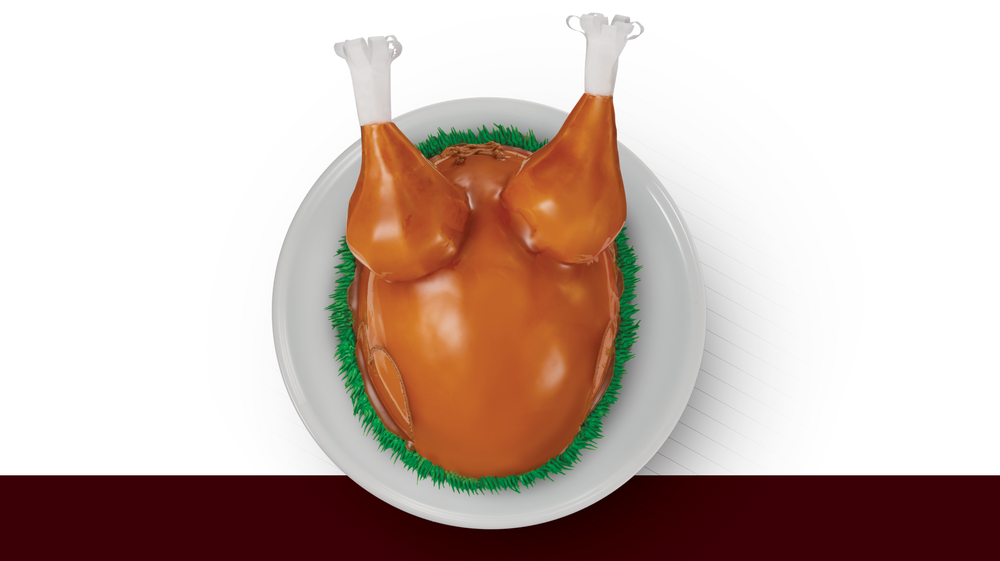
If you are still looking for a fun Thanksgiving week dessert, I highly recommend Baskin-Robbins' Turkey Cake, which puts their yummy ice cream cake in a seasonally appropriate bird shape, with sugar cones forming the drumsticks. (We ordered one for the second year in a row.)
Thanks to Megan Morrone and Scott Rosenberg for editing this newsletter and to Caitlin Wolper for copy editing it.
Sign up for Axios AI+
