Axios AI+
October 03, 2024

L'Shana Tova to those celebrating the Jewish New Year (I'll be off today).
Today's AI+ is 1,243 words, a 4.5-minute read.
1 big thing: OpenAI burns through billions


The $6.6 billion that OpenAI has just raised may be the largest single U.S. venture capital round ever, but it will only get the ChatGPT maker so far.
Why it matters: The AI revolution has an astronomical burn rate, and OpenAI can't stop fundraising if it wants to keep feeding the fire.
- That's a key difference between OpenAI and its chief rival Google, which makes tens of billions in profit each year and sits on a cash hoard of around $100 billion.
Driving the news: The OpenAI round, announced yesterday, was led by Joshua Kushner's Thrive Capital, joined by Microsoft, Nvidia, SoftBank, Khosla Ventures, Altimeter Capital, Fidelity, Tiger Global and MGX. Apple, which reportedly had been in talks to invest, did not participate.
- OpenAI's deal tops the $6 billion raised earlier this year by Elon Musk's xAI.
The intrigue: OpenAI's latest cash haul comes just a little less than two years after Microsoft announced it was investing $10 billion in the company over several years.
- And a recent New York Times analysis of the company's finances concludes that CEO Sam Altman is likely to need to hit the road to raise more money "over the next year."
Follow the money: OpenAI needs successive mountains of dollars for three chief purposes.
- Training big new generative AI models requires massive volumes of "compute" from high-end chips (mostly Nvidia's) that run up gigantic energy bills. It also takes tons of data, at least some of which the company has to pay for.
- Once the model is trained, operating an AI service like ChatGPT that's in heavy use by throngs of users also runs up high bills for computing power, data center use and energy.
- Since the AI boom hit, demand for skilled researchers and engineers has skyrocketed, and that has turned "keeping the talent happy" into a third cost center for OpenAI and its rivals. The company has added 1,000 employees over the past year, more than doubling in size.
By the numbers: OpenAI expects to bring in $3.7 billion this year, and predicts that number will rise to $11.6 billion next year, per the Times.
- But the company is on track to lose $5 billion this year, the Times says, citing an analysis by a financial professional who reviewed OpenAI documents.
- OpenAI's training costs could run as high as $3 billion this year, and it's spending nearly $4 billion to keep ChatGPT running, per The Information.
- Most of that money is going back to Microsoft, which hosts OpenAI's infrastructure.
OpenAI has seen huge growth in usage of ChatGPT since the company in April started giving access to users who haven't set up an account.
- June saw 350 million monthly users on the service, up from 100 million in March, according to the Times.
Between the lines: Software businesses have always benefited from economies of scale — once you build the product, adding incremental customers brings in revenue without piling up new costs.
- But for OpenAI right now, new customers are adding to the red ink.
- If the company wants to change that, its most likely move would be to start featuring ads in ChatGPT.
- Meanwhile, OpenAI faces a host of other risks, including competition for both talent and users, and potential liabilities for the use of copyrighted material to train models.
Our thought bubble: OpenAI's investors aren't contributing to a charity. The company was founded as a nonprofit but has steadily moved toward a for-profit structure since Altman became CEO in 2019.
- Investors in this round have the right to ask for their money back if the firm doesn't complete further governance changes in the for-profit direction within two years.
- Microsoft may not need to see a quick return on its dollars, since most of the money it's putting into the company is coming right back to it — as OpenAI pays the company for its cloud costs.
- But everyone else who has put cash into OpenAI expects to see profits, and right now the profits are still somewhere over the horizon.
2. What to know about Tesla's rumored robotaxi

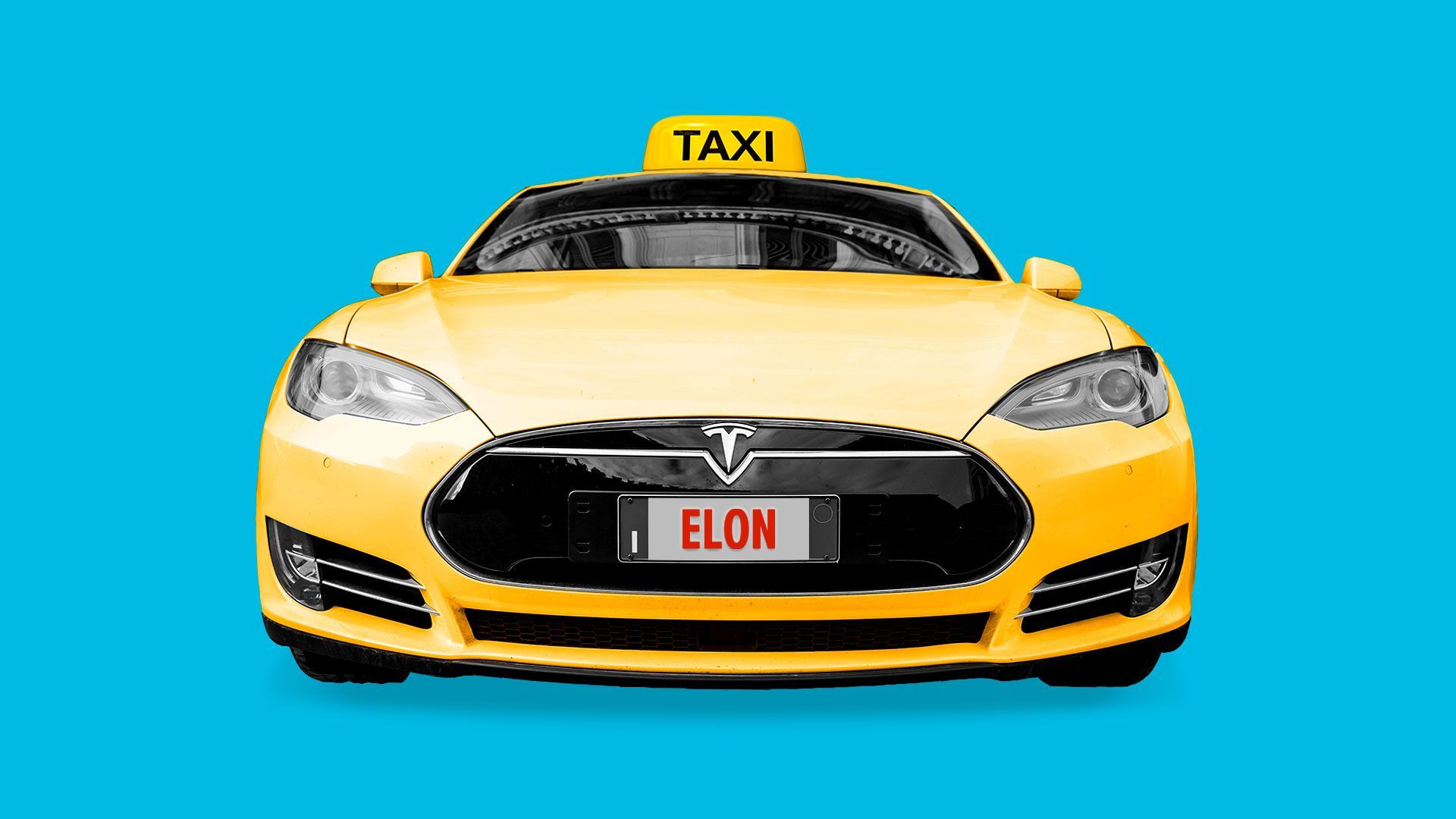
Tesla CEO Elon Musk has been promising self-driving taxis for years. Skeptics and true believers will find out soon whether he can deliver.
Why it matters: With new competitors eating into Tesla's electric vehicle market share, Musk is now betting the company on artificial intelligence, including robotaxis.
Driving the news: The billionaire CEO will host an event on Oct. 10 in Los Angeles, where he's expected to reveal a Cybercab prototype and share the latest advancements in Tesla's full self-driving (FSD) technology.
What we're watching: There are a multitude of unanswered questions about whether the technology is ready, and how a Tesla robotaxi business would work.
Images of a heavily camouflaged vehicle surfaced online recently, but until the actual Cybercab is revealed, the big question is: Does it have a steering wheel and pedals?
- The answer matters. Without such human controls, Tesla would need an exemption from federal motor vehicle safety standards to deploy them on U.S. roads.
That isn't likely. General Motors tried for years to get this exemption, finally giving up and scrapping its own purpose-built Origin robotaxi in July, citing "regulatory uncertainty."
- GM decided it'll be easier to scale its Cruise robotaxi service using a standard vehicle.
Musk has been adamant, however, that Tesla build a truly revolutionary robotaxi without a steering wheel or pedals.
- "This is the product that makes Tesla a ten-trillion company," he told biographer Walter Isaacson. "People will be talking about this moment in a hundred years."
Musk has said Tesla will be ready to launch its robotaxi service next year, but he's famous for saying, "I'd be shocked if such-and-such didn't happen next year," only to move the goalposts.
What we know is that Tesla has chosen a different development path than many others, including Waymo, the market leader, whose robotaxis are already operating in several cities.
- Instead of using machine learning to train cars to recognize road signs or pedestrians, for example, and then behave in a certain way, Tesla uses a neural network that learns from video data how to drive like a human.
- Such end-to-end AI systems — known as AV 2.0 — are viewed by some as a faster, more capital-efficient way to teach robots to drive. But they require massive amounts of data to train the AI models.
Tesla's advantage: It collects tons of video snippets of everyday driving from its own fleet of roughly 2.2 million cars on the road in the U.S.
- The downside is that such deep learning systems are a "black box" — if something goes wrong, it's impossible to trace the car's thought process to see why it made the decision, and reprogram it if necessary.
Tesla already faces scrutiny from federal auto safety regulators for hundreds of crashes in which its Autopilot technology failed to protect drivers and passengers.
- Critics say Tesla's camera-based system can't always see in bad weather and darkness. Other AV companies use a combination of camera, radar and laser sensors.
The bottom line: Tesla-watchers have questions. We'll see if Musk has answers.
3. Training data
- AI coding startup Poolside raises $500 million without releasing a product, and despite concerns with reliability of AI-generated code. (Bloomberg)
- Accenture formed an Nvidia business group and is training 30,000 of its consultants on the company's technology. (VentureBeat)
4. + This
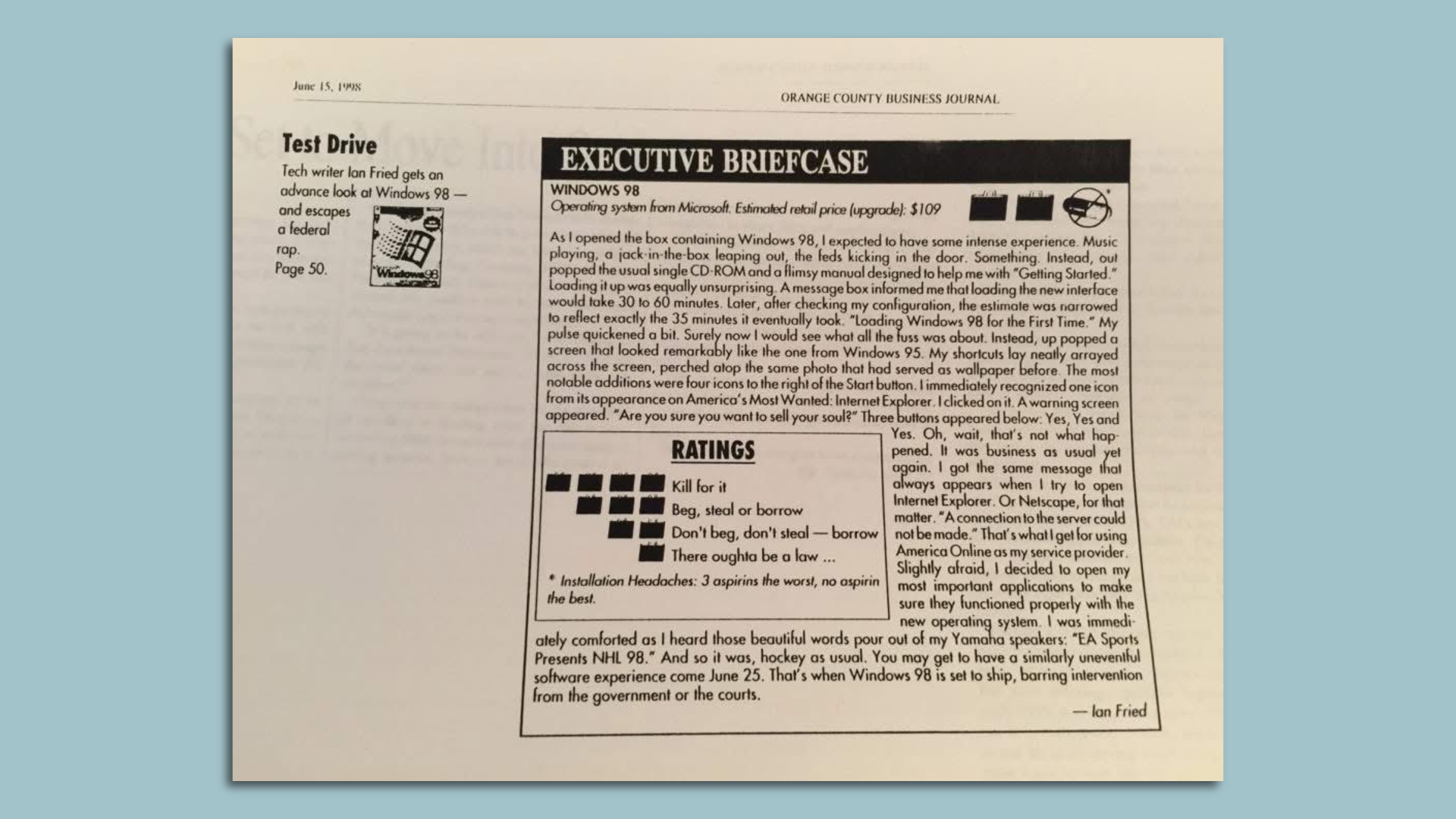
I recently came across my first-ever software review — from 1998!
Thanks to Megan Morrone and Scott Rosenberg for editing this newsletter and to Caitlin Wolper for copy editing it.
Sign up for Axios AI+
