Axios AI+

October 11, 2023

Ina here, reminding you that our Axios BFD business conference returns to NYC tomorrow. Tune in for exclusive conversations with Inflection AI co-founders Mustafa Suleyman and Reid Hoffman and more.
Register here to livestream the event.
Today's newsletter is 1,195 words, a 5-minute read.
1 big thing: AI is better at narrow tasks than entire human jobs

Illustration: Shoshana Gordon/Axios
Instead of viewing AI as a wholesale substitute for human workers and tasks, smart organizations and products are putting it to work in narrower niches.
Why it matters: AI is still far from being able to take over soup-to-nuts projects like writing entire articles or performing whole movie roles, but it can effectively shoulder painful but necessary tasks that people find tough or tedious.
"These tools are incredibly powerful, and they can do a lot of things, but they cannot do everything," Microsoft vice president Eric Boyd told Axios.
- Stanford professor Erik Brynjolfsson said in January that he and his colleagues broke out the tasks required in 950 occupations. AI could handle many of the functions, but not all: "We did not find a single one where machine learning ran the table and could do all of them."
What's happening: The talk in Hollywood, particularly in this year's heated labor negotiations, has been over whether the use of AI could put writers and actors out of jobs.
- Technology can be put to use today to allow movies and TV shows to be more accessible and interactive.
- PBS has been testing whether AI could help it create interactive TV shows for children. Historically, its educational shows have often paused to allow a child to answer, but AI might allow for two-way interaction.
- Sara DeWitt, senior vice president of PBS Kids, said it would be far too risky today to allow AI to generate the words to be spoken by its characters. "We're using our script writers; that's really clear to us," DeWitt told Axios.
Between the lines: Those who use AI to write whole articles have seen mediocre results and some embarrassing flops at CNET, G/O Media and the Columbus Dispatch. Quietly though, newsrooms have found AI to be adept at more narrow tasks, such as writing headlines or captions.
- Reuters is exploring whether AI can help devise headlines that get more attention from aggregators and search engines.
- Other news organizations are experimenting to see if AI can help with tasks ranging from caption-writing to detecting bias.
Even clergy are turning to ChatGPT. One Texas pastor found out the hard way that ChatGPT really isn't up to creating an entire worship service, while others have found even chatbot-generated sermons to be missing that divine inspiration.
- "It lacks a soul — I don't know how else to say it," Kentucky-based pastor and theology professor Hershael York told the Associated Press.
- By contrast, Rabbi Daniel Bogard says he has found generative AI "useful for finding sources, for thinking about different connections, and for sorting through huge amounts of text."
Yes, but: Even where AI is only capable of playing a supporting role today, the rapid pace of improvement suggests the technology might be ready to play a bigger part sooner than later.
2. Exclusive: Here comes AI government
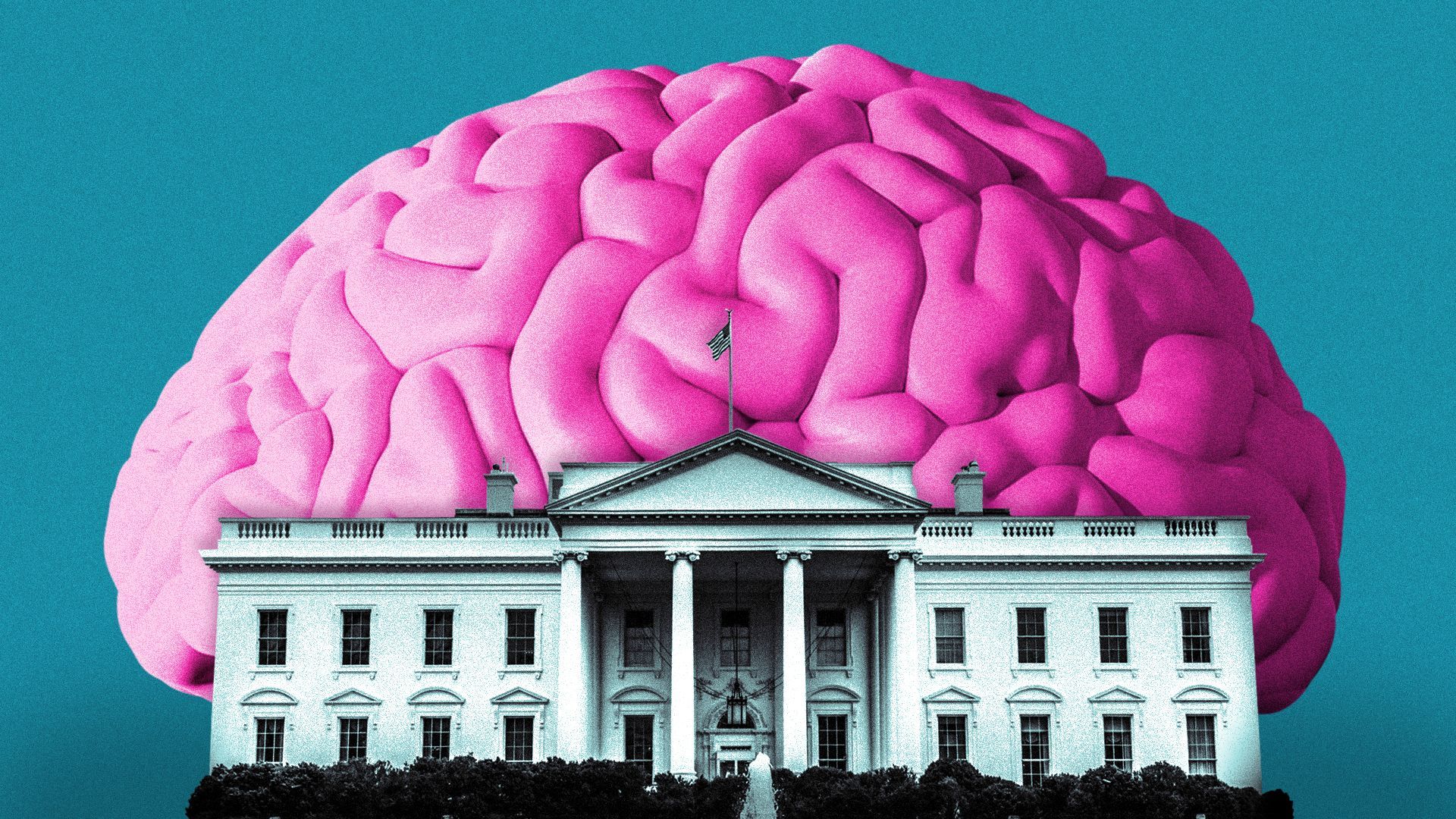
Illustration: Shoshana Gordon/Axios
Booz Allen Hamilton launched a new set of AI capabilities aimed at federal military and civilian clients and will tell investors on Wednesday that it's aiming for $500 million to $700 million in government AI contracts in fiscal year 2024, per data shared exclusively with Axios' Ryan Heath.
Why it matters: Generative AI offers government and military organizations the chance to deliver faster and better services — pushing officials to better organize and apply the huge amounts of data they already collect.
Details: Booz Allen's new AI products include some aimed to solve specific problems for specific users and others that provide more general capabilities that developers can adapt for many different purposes.
- The broader capabilities include fine-tuned generative AI models, software for ensuring responsible AI deployment, and tools to protect AI models from outside attack.
The big picture: Federal AI contracting could shape wider AI development, given the scale of federal procurement.
- Government agencies spend around $100 billion a year on IT but struggle to make use of the data at their disposal — prompting a rapid uptick in AI spending to around $3 billion a year, according to a Deltek report.
The intrigue: Government AI contractors are grappling with the tension between delivering more transparent AI systems and the risk that transparency will make the systems more vulnerable to attack.
Yes, but: While AI offers new capabilities in fields like situational awareness, Israel's advanced use of AI did not provide warning of Hamas' recent attack.
- U.S. federal officials have also sent mixed signals about use of generative AI — with most applying brakes.
What they're saying: AI "is no longer the purview of the nerds" within the federal government, John Larson, a Booz Allen executive vice president and leader of the firm's AI practice, told Axios.
- Larson said new tools (including chatbots) allow bigger groups of staff to interrogate data with natural language — surfacing more imaginative ideas and helping to overcome tech skill shortages.
- "The power of AI is finding patterns and trends that humans just can't perceive — finding signals among huge amounts of noise," Larson said.
3. Google: "We're not in a hurry" on AI in health care

Axios Pro Deals' Erin Brodwin in conversation with Google SVP of technology and society James Manyika. Photo: Claire Rychlewski/Axios
Google is in no rush to apply AI to health care, Axios' Erin Brodwin and Claire Rychlewski report.
Driving the news: "We're not in a hurry," Google senior vice president of technology and society James Manyika told Axios at the HLTH conference in Las Vegas on Monday. "The only race we feel we're in is the race to do this right."
The big picture: Indeed, the "move fast and break things" mantra that pervaded tech years ago appears to have been supplanted by a more delicate message, several builders and investors told Axios on the sidelines of the HLTH conference.
- "We're being slow and deliberative," Sunita Mishra, chief medical officer of Amazon Health Services, said during a meeting at the conference.
- "We're growing slow to grow fast," said Fortuna Health CEO Nikita Singareddy, meaning the company is spending a lot of its time assessing patient needs and use patterns.
Meanwhile, Google's AI-powered efforts span medical imaging, dermatology, genetic testing, and drug discovery.
The catch: The handling of public data by large tech companies has long vexed consumers, and Google is no exception.
- In 2019, the Wall Street Journal reported that doctors and patients weren't notified of a program Google ran with hospital system Ascension Health that allegedly provided 150 Google employees with access to patient data.
- A lawsuit against Google and the University of Chicago Medical Center accused the institutions of processing identifiable medical records.
4. Training data
- Adobe debuted several new AI models Tuesday, including what it says is the first tool that can generate vector-based illustrations. (Axios)
- Several federal law enforcement agencies haven't properly trained their staff on how to use facial recognition technology or set policies to protect the public's rights when it's used, a report by a government watchdog says. (Axios)
- The state of Utah sued TikTok on Tuesday for allegedly harming the mental health of children and teens, following in the footsteps of states like Arkansas and Indiana. (Axios)
- In sharp contrast to the pro-regulating-AI stance taken by the European Union, a bloc of Southeast Asian countries is taking a more laissez-faire approach. (Reuters)
5. + This
RIP Dorothy Hoffner, who died a week after setting the record for the oldest person to complete a parachute jump. May we all go out as you did, soaring.
Thanks to Megan Morrone and Scott Rosenberg for editing and Bryan McBournie for copy editing this newsletter.
Sign up for Axios AI+

Scoops on the AI revolution and transformative tech, from Ina Fried, Madison Mills, Ashley Gold and Maria Curi.