Axios AI+

May 01, 2025

Happy Friday (eve)! Today's AI+ is 1,107 words, a 4-minute read.
1 big thing: Chatbot shopping era dawns

Online shoppers will soon be able to make purchases straight from their chatbots, which could drive the biggest shift in shopping since Amazon or the iPhone.
Why it matters: Shopping has fueled every internet boom from the dot-com to mobile to social.
Driving the news: Visa yesterday announced a push to embed its payment network into AI systems, including chatbots and agents.
- The effort is in the early testing stage, with Visa listing OpenAI, Anthropic, Microsoft, Mistral and Perplexity among its partners.
- "We think the shift could rival the level of impact that e-commerce and mobile commerce themselves have [had]," Visa chief product and strategy officer Jack Forestell said at an event in San Francisco yesterday.
- Mastercard and PayPal also announced agentic commerce efforts this week.
How it works: Visa demoed how a user can enter their payment information into a chatbot, just once, and use natural conversation with an AI agent to purchase a range of goods and services.
- Under the hood, Visa is incorporating the tokenization technology it has used to secure mobile and online commerce, combined with mechanisms for communicating authentication, payment intent and instructions.
Separately, OpenAI said Monday that ChatGPT search will begin including direct product links in its results, starting with categories including fashion, beauty, home goods and electronics.
Between the lines: The biggest hurdle to so-called conversational commerce isn't technological. It's trust.
- "We could give AI agents payment tools today, and they'd be able to go out, access your credentials, your cards, your money, and go spend it," Forestell said on stage yesterday. "That would just uncover a bunch of other really important problems that we need to get solved before we take step one."
Reality check: Widespread use remains uncertain, even for early adopters.
- "I find this one really hard to call," Forestell said, noting that e-commerce has been around for 25 years and still accounts for less than half of sales globally. "Part of me says that it takes time."
- On the other hand, he said, "It was 29 months ago when zero people were using [generative AI chatbots]" and now there are billions using ChatGPT, Llama and similar tools.
- Forestell is "hopeful that within the next 12 months" people have the option to use autonomous agent payments, at least within certain use cases.
The intrigue: Chatbots will reshape shopping. And shopping will reshape chatbots.
- Where commerce goes, advertising tends to follow, as do other means for technology providers to benefit, such as revenue-sharing and affiliate programs.
- Google was once free of advertising and commerce, as was Facebook. The tech giants eventually changed the face of both industries, while their services also morphed into something radically different from how they launched.
What they're saying: An OpenAI representative said that the company does not have affiliate links nor does it receive revenue from purchases made through ChatGPT search, nor does it have current plans to do so.
- In a video shown at the Visa event, OpenAI CFO Sarah Friar said that the company wants customers to have confidence ChatGPT is always "giving them the best answer, not an answer that got skewed by, say, our business model, or a decision on something like advertising."
What's next: Experts say retailers need to start rethinking their e-commerce strategy to prepare for chatbots to play a significant role.
- The shift could allow companies to spend less on search advertising, but having the most up-to-date information on products and their availability will become more important, Pimberly CEO Martin Balaam told Axios. His company helps boost revenue for retail clients including Marshalls and Build-A-Bear.
- "If your product data isn't pristine — if attributes are missing or inconsistent — you risk being misrepresented or filtered out entirely by the AI engine."
2. Apple must remove hefty fee on off-app sales

/2025/04/30/1746057476228.gif?w=3840)
Apple must stop levying 27% commissions on sales that take place when apps point users to websites beyond Apple's App Store, a federal judge ordered yesterday.
The intrigue: In a scorching ruling that called Apple's response to a previous order "an obvious cover-up," Judge Yvonne Gonzalez Rogers also referred Apple's behavior to federal prosecutors to investigate whether to bring criminal contempt of court charges.
Catch up quick: The ruling comes as part of the long legal fight between Epic Games and Apple over Apple's control of the App Store.
- The court originally ruled mostly in favor of Apple, but ordered the iPhone maker to allow app makers like Epic to send users "off-app" to conduct business via channels that wouldn't be subject to Apple's 30% commission.
- Apple's response — after losing an appeal — was to allow such transactions but add a new 27% fee on them.
The big picture: Apple earns significant revenue from its App Store fees.
- While users may find it less convenient to conduct business with app makers via websites rather than inside apps, doing so could save everyone a lot of money, and hurt Apple's bottom line.
The other side: Apple has argued that its App Store fees fund the store's operations and support Apple's efforts to vet apps and keep its customers secure and safe.
- "We strongly disagree with the decision. We will comply with the court's order and we will appeal," Apple said in a statement.
3. Google CEO: AI will be huge part of search

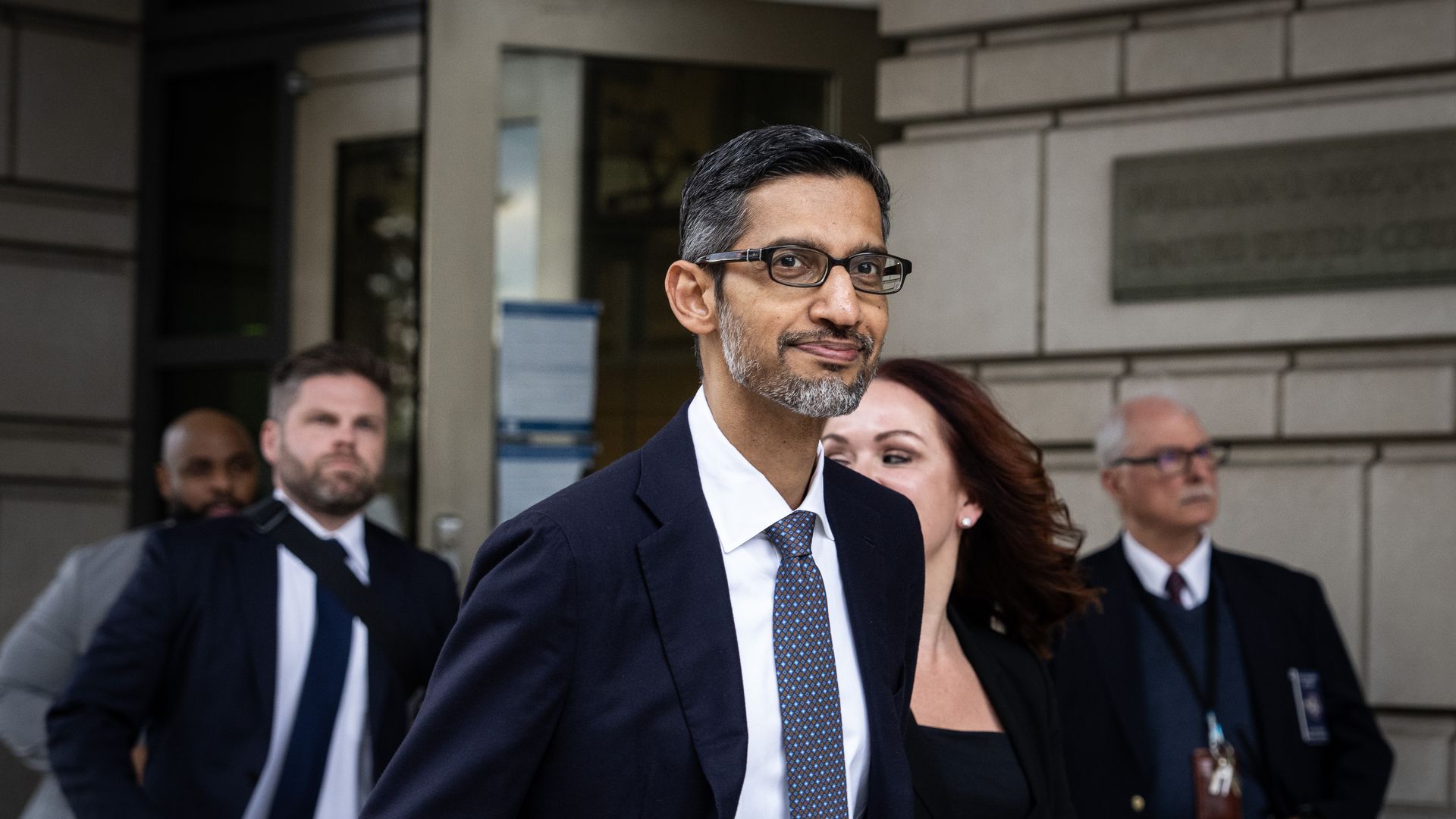
Google is hashing out an agreement with Apple that would offer Gemini AI as an option for inquiries to Apple Intelligence by "the middle of this year," CEO Sundar Pichai said in federal court yesterday.
- Gemini AI will be a part of paid agreements with other companies to feature Google's products, just like Google Search has been, Pichai also said.
Driving the news: Pichai testified in a federal court in Washington, D.C., as part of the DOJ's search antitrust case against the tech giant.
Pichai argued that Google has not shut off other companies' ability to compete in the rapidly growing generative AI space:
- "I think it's one of the most dynamic moments in the industry. There are many companies, both big and small, which are both building models as well as using models to build chatbots or generative AI applications."
4. Training data
- Sam Altman-backed World is bringing its eyeball scanner to the U.S. to verify identities and prove who's a bot or not. (Axios)
- Microsoft and Meta reported upbeat earnings as the AI economy continues to surge. (Axios)
- Chinese device maker Xiaomi debuted its first AI model. (Bloomberg)
- DeepSeek open sourced its latest math-focused model and uploaded it to Hugging Face. (South China Morning Post)
- Researchers say Chatbot Arena's benchmark ratings give an unfair edge to a handful of leading companies. (404 Media)
5. + This

On this day in 1941, General Mills introduced CheeriOats, which was eventually renamed Cheerios.
Thanks to Scott Rosenberg and Megan Morrone for editing this newsletter and Matt Piper for copy editing.
Sign up for Axios AI+
