Axios AI+

January 15, 2026

Guten Tag from Munich. Today's AI+ is 1,160 words, a 4.5-minute read.
1 big thing: Anthropic's window on economic impact


Instead of putting people out of work, AI is mostly helping them do their jobs, finds a new Anthropic study.
Why it matters: The findings land amid a heated debate over whether AI will ultimately eliminate jobs or create new ones.
The big picture: The report offers a detailed examination of AI use, looking at an anonymized sample from 2 million real Claude conversations that took place last year on its free and paid services.
Between the lines: Anthropic's founder and CEO has warned that AI could wipe out half of all entry-level white-collar jobs and push unemployment as high as 10–20% within one to five years.
- But the study out today, from his own company, paints a more nuanced picture. And many other researchers find that like with past technological revolutions, AI is more likely to create jobs than destroy them.
- "The future is uncertain," says Peter McCrory, Anthropic's head of economics.
Zoom in: AI is reshaping how people work, not if people work.
- Put another way: AI takes over parts of people's jobs.
How it works: Researchers used Claude to analyze transcripts of conversations along different dimensions.
- How long would it take to complete a task if they didn't have AI? How many years of education would someone need to understand Claude's response?
- They considered whether people were using Claude to fully automate a task for them — "translate this into French." Or were they augmenting their work — "let's write this report together."
By the numbers: The study found about a 50/50 split between augmentation and automation, with a slight edge to augmentation.
- 52% of work, on the Claude site, involved augmented tasks, slightly down from the share last January.
Zoom out: The way AI changes your job depends on what kind of work you do, and broadly speaking the differences can be grouped into two buckets.
- De-skilling: AI starts to take on large portions of the roles — say for data entry workers or IT specialists. This work appears to be more at risk for being automated away — continuing decades-long trends.
- Upskilling: AI takes on some of your more rote work, leaving more time for higher-skill human tasks. As with radiologists or therapists, for example, who can devote more time to interacting with clients and less on back-end, time-intensive work.
Friction point: The study finds that AI delivers the biggest productivity gains on complex work — the same work that most requires human oversight.
- It can take Claude minutes to pull together a broad overview of research, says McCrory.
- But whether or not that actually generates any real value hinges on your expertise in evaluating that work, he says.
- "The most complex tasks that people use Claude for are the ones where Claude tends to struggle most," he says. "Human oversight, direction and iteration is thus that much more valuable." (I told you this yesterday, btw.)
What to watch: The need for humans is either a bottleneck that will slow down any productivity gains brought on by AI — or a force multiplier that will keep us all employed.
Reality check: The tech is improving quickly and Anthropic also has an interest in portraying its technology as revolutionary, to draw users and investors.
2. Samsung plans massive AI smartphone expansion
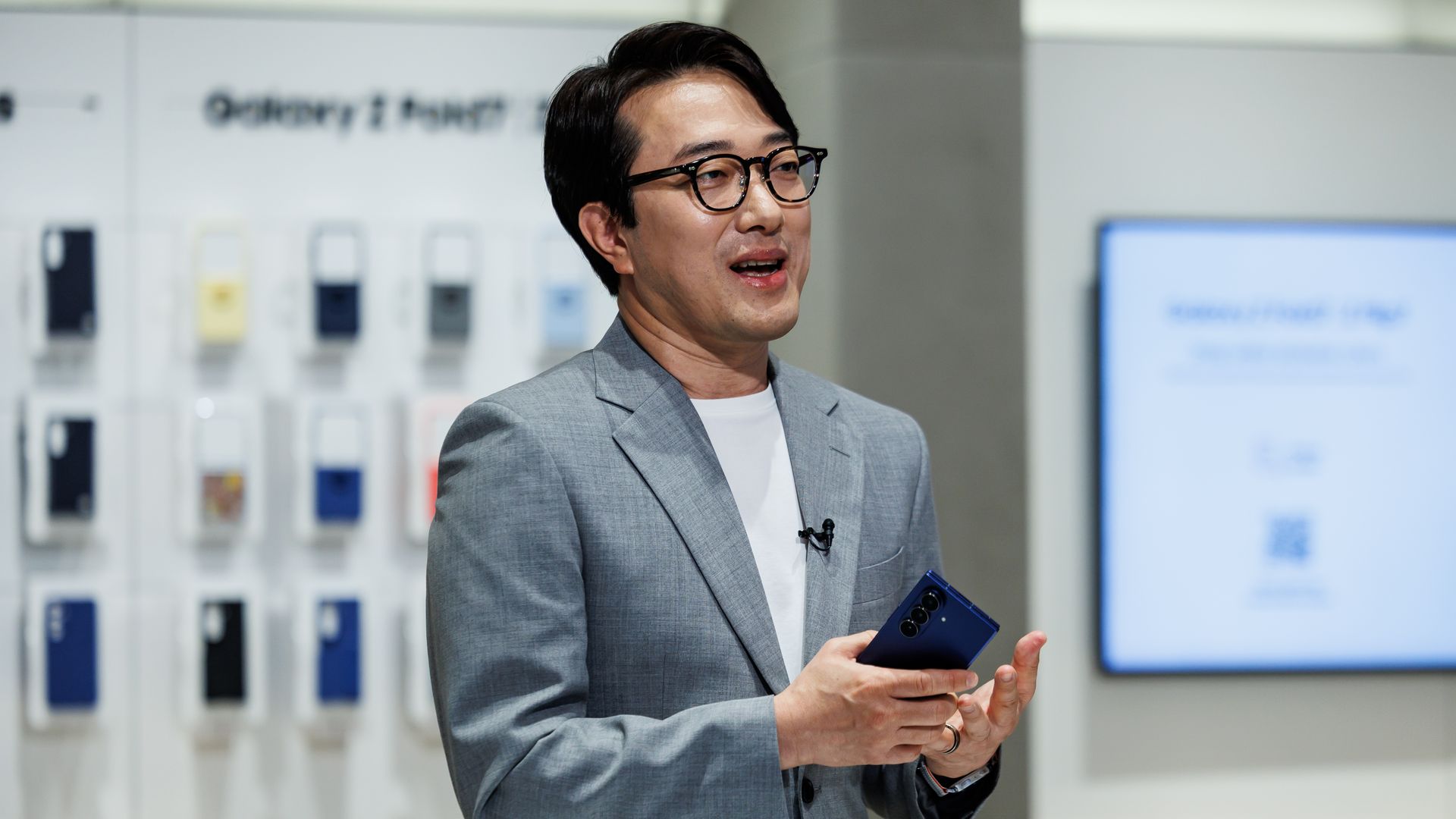
Samsung wants to put mobile AI into the hands of millions more people — whether they buy the company's pricey foldables or its entry-level phones, a top executive told Axios.
Why it matters: The company aims to double the number of AI-equipped Samsung smartphones to more than 800 million by the end of 2026.
- "We really want to increase accessibility of AI for all people," Won-Joon Choi, COO of Samsung's mobile device business, told Axios.
The big picture: As the largest Android phone maker, Samsung sees the iPhone as its main competition.
Yes, but: The company also needs to differentiate itself from other Android phones, including Google's Pixel line.
- Samsung relies on Google, which develops both the Android ecosystem and its key apps — Gmail, Chrome and YouTube.
- The company has long tried to add its own software, sometimes offering apps that largely overlap with Google.
- Past software efforts have often failed to click, but Samsung says its AI features are showing signs of stickiness.
What they're saying: "Generally when we launch a new feature, we'll see usage peak right after the launch, and then the usage will continue to dramatically drop," Choi said.
- With Galaxy AI, however, Choi says usage is staying high.
- Samsung's most popular in-house AI tools include photo editing features and its "Now Brief," which summarizes upcoming events and surfaces relevant weather, news and other information, he said.
Between the lines: Choi says AI is reshaping Samsung's hardware priorities, with more emphasis on neural processors and high-bandwidth memory.
3. Exclusive: Nvidia invests in buzzy math startup

Chipmaker Nvidia is joining the list of investors backing Harmonic, a hot startup focused on AI systems designed to solve mathematical problems.
Why it matters: Large language models are doing increasingly well in math contests, but Harmonic says there's still a big market for AI systems that can formally verify the accuracy of their results.
The big picture: Nvidia is joining Harmonic's $120 million Series C round, which valued the company at $1.45 billion, Harmonic told Axios.
- Emerson Collective is also joining as a new investor, alongside existing backers Ribbit Capital, Sequoia Capital, Index Ventures and Kleiner Perkins.
Between the lines: Harmonic says its model, known as Aristotle, is not only solving math challenges, but also showing promise in coding and chip design.
- The company plans to use some of the funding to expand its workforce from under 30 to somewhere between 50 and 75, though much of the money will be used to pay for needed compute resources.
Zoom in: Large language models work by predicting the next token rather than operating off a fundamental set of truths.
- Harmonic's approach, by contrast, is able to not only solve problems, but also to verifiably show its work.
Zoom out: Harmonic launched in 2024 with backing from Robinhood CEO Vlad Tenev.
- "We see a world where the vast majority of software and hardware will be AI-generated and formally verified, and we're just getting started," Tenev said in a statement.
What to watch: Harmonic's API remains in a free beta. The company says it isn't ready to announce how or when it plans to charge for Aristotle.
4. Training data
- X's Safety team says it will prevent Grok from editing images of real people in bikinis for everyone, even paid subscribers, and that any image editing will be limited to paid subscribers. (X)
- Trump set a 25% tariff on Nvidia chips the company plans to sell in China and other select semiconductors. (Axios)
- Airbnb hired former Meta exec Ahmad Al-Dahle as its new CTO and plans to launch AI search in the app this year. (Bloomberg)
5. + This
Alright, alright, alright.™ Guess who trademarked himself to prevent AI clones.
Thanks to Megan Morrone for editing this newsletter and Matt Piper for copy editing.
Sign up for Axios AI+
