Axios AI+

July 26, 2024

I'm ready for the Olympics opening ceremonies in Paris today, where Samsung's smartphones will play a key role in giving TV viewers an up-close look.
Today's AI+ is 1,145 words, a 4.5-minute read.
1 big thing: OpenAI moves in on search

OpenAI's announcement of SearchGPT yesterday kicks off the next phase of the search industry's rapid AI remodel.
Why it matters: Tech leaders believe that traditional search engines will give way to ChatGPT-style conversational interfaces as the dominant mode of information-gathering online.
- But most AI chatbots today don't do a reliable job of keeping up with news and information, ensuring accuracy or crediting sources.
The big picture: Google and Microsoft, the last major players left standing in the traditional search business, are already weaving generative AI into their search engines, with mixed results.
- Microsoft announced Wednesday it was beginning to test a new version of Bing's "generative search experience" that produces "a bespoke and dynamic response to a user's query."
OpenAI's new offering promises to cite and link to sources and to let users refine their inquiries in the course of dialogue with the bot.
- SearchGPT is "designed to give you an answer," OpenAI said in its announcement.
- "SearchGPT will quickly and directly respond to your questions with up-to-date information from the web while giving you clear links to relevant sources."
- "You'll be able to ask follow-up questions, like you would in a conversation with a person, with the shared context building with each query."
How it works: The company has a waitlist for users to request access to SearchGPT, which for now will operate separately from other OpenAI services like ChatGPT.
- OpenAI described SearchGPT as a "temporary prototype" and said, "We plan to integrate the best of these features directly into ChatGPT in the future."
Between the lines: OpenAI also said it was partnering with publishers to make sure that the new tool would be "prominently citing and linking to them."
- Content providers will be able to feature their material through SearchGPT without providing it for use in training the company's AI models, OpenAI added.
Zoom out: OpenAI and its rivals are all betting that most users would rather just ask a question and get it answered than dig through search results.
- That makes sense for casual queries and simple facts ("What time is the Super Bowl?"), but AI search summaries like Google's have so far fallen down when faced with complex topics, controversies and ambiguities.
Follow the money: Much of the current information on today's web is either tucked behind paywalls or larded with popup videos and annoying ads.
- Chatbot search answers don't come with such distractions, making them a relief — but that's just because the AI companies haven't yet gotten serious about the monetization strategies that will eventually pay for their expensive technology.
What's next: Google had a bumpy ride rolling out its AI-driven search summaries, and the industry will be watching closely to see whether OpenAI's approach provides better answers.
2. Google's DeepMind becomes a math whiz


Two AI systems from Google DeepMind together solved four of the six problems in this year's International Mathematical Olympiad — on par with silver medalists in the annual world math championship for high school students.
Why it matters: The ability to solve a range of math problems in step-by-step proofs is considered a "grand challenge" in machine learning, and has been beyond the reach of current state-of-the-art AI systems.
- "These are extremely hard mathematical problems and no AI system has ever achieved a high success rate in these types of problems," Pushmeet Kohli, vice president of research focused on AI for science at DeepMind, said in a press briefing.
DeepMind's AlphaProof was able to solve three of this year's math Olympiad problems — two algebra problems and one in number theory.
- One was solved in minutes and the others took up to three days. (Students have two 4.5-hour sessions to submit answers.)
The other member of the AI team, AlphaGeometry 2, solved the competition's geometry problem in 19 seconds.
- The system can solve 83% of Math Olympiad problems from the past 25 years compared to its predecessor, which could solve 53%, the company said.
Overall, the AI systems scored 28 out of 42 possible points — putting them in silver-medal territory and one point shy of the gold-medal threshold, the company said.
3. Exclusive: Anthropic weighs in on AI bill

Leading AI company Anthropic does not support California's AI regulation bill, SB 1047, but is suggesting changes that could lead to a shift, per a letter shared exclusively with Axios Thursday.
State of play: SB 1047 from California State Sen. Scott Wiener passed the California Senate in May and could get a vote in the California Assembly next month.
- The bill, which many startups and tech companies have opposed, would make AI developers liable for how others use their models and prohibit the models from being used in dangerous ways.
What they're saying: The current version of the bill "could blunt America's competitive edge in AI development," an Anthropic spokesperson tells Axios.
- "[Our letter proposes] to refocus the bill on frontier AI safety and away from approaches that aren't adaptable enough for a rapidly evolving technology."
What's inside: Anthropic's letter to Buffy Wicks, chair of the California Assembly Appropriations Committee, suggests the bill shift to "outcome-based deterrence" from "pre-harm enforcement," letting AI companies develop and deploy safety protocols and be held liable for any catastrophes they cause.
4. Exclusive: France's AI envoy wants concrete action

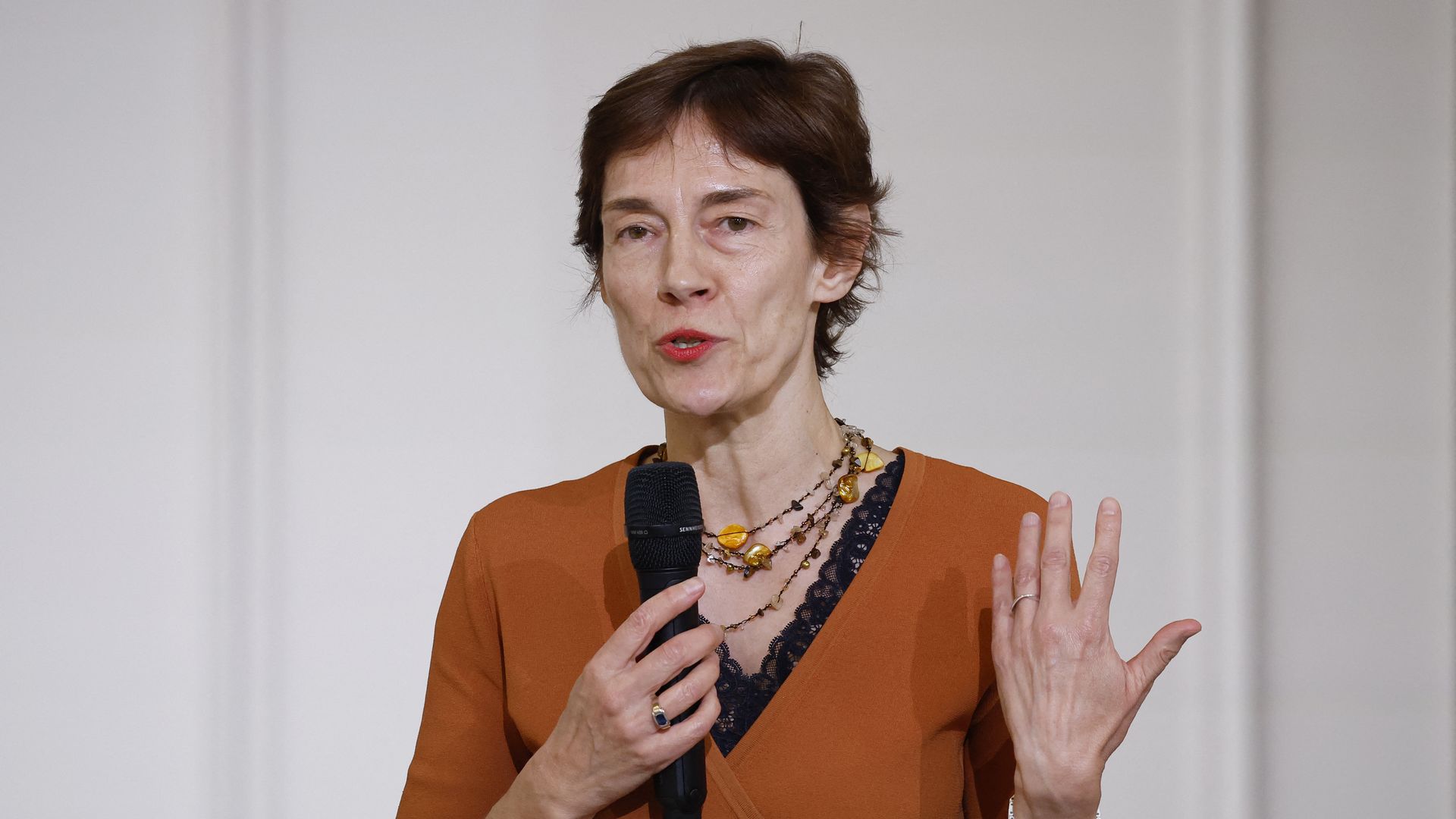
Anne Bouverot, France's special envoy for AI, says it's time to shift from voluntary AI commitments to concrete action.
Why it matters: The recommendations of global AI safety policymakers have so far largely been elective and lacking in enforcement teeth.
Driving the news: In an interview on the Washington AI Network podcast — shared first with Axios — Bouverot told podcast host Tammy Haddad that the 2025 AI Action Summit, planned for Feb. 11 in France, will focus on hard policy commitments.
The big picture: In the nearly two years since the launch of ChatGPT, global leaders have met repeatedly to discuss and agree on global AI safety and privacy policies.
- Voluntary agreements announced at these summits have often lacked clear benchmarks to judge whether companies have met their pledges.
- "After two summits, you do want to tell people that you're not just meeting to meet," Bouverot said.
Between the lines: Bouverot also stressed that global participation in AI requires access and training, and urged policymakers not to see these as merely buzzwords.
Context: Bouverot is an engineer, tech company adviser and educator who earned a Ph.D. in AI "way before the hype," she writes in her LinkedIn profile.
5. Training data
- Apple joined other leading AI companies in adopting the Biden administration's voluntary AI safety guidelines. (Bloomberg, Axios)
- Google outlined a behavior code for its Gemini chatbot, establishing principles for the AI and its users. (Axios)
- SAG-AFTRA members who work on video games are going on strike after contract talks continue to stall over the industry's use of AI. (AP)
- CrowdStrike CEO George Kurtz says 97% of the Windows sensors that went offline during last week's global IT outage are now up and running again. (Axios)
6. + This

Hi from the Olympic Village.
Thanks to Scott Rosenberg and Megan Morrone for editing this newsletter and to Caitlin Wolper for copy editing it.
Sign up for Axios AI+
