Axios AI+

January 22, 2024
Hi it's Ryan and Ina together, just back from Davos — or more accurately, the Lindt chocolate museum in Zurich, which we thoroughly recommend. There's a 50-foot chocolate fountain and unlimited tastings and a bunch of fun exhibits. Today's AI+ is 1,216 words, a 4.5-minute read.
1 big thing: Meta joins general intelligence quest

Illustration: Maura Losch/Axios
Meta has now joined Google and the Microsoft/OpenAI alliance in the quest for "artificial general intelligence," the AI industry's holy grail, Axios' Scott Rosenberg and Ryan report.
Driving the news: Meta CEO Mark Zuckerberg announced last week that Meta's long-term vision is to build artificial general intelligence (AGI) and to open source it "so everyone can benefit."
Yes, but: None of these companies can clearly define what AGI means — or how they will know they've achieved it.
Why it matters: Meta is now in a race with both Google and OpenAI, which is closely allied with Microsoft, to shovel cash, brains and energy at the daunting challenge of reproducing human-level reasoning in chips and code.
- ChatGPT maker OpenAI was founded as a nonprofit in 2015 specifically to develop AGI and make sure that it would "benefit humanity" — and not run amok.
- Google's DeepMind unit says its mission is to "solve intelligence." The DeepMind lab, which long operated as an independent research outfit, got merged with Google's Brain team last year, moving it closer to the firm's product side.
- A year ago, Microsoft researchers claimed they'd found "sparks of artificial general intelligence" in OpenAI's latest large language model.
The big picture: The AI industry has been trying to match human-level reasoning, knowledge and creativity since the term artificial intelligence was first coined in the 1950s.
- The goal proved much harder than envisioned by the field's pioneers, who thought it might take just a few years.
- Machine learning techniques powered by neural networks finally began to notch some wins over the past two decades, like mastering chess and Go.
- Researchers began using the phrase "artificial general intelligence" in the 2010s to describe the broader aim of endowing computers with human-level thinking.
- The label also aimed to distinguish that broad goal from smaller targets — like beating a Go master or passing the Turing test — that machine learning was already hitting.
The catch: No one agrees on how to define AGI and no one has a testable way of determining whether any given AI project meets the bar.
- Zuckerberg waved his hands when The Verge asked him what he meant by "general intelligence."
- "I don't have a one-sentence, pithy definition... You can quibble about if general intelligence is akin to human level intelligence, or is it like human-plus, or is it some far-future super intelligence."
- "But to me, the important part is actually the breadth of it, which is that intelligence has all these different capabilities where you have to be able to reason and have intuition," Zuckerberg told The Verge.
The other side: At a side event at the World Economic Forum in Davos last week, Yann LeCun, Meta's top AI scientist, threw cold water on the notion, increasingly common in Silicon Valley, that AGI is just around the corner.
- "Why is it that a cat can plan a complex trajectory to jump on a piece of furniture and yet we cannot do this with robots? Why is it that a 10-year-old can learn in one shot to clear out the dinner table and put it in the dishwasher and we're nowhere near being able to do this with robots? It's not because we can't build the robots. It's because we can't make them smarter."
- "Obviously, we're missing something really, really big. So we're nowhere near human level intelligence, despite what you might hear from the most optimistic people who tell you AGI is just around the corner."
- "I'd be happy if by the end of my career, we can get something as smart as a cat."
Between the lines: One reason tech leaders are having trouble nailing down what AGI means is that humans continue to have enormous difficulty defining what "intelligence" itself means.
- Tests from IQ to the SAT have never reliably measured more than a fraction of what we might think of as human brainpower and have always faced criticism over embedded cultural biases.
- Human intelligence takes myriad forms, with psychologists and neurologists, engineers and philosophers, diplomats and artists each viewing the concept from a different angle.
- Senses of perception, time and self-awareness all shape the human experience in ways that may or may not ever be duplicated by the creations of technology.
What we're watching: With Google, Microsoft and Meta all on board the AGI train, Apple's absence is increasingly notable.
- The notoriously secretive iPhone maker could, of course, pursue the same quest in its own hush-hush labs.
- Or — as it often does — it could wait for the raw tech to mature and then swoop in to perfect and popularize AGI for the affluent mass market.
2. Meta's stock is roaring again


Meta's stock reached an all-time high Friday, reversing the post-pandemic drubbing it took beginning in 2022, Axios' Sara Fischer reports.
Why it matters: The company's investments in artificial intelligence (AI) have not only helped its ad business recover from a volatile market, but have also convinced Wall Street that the firm is poised for future growth.
- That's become critical amid declining investor interest in mixed reality and the metaverse. Meta is still losing billions of dollars on investments in those products.
Details: On Thursday, CEO Mark Zuckerberg doubled down on his company's investments in AI in an Instagram post.
Between the lines: While big announcements around generative AI have proven helpful in boosting investor confidence, quieter AI-related investments Meta has made in its ad business have helped the company keep its massive revenue and profit engine from slowing down.
- The company's revenues hit an all-time high in the third quarter of last year, the latest to be publicly reported.
The big picture: Meta's gains are especially notable considering how hard it's been for other ad-supported tech firms to regain their momentum since the market began to slow down in 2022.
3. OpenAI boots election bot
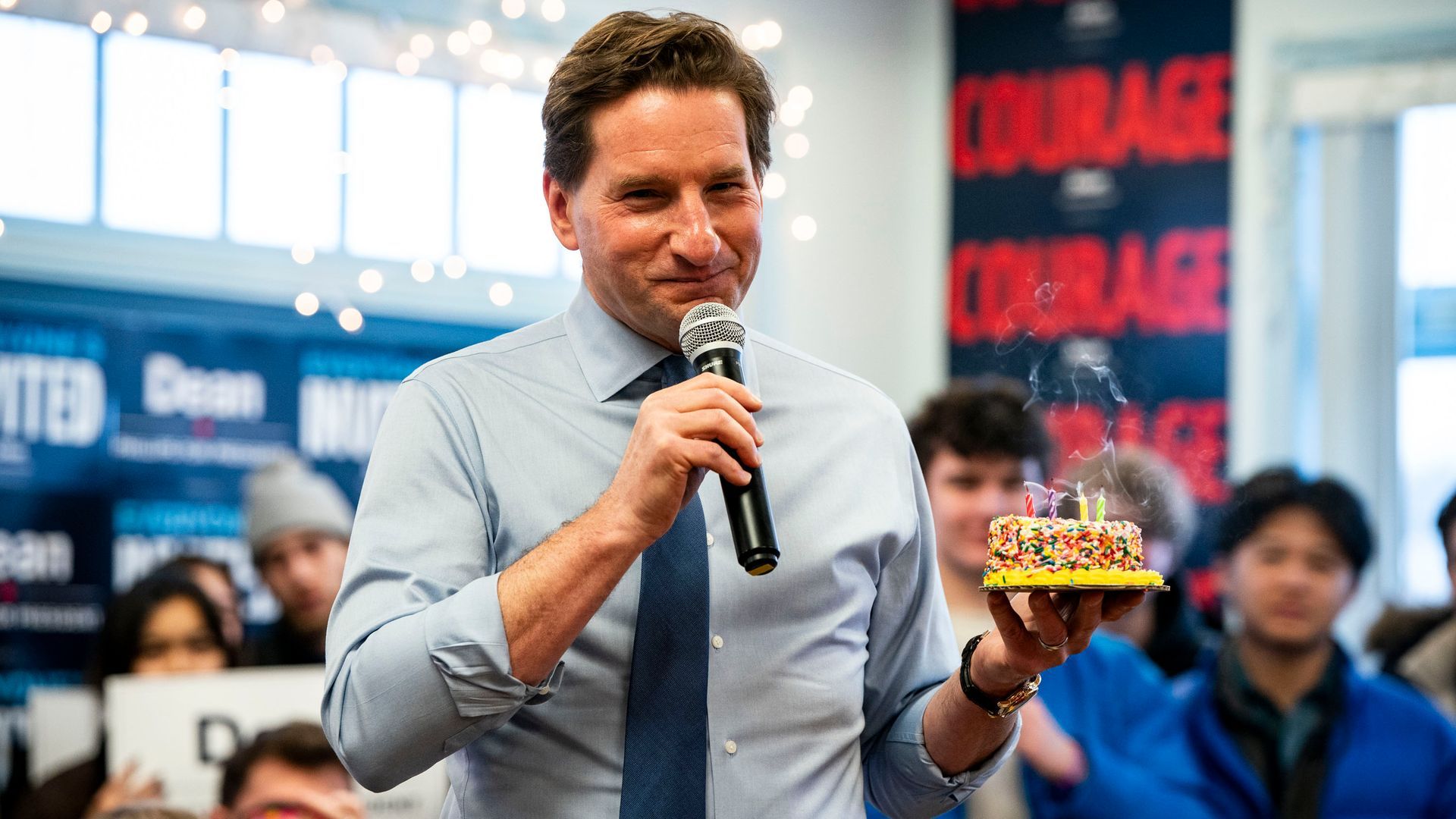
Rep. Dean Phillips (D-Minn.) in New Hampshire Jan 20. Photo: Haiyun Jiang/Bloomberg via Getty Images
OpenAI has banned the developer of a bot that mimicked Democratic White House hopeful Rep. Dean Phillips (D-Minn.), reports Axios' Shauneen Miranda.
Why it matters: The suspension is the first known restriction of AI in political campaigns by the maker of ChatGPT.
Details: OpenAI suspended the account of Delphi, a startup contracted to build Dean.Bot, which could "talk" with voters in real time, the Washington Post reported Saturday.
- The bot originated with Silicon Valley entrepreneurs Matt Krisiloff and Jed Somers, who started a super PAC — We Deserve Better — in support of Phillips.
What they're saying: OpenAI said in a statement that all developers must follow its usage policies, which "disallow political campaigning, or impersonating an individual without consent."
4. Training data
- The same Russian hackers believed to be responsible for the giant SolarWinds hack gained access to "a very small percentage" of email accounts belonging to Microsoft executives and security team, the company announced. (Axios)
- A group of Google DeepMind scientists are in talks to leave the giant and form a France-based AI startup called Holistic, with finance of up to $200 million. (Bloomberg)
- We're more boring than we think and that's helping AI predict when we'll die. (Washington Post)
- $200 kamikaze drones are starting to reshape the war in Ukraine. (The Times of London)
- Google DeepMind's new tool AlphaGeometry combines a symbolic engine and LLM to create a leap forward in AI reasoning. (Technology Review)
5. + This
Photo: Ryan Heath/Axios
Ina with what may be the world's biggest single chocolate.
Thanks to Megan Morrone and Scott Rosenberg for editing this newsletter.
Sign up for Axios AI+

Scoops on the AI revolution and transformative tech, from Ina Fried, Madison Mills, Ashley Gold and Maria Curi.