Axios AI+
November 02, 2023

Hi, it's Ryan. I've given in and started wearing my coat. I hope it's not too cold where you are. Today's AI+ is 1198 words, a 4.5-minute read.
1 big thing: Labeling won't solve AI's problems
Illustrations: Natalie Peeples/Axios
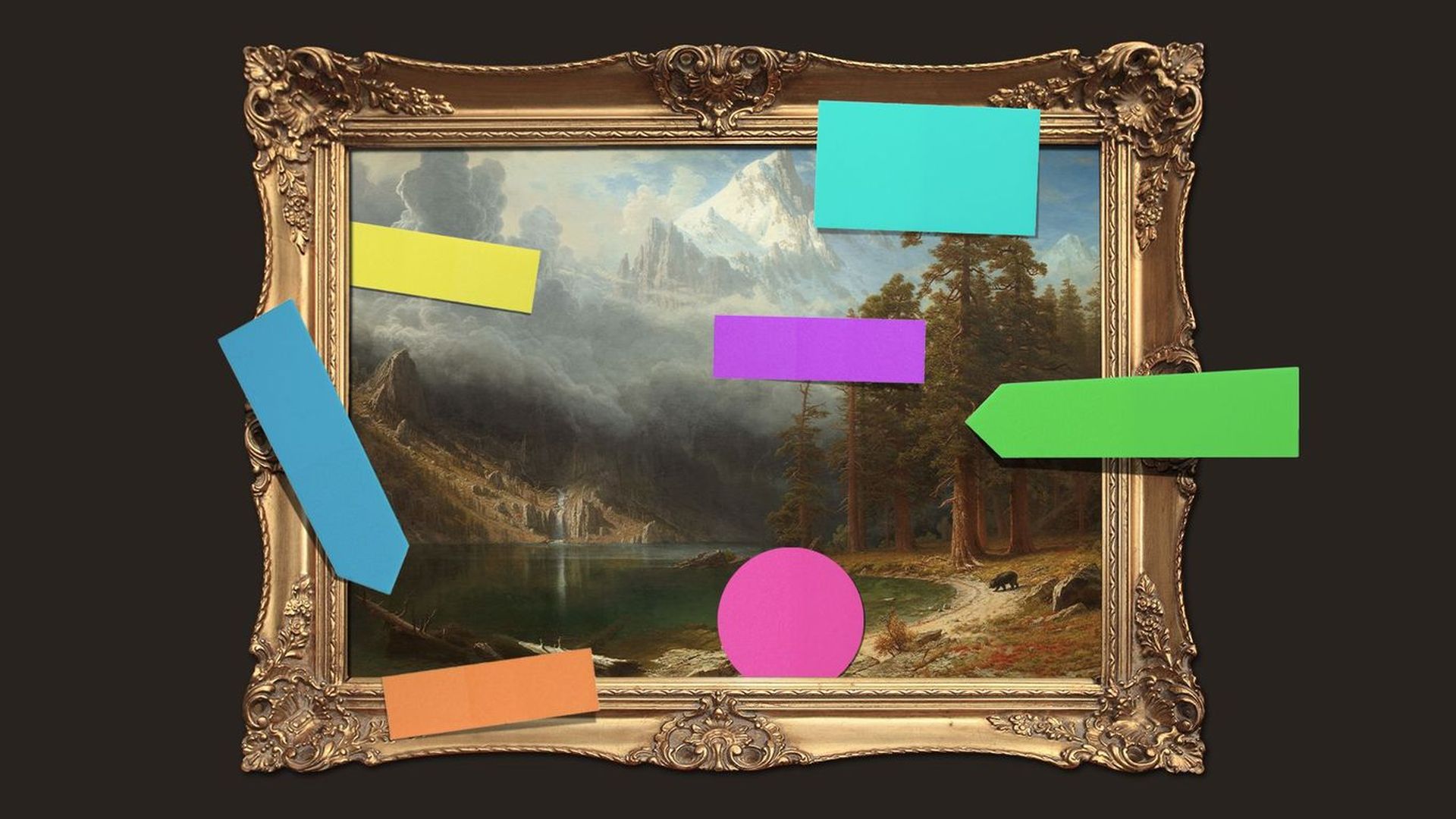
As AI continues to embed itself in our digital tools and our lives, it's getting harder to draw clear lines between what's AI-generated and what's not, Axios' Scott Rosenberg reports.
What's happening: Legislators, regulators and ethicists are going all in on requiring labeling for AI-created work — but as AI use becomes more of a human-machine collaboration, labeling will lose its coherence and meaning.
Driving the news: The Biden administration's long-awaited AI executive order directs the Commerce Department to come up with a scheme for "watermarking" works produced by AI.
- Meanwhile, members of Congress have introduced an AI Labeling Act that requires "clear and conspicuous" disclosure of AI generated content across all media types.
Why it matters: Labeling advocates argue that clearly distinguishing between the work of humans and that of AI will help the public cope with an expected onslaught of synthetic video, audio, images and text.
Be smart: It's easy enough to demand that you stamp "Created by ChatGPT" on entire essays the chatbot spits out in response to your prompt.
- But the moment you start using an AI tool as a collaborator — to brainstorm ideas, sketch out alternatives, fill in an outline's blanks, or touch up a final draft — you face tougher questions about provenance and authorship, and binary "human or AI" labeling becomes inadequate.
Software developers are on the front lines of this latest wave of change — as they usually are.
- Generative AI-based tools like GitHub's Copilot that serve as a programmer's collaborator, writing and updating chunks of code, have soared in popularity since their introduction over the last couple of years.
- Earlier this year an executive at Microsoft (which owns GitHub) reported that 40% of the code developers were checking in to Github repositories was "AI-generated and unmodified."
- In many cases, that code won't fall neatly into "AI-created" or "human-written" categories. Each program is woven with threads of both human and AI origin.
The field of image creation has used algorithmically based tools for myriad tasks like color-correction, outline detection and sharpening or blurring for decades.
- You can ask Midjourney or DALL-E to draw George Washington on the bridge of the Starship Enterprise, or you can paint the same image with oils on canvas yourself.
- Virtually anything in between — any digital image made with modern graphic tools, like Adobe's Photoshop, Illustrator and Creative Suite — will depend in some way on the contributions of AI.
- That means even if you could devise a reliable and tamper-proof watermarking technique to ID AI-generated content, you're going to face endless uncertainty classifying most digital images according to any consistent AI-vs.-human scheme.
Labeling text is no less of a quagmire.
- Software makers are building AI helpers into all of the most popular writing environments, from Google Docs to Microsoft Word.
- Every time you use any kind of auto-complete, modern spell check or grammar check, you're using AI.
- If you want to be certain that your writing is "all-human," you're going to have to use a typewriter or a pen.
Yes, but: Efforts by software giants Adobe, Microsoft and Google to establish new standards for image metadata could help make it easier to track how an image was created and what tools modified it.
- Still, this approach doesn't work very well beyond images and bad actors will find ways to use tools that don't leave this sort of trace.
Between the lines: The problem with labeling is already emerging in controversies over voice-acting in video game development.
- In a popular new shooter, The Finals, Axios Gaming's Stephen Totilo reports, actors' voices are encoded and then text-to-speech AI generates impromptu interjections for their characters.
- In other words, like so many creations we will increasingly encounter, this material is a hybrid of human and AI that's impossible to disentangle.
What's next: Much of Silicon Valley now believes that generative AI's facility with natural human language means it's inevitable that AI will become the new interface for all computing tasks.
- That means AI will play a role in every creative tool used to make content, and the "AI-generated" label will cease to have any meaning.
Go deeper: When humans and machines share a canvas
2. IAC warns generative AI could wreck the web
Illustration: Sarah Grillo/Axios
IAC, one of the word's largest internet holding companies, has submitted comments to the U.S. Copyright Office warning that unless the government protects copyrighted material from being used by generative AI, "the creation and publication of high-quality original content will wither and die," Axios' Sara Fischer reports.
Why it matters: IAC — which is home to Dotdash Meredith, the largest digital and print publisher in the U.S. — argues that if generative AI firms aren't forced to pay publishers for copyrighted content their algorithms are trained on and their bots recycle, the internet will become "unrecognizable" and users won't trust it.
Details: In the memo, representatives from IAC and Dotdash lay out a doomsday vision of what the web would become if copyright law doesn't evolve to force generative AI companies to pay for access to quality content.
- "Deploying algorithms to take the proprietary content of others for free and use it to compete in the marketplace against the actual creators and owners of that content will kill content creator jobs," they write.
- "If the meritocracy of quality online content is replaced by whatever GAI [generative AI] happens to cull from wherever on the web, media in all of its forms will shrivel, copyright will protect nothing of value, and the overall quality of publicly available information, and of our public discourse, will suffer," their memo continues.
Between the lines: The comments were submitted to the U.S. Copyright Office to be considered as part of a broader study of generative AI that will be used by regulators to analyze the current state of copyright law.
- The News/Media Alliance (NMA) — a trade group that represents thousands of newspapers, digital outlets and magazines — also submitted comments, including a study that shows the extent to which AI companies rely on premium content and news to train their algorithms.
- In its submission to the Copyright Office, IAC said it is in "general agreement" with the views expressed by the NMA, but is writing separately to address matters of "special relevance" to its business.
- For example, Dotdash Meredith is home to free websites that distribute health information and financial recommendations vetted from medical experts and business professionals. Generative AI, the firms argue, could undercut not just the business of traditional journalism but other sites that deliver reliable and safe information as well.
Be smart: IAC chairman Barry Diller has for years argued that Google, the biggest search engine in the U.S. and now a leading player in artificial intelligence, needs more regulation.
The big picture: The comments represent a broader tension within news companies around how to leverage generative AI tools to remain competitive while protecting their published content from AI companies.
- IAC and Dotdash acknowledge that the technology represents "an important, and potentially revolutionary," advance — and that they are embracing generative AI tools themselves.
The other side: AI companies generally argue that they don't knowingly use copyrighted material, or that their use is protected by the fair use principle.
3. Training data
- The "Bletchley Declaration" to reduce AI risks across borders was signed Tuesday afternoon by the U.S., EU, China, India, Japan and nearly 20 other governments.
- Apple is reportedly still working on a paid health coach service that will offer personalized diet and exercise plans generated by AI. (Bloomberg)
- Senate Majority Leader Chuck Schumer's next AI forum will be on elections and will be held Nov. 8. (Axios)
- Matt Renner will join Google Cloud as president of North America and global startups, from Microsoft. (Crain's Chicago Business)
- A former Microsoft leader argues that regulations like Biden's AI executive order are "premature" and would squelch innovation. (Steven Sinofsky)
- Another AI first: The term "AI" has been named "word of the year" by Collins Dictionary. Never mind that it's an acronym.
4. + This
The best way to dispose of your Halloween pumpkins ... is to donate them to needy pigs, who love pumpkins.
Thanks to Megan Morrone and Scott Rosenberg for editing this newsletter.
Sign up for Axios AI+

Scoops on the AI revolution and transformative tech, from Ina Fried, Madison Mills, Ashley Gold and Maria Curi.