Axios AI+

September 27, 2024

TGIF. Seriously.
Today's newsletter is 1,241 words, a 4.5-minute read.
1 big thing: Meta plans to seed your feeds with AI-made posts

Meta's plan to generate synthetic content tailored to individual users — which attracted little notice this week amid a slew of product announcements — opens a whole new Pandora's box in an AI world already full of them.
Why it matters: Generative AI has largely been used to create content at the behest of individual users, but now Facebook's parent company says it will proactively surface AI-generated posts based on users' interests.
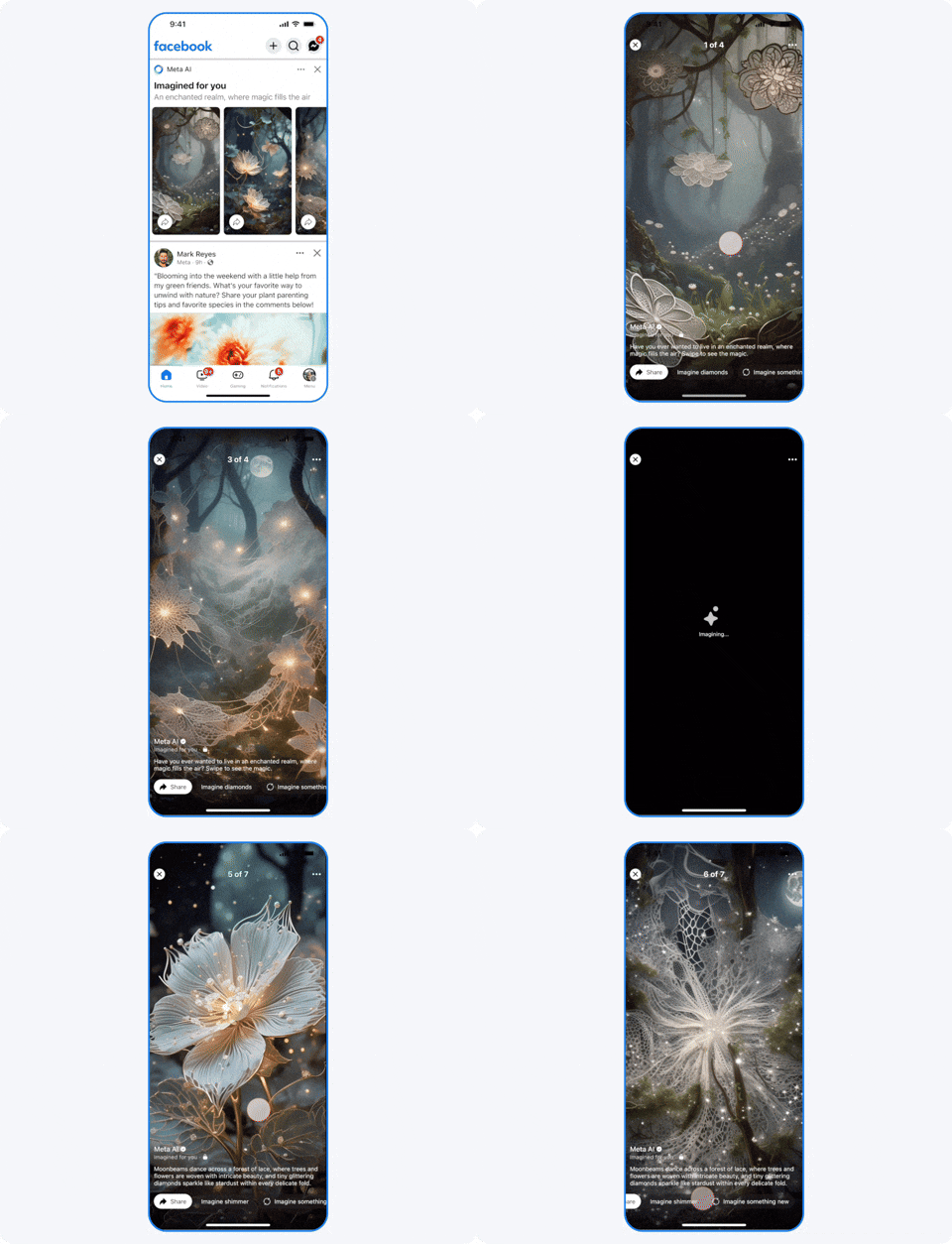
Driving the news: As part of its slew of announcements on Wednesday at its annual developers conference, Meta said it's "starting to test content imagined for you by Meta AI that will appear in your Facebook and Instagram Feeds."
- Meta said it will generate some images based on a user's interests and others that feature their likeness "so you can be the star of your own story and share your favorites with friends."
- Users will have the option, Meta said, "to take that content in a new direction or swipe to see more content imagined for you in real time."
- People will also be able to opt out of such auto-generated "imagined for you" content, a Meta representative told Axios.
Zoom in: In sample images, Meta showed its AI serving up the kinds of things users can choose to make today, such as stylized images and fantastical scenes.
Between the lines: The move is a logical next step for Meta, which has increasingly been using the Facebook feed to surface content its algorithm thinks you will like, often instead of posts shared by friends.
- Meta has been testing other ways its AI can become part of the conversations on its platforms, including making its tools available within Messenger and a since-scrapped test that had Meta AI posting in the comments sections of social media threads.
Yes, but: So far, a lot of the public reaction to AI-generated content in the realm of media and entertainment has not been enthusiastic, particularly outside gaming.
- Many people — once they get over the amazement that AI can duplicate the sound of a famous voice or generate a few minutes of video — simply lose interest.
- There's a reason so much AI-generated content is now referred to as "slop": Much of it is mediocre, impersonal and monotonous, both thematically and aesthetically.
Our thought bubble: Expect strong reaction — both positive and negative — to the notion of social media platforms proactively serving up personalized AI content.
- We don't know just how far Meta plans to take this — but once it starts to push bot-made posts at us, we should get a sense pretty quickly whether the public is tickled or repelled.
The bottom line: A future where our feeds will be filled with stuff written by a computer rather than a person is not a foregone conclusion. But it's not far off, either.

2. OpenAI's corporate soul at risk
OpenAI plans to overhaul its governance structure so that it's no longer controlled by a nonprofit organization as part of its current effort to raise $6.5 billion — the largest venture capital raise in history.
Why it matters: At stake is OpenAI's overarching commitment "to build general-purpose artificial intelligence that benefits humanity, unconstrained by a need to generate financial return." (That's from its most recent nonprofit tax filing.)
- If the changes go into effect, the nonprofit will still exist, and will still have that goal, OpenAI says. But the company that operates ChatGPT will instead have a fiduciary obligation to maximize the return to its shareholders.
Between the lines: Some observers, including Robert Weissman, co-president of Public Citizen, have already concluded that "OpenAI is no longer serving its public, nonprofit purpose and is instead effectively controlled by the for-profit OpenAI affiliate."
- "As far as we can tell, OpenAI no longer exists as a public interest organization." says Mozilla Foundation president Mark Surman, who leads one of the tech world's best-known nonprofits.
The big picture: OpenAI has been blurring the lines between nonprofit and for-profit for some years now as its cash needs continue to spiral upwards. (It's a lot easier to raise $6.5 billion in venture capital than in charitable donations.)
- Its latest transformation, reportedly into a public benefit corporation (PBC), would be its largest governance shift yet.
- PBCs pay a certain amount of lip service to the idea that they're answerable to more than just shareholders, but they can give up that status at any time.
How it works: OpenAI's current board is well-stocked with dyed-in-the-wool capitalists, including former Treasury Secretary Lawrence Summers as well as the current or former CEOs of Salesforce, Instacart, Quora and OpenAI itself.
- They can decide that the best way for OpenAI to reach its goal of benefiting humanity is to align itself entirely with deep-pocketed for-profit investors — while probably retaining for the nonprofit some financial stake in the company.
Zoom out: OpenAI was founded by a group of researchers who feared Silicon Valley would race to build super-powerful AI without making sure it was safe first. Critics of the company's evolution argue that, under Sam Altman, OpenAI flipped that script once it found that it could lead the race.
The bottom line: Getting rid of OpenAI's nonprofit control won't be easy, and will almost certainly attract litigation from figures such as Elon Musk, an OpenAI co-founder who put up some of the original money behind the nonprofit and has already filed a different suit against the company.
- But with two years to achieve the switch, and with the possibility of obtaining a 7% stake in a $150 billion company for himself, there's a decent likelihood Altman will pull it off.
3. OpenAI aims to reassure staff after exec exodus
OpenAI's chief financial officer told workers that investor interest in the company's massive funding round was "incredibly high" as part of an effort to reassure them after a wave of high-profile departures, a source familiar with the situation told Axios.
Why it matters: Staffers were caught off guard at the exit of CTO Mira Murati, followed by a news cycle driven by the company's potential push to become a for-profit business.
- Murati's departure, conveyed to CEO Sam Altman Wednesday morning and announced in the afternoon, was followed by the announcement of two other exits: Bob McGrew, chief research officer, and Barret Zoph, VP of research.
Zoom in: Company executives — including Altman (appearing remotely from Italy), CFO Sarah Friar and Murati — spoke at a half-hour staff meeting on Thursday that included a question-and-answer session.
- Altman thanked Murati and recognized the leaders who are being elevated, including Mark Chen, who has been promoted to senior VP of research and Jakub Pachocki, who was named chief scientist in May.
- Friar said she couldn't go into details about the fundraising effort, but said it was "very oversubscribed and market-defining" — a testament to both the round's size and the demand among investors to take part, according to a source. She also said investors are "wowed by the OpenAI o1-preview."
4. Training data
- Hugging Face, the hosting platform for AI models, reports it has surpassed 1 million listings, with growth driven by customization. (Ars Technica)
- X suspended a journalist after he posted a leaked document that the Trump campaign had compiled to vet JD Vance as a potential running mate. (Axios)
- Self-driving electric wheelchairs are ferrying passengers around the Seattle airport. (Axios Seattle)
5. + This
Since it's been a long week, I thought you need a double dose of cuteness: Here's a foster mama and her baby gorilla, and here's the first aardvark born at the San Diego Zoo.
Thanks to Megan Morrone and Scott Rosenberg for editing this newsletter and to Caitlin Wolper for copy editing it.
Sign up for Axios AI+


/2024/09/27/1727409600677.gif?w=3840)