How local journalism is faring in Tampa Bay — and how to help

Add Axios as your preferred source to
see more of our stories on Google.
I'm about a month away from my 10-year anniversary as a professional journalist, reporting on Florida and Tampa Bay from local newsrooms and my home office here in St. Petersburg.
- It feels weird to acknowledge the milestone this early. I don't want to jinx a career that's already on borrowed time.
Why it matters: New data puts in stark terms what I've watched with increasing dread over the years: a collapse in local news so dramatic it feels like a miracle that I'm still here.
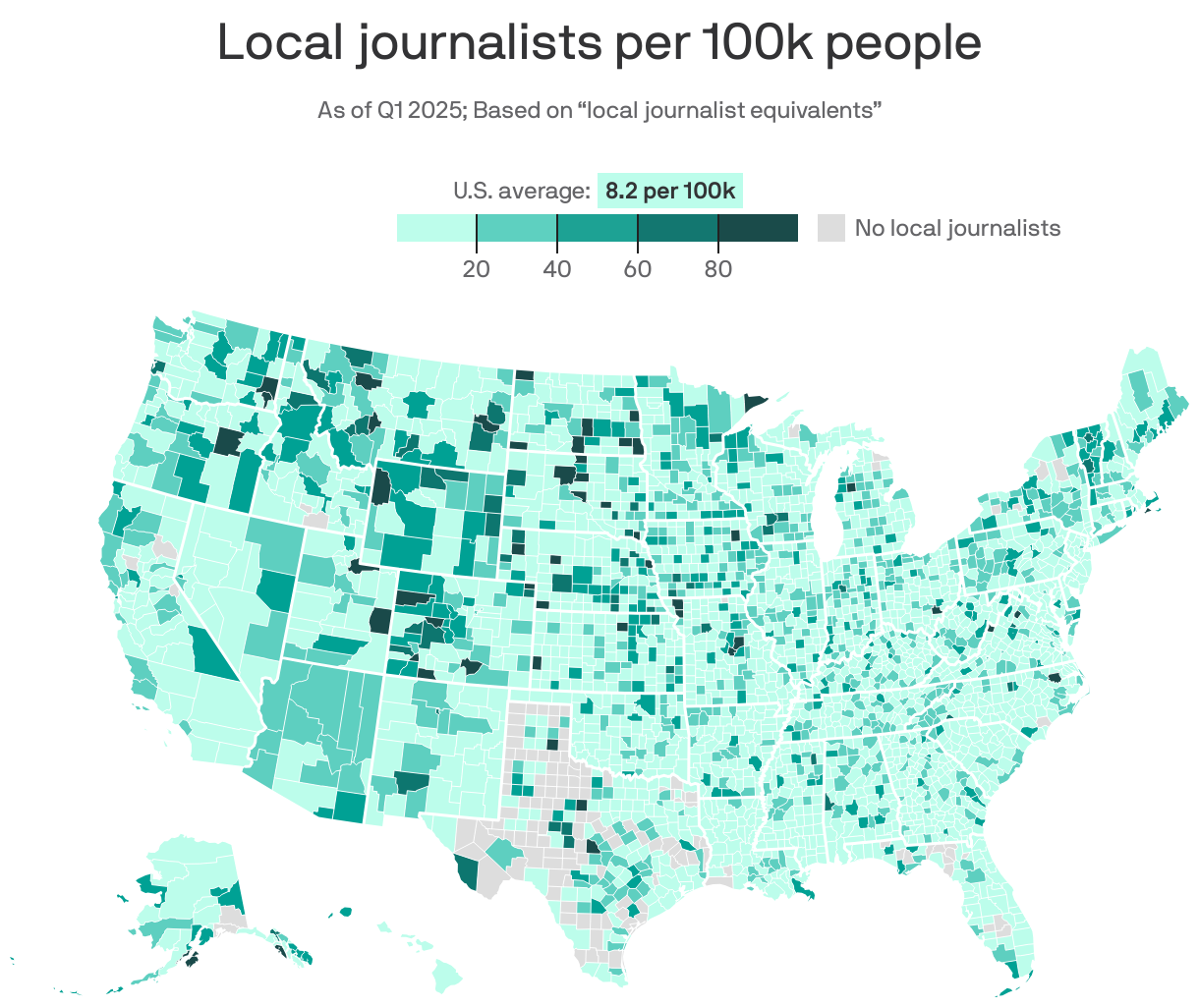
Stunning stat: The U.S. has 8.2 "local journalist equivalents" per 100,000 people — a 75% drop since 2002, when there were 40, Axios' Alex Fitzpatrick reports.
- That's according to the Local Journalist Index 2025 from technology platform Muck Rack and Rebuild Local News, a local journalism nonprofit.
The big picture: The issue plagues big cities, growing communities and rural areas. More than 1,000 counties, or one in three, don't even have one full-time local journalist.
- That means fewer people watchdogging your local government, fewer trusted sources to turn to during hurricanes and breaking news, and fewer stories by locals for locals that help you connect with your community.
- As media analyst Brian Stelter put it, "The loss of local news relates to so many other problems plaguing the US: Polarization, radicalization, loneliness, lack of trust in everyone and everything."
Zoom in: Tampa Bay is hanging in there. Pinellas County has eight journalists for every 100,000 people, or about 77 total. Hillsborough has 4.5 per 100,000, or 69 total.
- Sarasota fares the best with 13 per 100,000 while Pasco has two and Polk has one.
The latest: Public media outlets including Tampa Bay's WUSF, WMNF and WEDU are working to make up funding cuts after Gov. Ron DeSantis vetoed more than $5 million in state money and Congress voted to cut $1.1 billion in federal funding.
Between the lines: I love my job and feel lucky every day to be here. It's also come with a lot of heartbreak:
- Round after round of layoffs, tearful goodbyes with long-time editors who had their autonomy to leave on their own terms snatched away from them, and watching my generation of reporters move on to other industries just to pay their bills.
Yes, but: There is still so much good.
- Just in the last couple weeks, Tampa Bay's local news media (including yours truly) has shed light on St. Pete's vulnerable pavement art, the rising cost of living for mobile home owners, and the funding challenges faced by local school districts.
How to help: Consider financial support for your favorite local news outlet, whether that's becoming a member of Axios Tampa Bay, subscribing to the Tampa Bay Times or donating to WUSF.
- Read and share our stories widely.
- If you have feedback or suggestions, reach out! That's another benefit of a thriving local ecosystem — we're your neighbors, and we want to hear from you.
And to the readers, mentors and loved ones who have supported me over the last decade: Thank you.