Florida among most restrictive states for birth control access


Add Axios as your preferred source to
see more of our stories on Google.
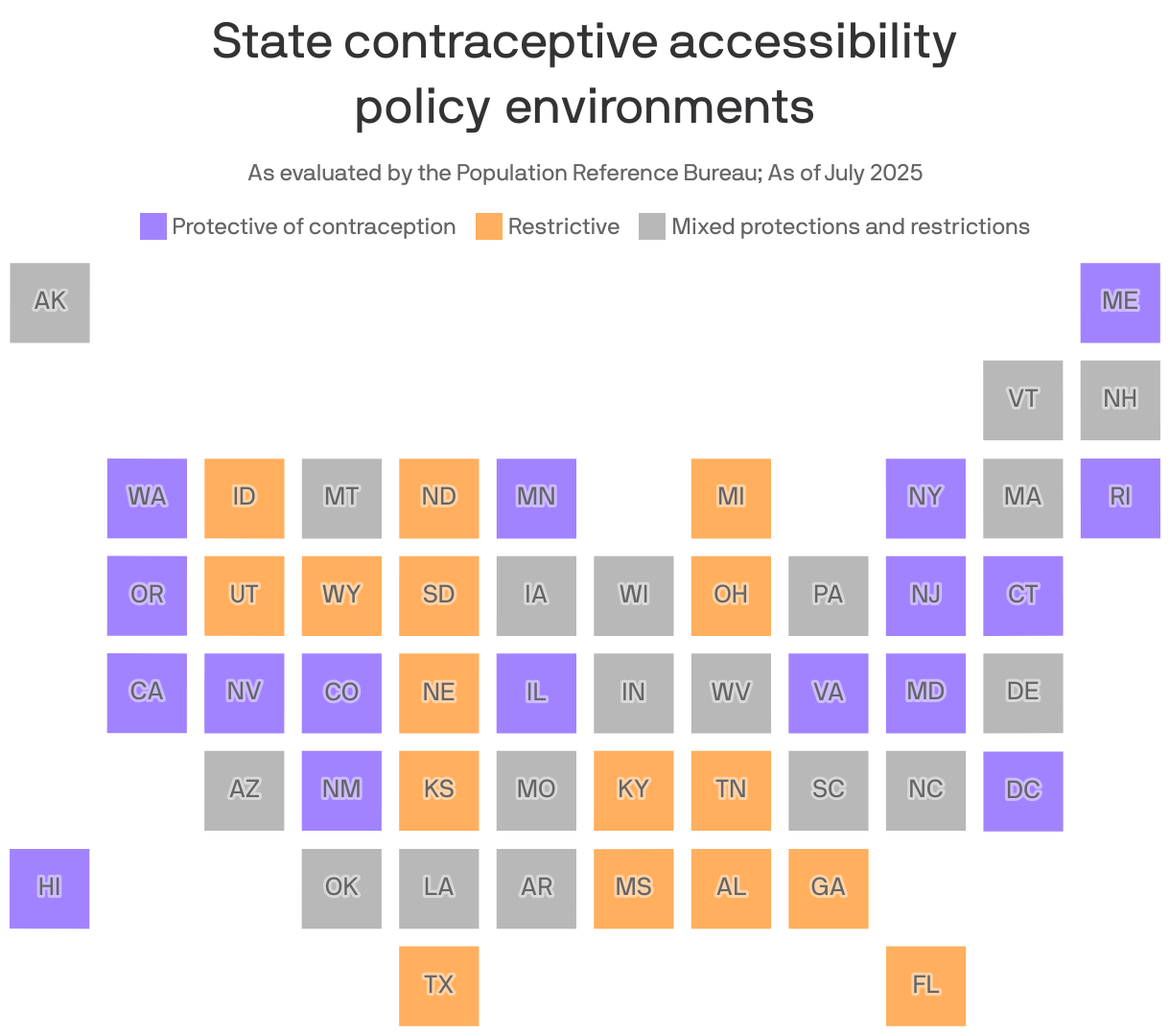
Florida is among states with the most restrictive access to contraception, a new scorecard from the Population Reference Bureau shows.
Why it matters: Contraception access has become a political flashpoint since the Supreme Court ended Roe v. Wade, with Democrats unsuccessfully pressing to codify contraceptive access nationwide and some patients concerned that conservative state legislatures could enact new curbs.
- The court's decision also paved the way for Florida's six-week abortion ban, which has forced more patients to seek care out of state.
Zoom in: While Florida expanded Medicaid coverage for family-planning services, the state hasn't enacted a broader expansion of the health insurance program for low-income residents.
- That leaves gaps in coverage for men and people younger than 19, the report notes.
- The state has no laws requiring insurers to cover birth control and only allows minors to consent to contraceptive services if they're married, pregnant or parenting, or if withholding care poses a health risk.
- Florida also doesn't require sex education in schools, per the report.
The latest: Last year, state education officials told districts to stop teaching about contraception and focus sex education lessons on abstinence.
The big picture: Nearly 35% of Americans, or 121 million people, currently live in a state that actively restricts access.
- Of the 16 states the group identified in that cohort, the most restrictive included Florida, Kansas, Mississippi, Alabama and Wyoming.
- The most protective included California, Washington, Connecticut, New York, New Mexico, Maryland and Oregon.
- Another 18 states were considered a mix between the two.
"Reproductive health care access depends on where you live," said Cathryn Streifel, senior program director at PRB and co-author of the scorecard.
- "State policies are more important than ever in shaping the reality of contraceptive access on the ground," she said.
- Recent federal proposals to impose work requirements on Medicaid beneficiaries would further threaten access,
The bottom line: As federal safeguards weaken, state laws have become the front line in determining whether people can access contraceptives.