Charging electric vehicles is getting easier in Florida


Add Axios as your preferred source to
see more of our stories on Google.
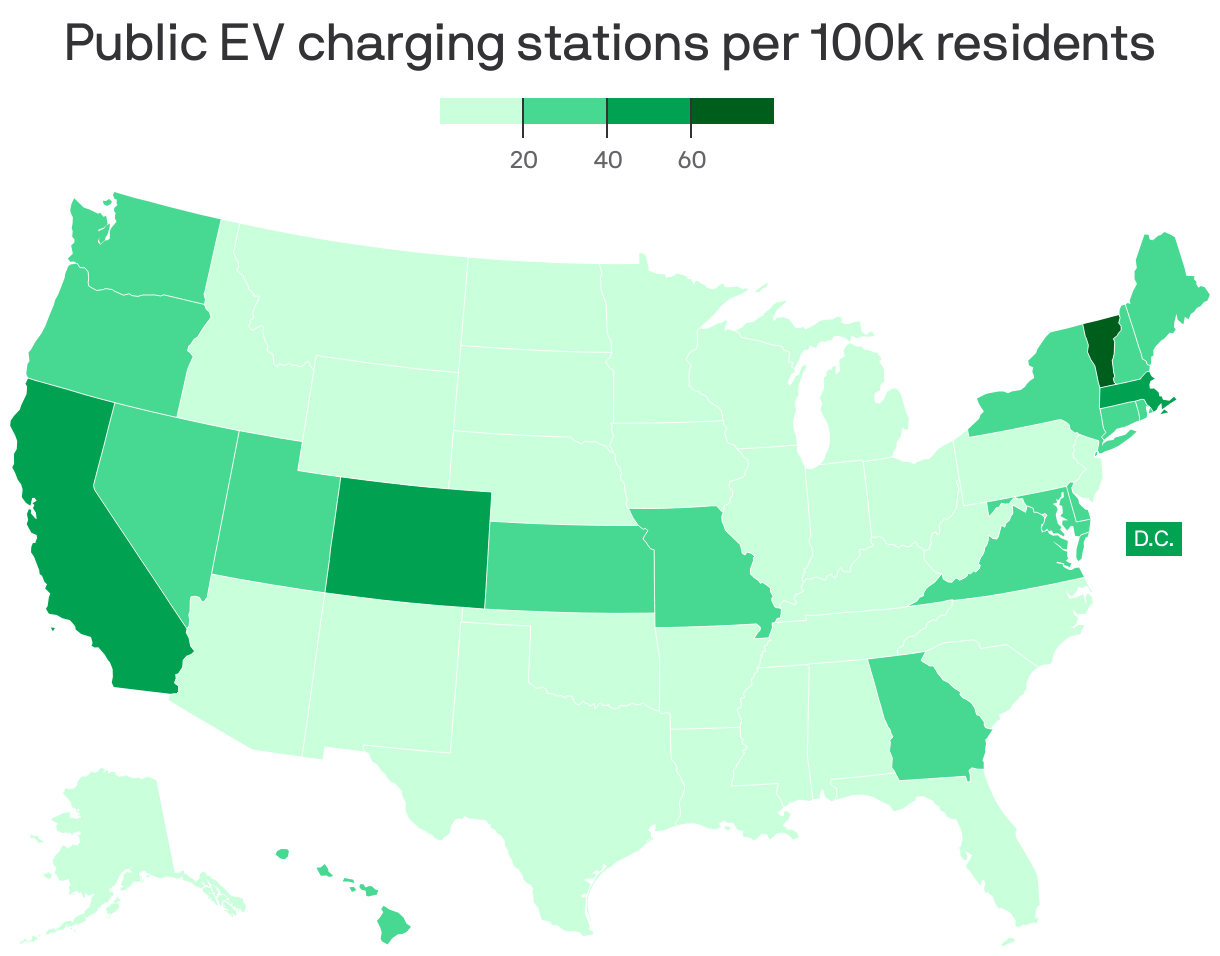
The number of public electric vehicle charging stations in Florida has more than doubled in the past four years, per federal data.
Why it matters: EVs and charging have been a chicken-and-egg problem that's now getting a little easier.
- People won't buy an electric car unless they're confident they have somewhere to charge it.
- Companies won't invest in charging infrastructure without enough EV owners to plug in.
By the numbers: There are now more than 3,600 electric vehicle charging stations open to the public in Florida, offering about 11,200 charging ports, according to data compiled by the U.S. Department of Energy.
- That's up from roughly 1,600 public charging stations with about 4,800 ports in January 2021.
The big picture: Nationwide, there were fewer than 29,000 public electric vehicle charging stations four years ago, which provided about 100,000 charging ports in all.
- Now, there are more than 75,000 stations, offering more than 200,000 hookups, per the federal data.
Yes, but: Charging might be getting easier — but the U.S. is still far short of the estimated 1.2 million public chargers that a National Renewable Energy Laboratory report says will be needed by 2030 to support expected EV sales.
Between the lines: Spurring a switch from gasoline-powered cars to battery-electric vehicles was a key part of former President Biden's climate agenda.
- He pushed policies — consumer EV tax credits, manufacturing incentives for carmakers and tougher tailpipe emissions laws — with the intent to make EVs account for 50% of new car sales by 2030.
Reality check: Electric vehicle sales are growing, but far off the expected pace.
- Only 8.1% of new car sales in 2024 were EVs, according to Cox Automotive. Still, that's a record 1.3 million EVs sold.
Editor's note: Cox Automotive and Axios are both owned by Cox Enterprises.