DeSantis administration cites rejected signatures to justify abortion amendment probe

Add Axios as your preferred source to
see more of our stories on Google.
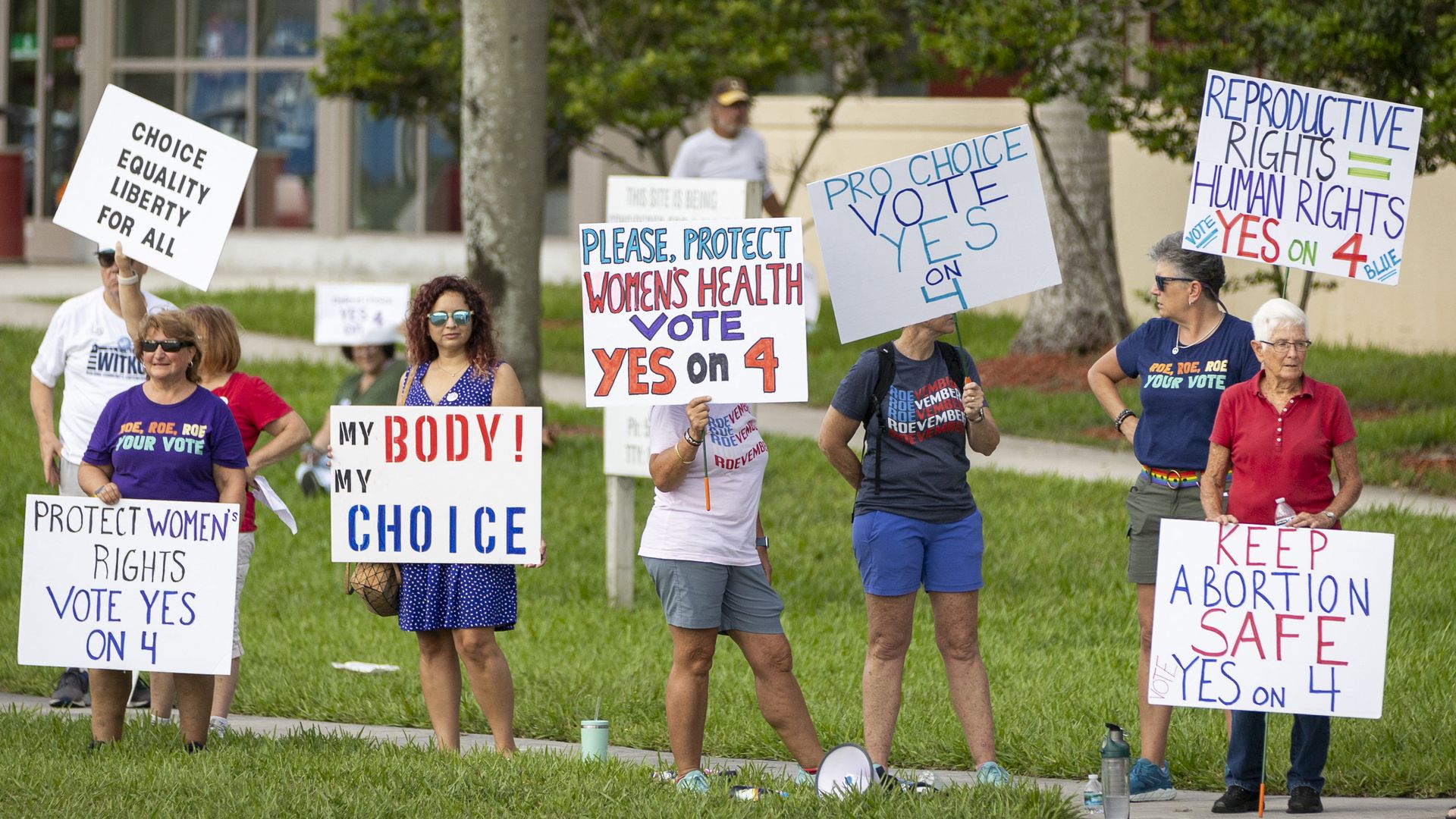
People hold up signs during a pro-abortion rights rally on the second anniversary of the Supreme Court ruling to overturn Roe v. Wade. Photo: Marco Bello/AFP via Getty Images
Fraudulent petition signatures cited by the DeSantis administration as justification for its probe of Florida's abortion rights referendum had already been rejected, according to a local elections supervisor.
- That means those signatures never counted toward the total required to put the measure before voters, Palm Beach County supervisor of elections Wendy Link, a Gov. Ron DeSantis appointee, tells Axios.
Why it matters: The administration has not produced evidence that fraudulent signatures helped get Amendment 4, which would enshrine abortion access in the Florida Constitution, on the ballot.
- Rather, records suggest state investigators justified their review of tens of thousands of signatures by citing potentially fraudulent petitions that had already been caught.
- Several local supervisors have described the probe as highly unusual and labor-intensive.
The other side: In a statement, Florida Department of State spokesperson Mark Ard said the state's review of Amendment 4's verified signatures is "in early stages and is ongoing."
- "We have identified cases of fraud. We are working on compiling findings and will refer these to appropriate authorities in the near future," Ard said.
Driving the news: DeSantis on Monday told reporters that an investigation into the petition-gathering process for Amendment 4 had already uncovered "fraudulent activity."
- The next morning, conservative news outlet Florida's Voice, citing documents from the state, reported that DeSantis' administration was "investigating tens of thousands of potentially fraudulent signatures on petitions used to get the pro-abortion Amendment 4 on November's ballot."
- When Axios requested that documentation, Ard sent four examples of fraudulent petitions and a redacted letter from Deputy Secretary of State Brad McVay.
- "Over the past several months, we have received some alarming information from the Palm Beach County Supervisor of Elections Office regarding fraudulent constitutional initiative petitions," McVay's letter, dated July 11, begins.
How it works: Filtering out invalid petitions — like those with mismatched signatures or signed by people who aren't registered to vote — is a standard administrative process for the Supervisor of Elections office, Link said.
- The office adds those petitions to a spreadsheet that several parties, including the state's Office of Election Crimes and Security, can access.
- Petitioners with signature discrepancies are given a chance to correct the issue or, if they didn't fill out a petition at all, to file a complaint.
Zoom in: The documents from the state included two such forgery complaints along with two petitions with notes indicating they were signed in the names of dead people.
- As of Tuesday, Link's office had found no evidence of fraud involving valid petitions, she said, although her office was still reviewing more than 17,000 of them, at the state's request.
- "That's going to take a long time," she said.
Between the lines: It's typical in a campaign like this that a chunk of collected petitions aren't eligible, so organizers typically gather far more than they need, attorney and election law expert Nicholas Shannin tells Axios.
- Amendment 4 organizers needed 891,523 petitions to get the amendment on the ballot. The count of valid signatures they submitted was well over that threshold at 997,035.
- The deadline to challenge the ballot initiative has long since passed and there's "absolutely no basis" to do so now, per Shannin, a former general counsel for the Orange County Supervisor of Elections.
The intrigue: While the DeSantis administration hasn't indicated the end goal of the review, investigators appear to be building a case against specific petition gatherers, according to the Department of State documents.
- McVay's letter lists 35 circulators who "submitted suspected illegal petition form(s)." Their names are redacted.
- Those petitioners account for about 37,000 submitted petitions, of which about 23,000 were verified, according to a footnote in McVay's letter.
- Investigators are "concerned that a substantial number of voter signature forgeries" were verified as valid by local supervisors, the letter says.
What they're saying: On a media call Wednesday, organizers with Floridians Protecting Freedom, the coalition backing the amendment, said their petition-gathering process had multiple quality control measures in place.
- Spokesperson Keisha Mulfort said she suspected the state was seeking "to throw doubt on this amendment" with its probe.
- "But let's be clear: It's nothing more than a distraction."
What's next: Organizers said they plan to file a lawsuit against the state over a recently launched website containing misinformation about the amendment.