Tampa Bay's overwhelmed drainage systems led to widespread flooding, officials say


Add Axios as your preferred source to
see more of our stories on Google.
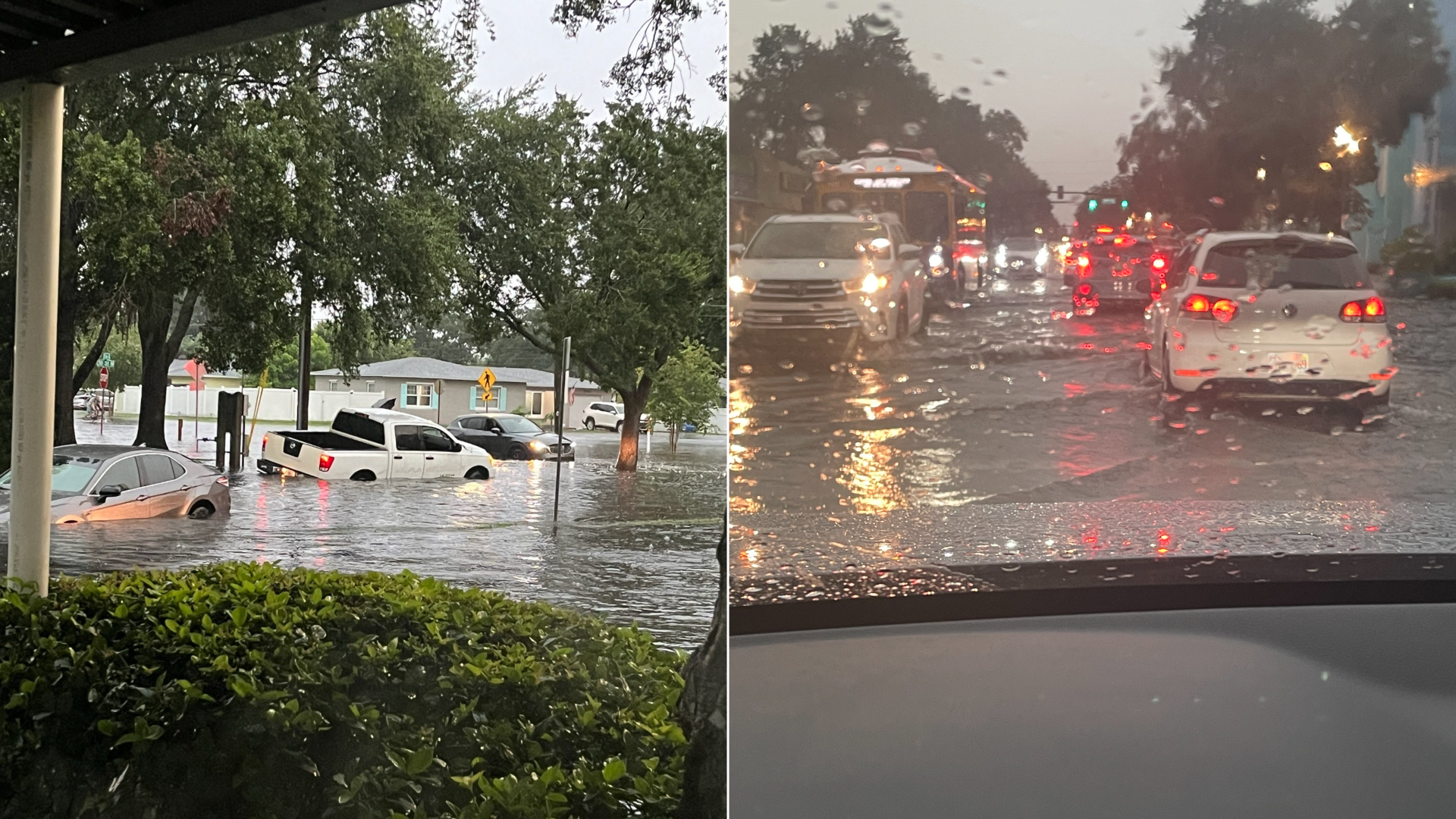
Flooding near Gladden Park and on Central Avenue in St. Petersburg. Photos: Sarah Kochan and Winston Bartlett
Officials across Tampa Bay gave the same answer Thursday: There was just too much rain.
Why it matters: This week's afternoon storms caused intense flooding that all but shut down some parts of the region — including areas that rarely flood.
Driving the news: On Wednesday, neighborhood streets to major thoroughfares were underwater in St. Petersburg and Tampa, snarling traffic during residents' evening commutes. Photos on social media showed cars abandoned in rising water.
- Waves lapped over the sidewalk of St. Pete's Central Avenue, while Bayshore Boulevard and downtown Tampa streets were covered in water ahead of a Childish Gambino concert at Amalie Arena.
- Even some higher-elevation neighborhoods, like Central Oak Park in St. Pete, saw flooding that residents had rarely, if ever, seen before.
By the numbers: Tuesday's rainfall broke records at the National Weather Service's Tampa International Airport reporting station, meteorologist Rodney Wynn told Axios.
- It captured 4.67 inches of rain, a quarter-inch more than the previous record set in 1985.
- On Wednesday, citizen rain gauges in St. Pete captured up to 5.5 inches of rainfall, Wynn said.
Yes, but: It's not just the amount of rain — it's how fast it's coming down, city and county officials said.
- Tampa saw 3.8 inches in an hour on Tuesday, shattering the previous record of 3 inches.
- Town 'n' Country in unincorporated Hillsborough County got slammed with nearly 4 inches of rain in 45 minutes Wednesday night, on top of 3 inches the night before.
- Some parts of St. Pete saw as much as 5 inches in an hour on Wednesday, public works administrator Claude Tankersley told reporters.
What they're saying: "That unfortunately overwhelms our systems," Tankersley said, noting they are equipped to handle about 7.5 inches of rainfall in 24 hours — the standard across the state.
- "Quite simply, our stormwater system … [is] not prepared to instantaneously drain this amount of water in this short of a time," Tampa mobility director Vik Bhide told City Council members on Thursday.
- Building a stormwater drainage system that could handle such intense downpours would be "prohibitively expensive — in the billions of dollars," Tankersley said.
The big picture: Climate change is causing extreme precipitation events to be more intense and frequent in much of the U.S. and around the world.
- This is because a warmer atmosphere can hold more water vapor, which provides added moisture and energy to storm systems.
State of play: Crews in Tampa are working to remove debris and unclog drains, while Hillsborough County continues pumping water in anticipation of more rain.
- The majority of St. Pete's pipes are clear of debris, Tankersley said. Public works officials are working to clean sediment from the remaining lines.
- There are a number of stormwater projects in the queue, including a large retention pond at MacDill 48 Park in South Tampa that the city expedited and expects to finish next year.
What's next: A weather front sitting over North Florida is expected to continue dumping rain on the area for the next few days, Wynn told Axios.
- City and county officials urged residents not to drive or walk through floodwater.
- With the ground already saturated, Wynn said, "things can get really bad really fast."