Tampa Bay's young people are worse off than their parents were


Add Axios as your preferred source to
see more of our stories on Google.
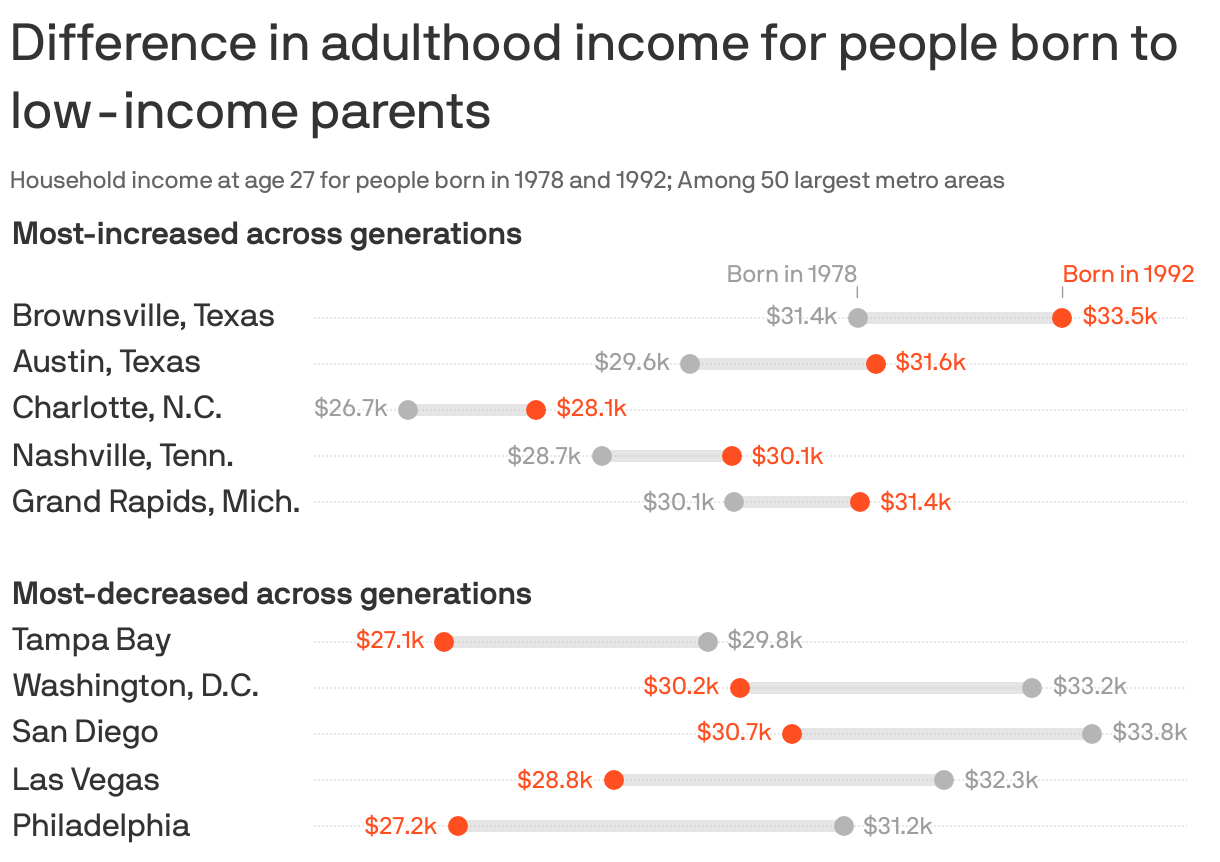
Tampa Bay residents and low-income families are faring worse than the last generation, according to a new analysis.
Why it matters: Intergenerational mobility — the idea that you'll do better than your parents, your children will do better than you, and so on — is core to the American dream, but it's far from a guarantee.
What they did: The Census Bureau and Opportunity Insights, a research group at Harvard University, sought to measure intergenerational mobility at the county level.
- Researchers compared the average household income at age 27 for Americans born to low-income families in 1978 and 1992 to get a localized picture of changing opportunities over time.
What they found: Millennials born to low-income families in our region earn less at age 27 than Gen Xers made at that age.
- In Tampa Bay, those born in 1992 had an average household income of $27,111 at age 27, compared to $29,821 for those born in 1978.
- That's a backslide of about 9%, among the worst in the nation.
Zoom out: We're not alone. In 38 of the 50 largest U.S. metro areas, Americans born to low-income families in 1992 were doing worse at age 27 than those born in 1978 at that age.
- Philadelphia had the worst plunge: 12%.
The intrigue: The upward mobility rates of white kids born into low-income families in many parts of the country had fallen, while class mobility among Black kids improved significantly between generations, researchers found.
- Low-income, white 27-year-olds in Tampa Bay saw the greatest drop in household incomes between the two generations, dropping 10%, or around $3,000.
- Kids born to low-income Asian and Hispanic households both saw decreases of 7.4%.
- Meanwhile, Black 27-year-olds born to low-income Tampa Bay households fell 2.8% in earnings.
Yes, but: "Black children born in 1992 still had poorer prospects of rising up than white children in virtually every county in America, because initial Black-white disparities were so large," per the analysis.
The bottom line: It wasn't the avocado toast.
- A 30-year-old from Tampa Bay is more likely to be in a worse financial position than someone who was that age in 2014.