New data shows Tampa Bay's true unemployment rate


Add Axios as your preferred source to
see more of our stories on Google.
America has lots of good jobs, but they're not evenly distributed.
Why it matters: The full spectrum of inequality within the U.S. is on display in an updated dataset released this month by the Ludwig Institute for Shared Economic Prosperity (LISEP).
How it works: LISEP's proprietary True Rate of Unemployment measures the proportion of workers looking for a full-time job that pays a living wage — and who can't find one.
- Nationwide, the True Unemployment rate was 24.2% as of April.
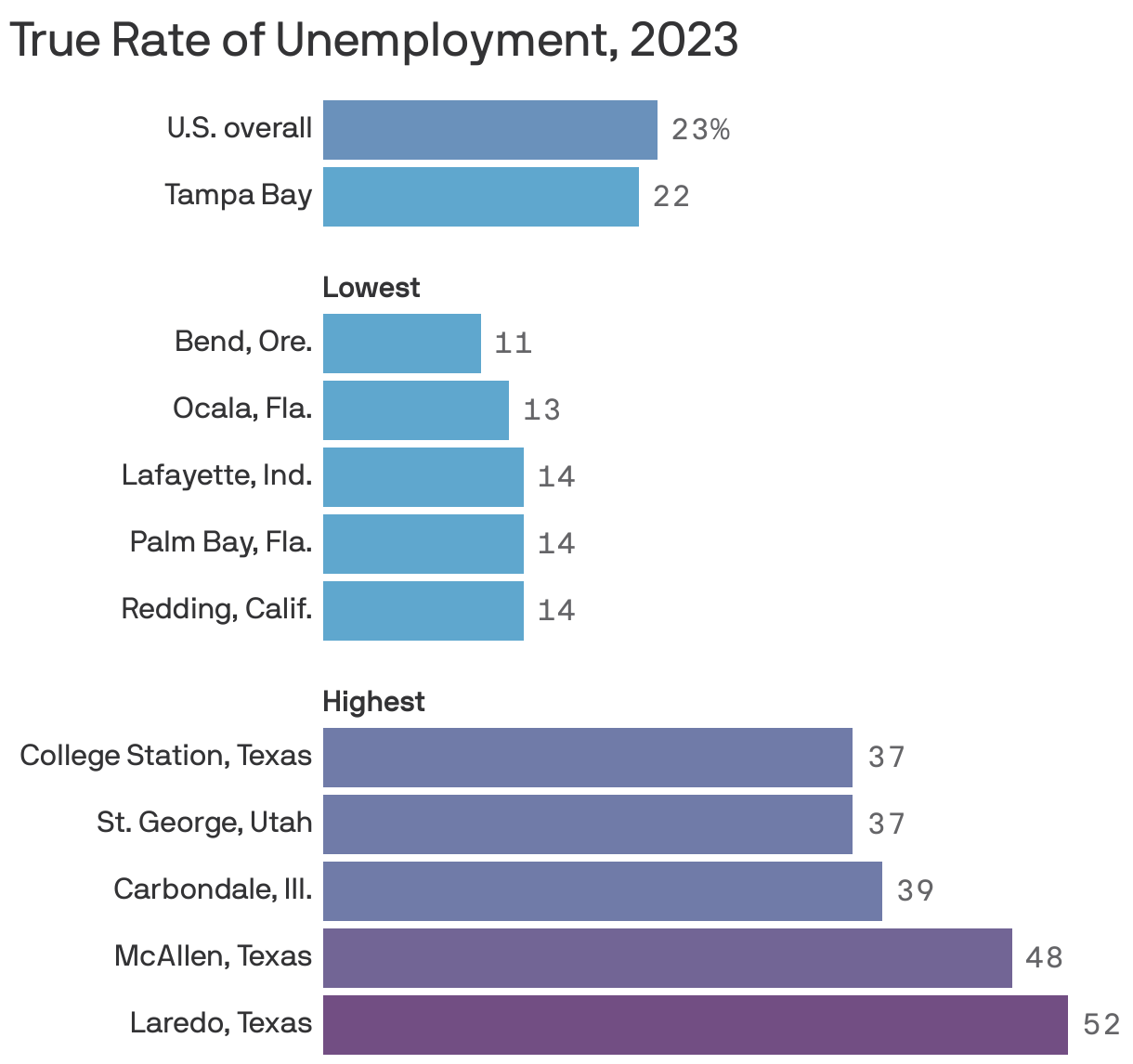
Zoom in: In 2023, Tampa-St. Petersburg-Clearwater (22.5%) and Lakeland-Winter Haven (20.2%) had slightly lower rates than the national True Unemployment rate of 23%.
- North Port-Sarasota-Bradenton averaged 23.8%.
- Ocala (13%) and Palm Bay (14%) had some of the nation's lowest unemployment rates. Such low rates can indicate a community is disproportionately home to wealthier residents who don't need to work.
Between the lines: The True Unemployment rate tends to track — but also be much higher than — the headline Bureau of Labor Statistics unemployment rate.
- That's because the BLS rate excludes people who might be earning only a few dollars a week; LISEP, by contrast, counts as unemployed anybody earning less than $25,000 per year.
- The BLS, unlike LISEP, also excludes anybody who has stopped looking for work or is discouraged by a lack of jobs or the demands of child care.
State of play: "Local communities investing in infrastructure, housing, and future-oriented industries consistently outperform those more reliant on low-wage jobs," says LISEP founder Gene Ludwig.
The other side: Pockets of painfully high unemployment remain.
- In the border town of Laredo, Texas, the True Unemployment rate is a shocking 52% — despite it being the busiest port in the country.