School segregation in Tampa Bay rising, following national trend


Add Axios as your preferred source to
see more of our stories on Google.
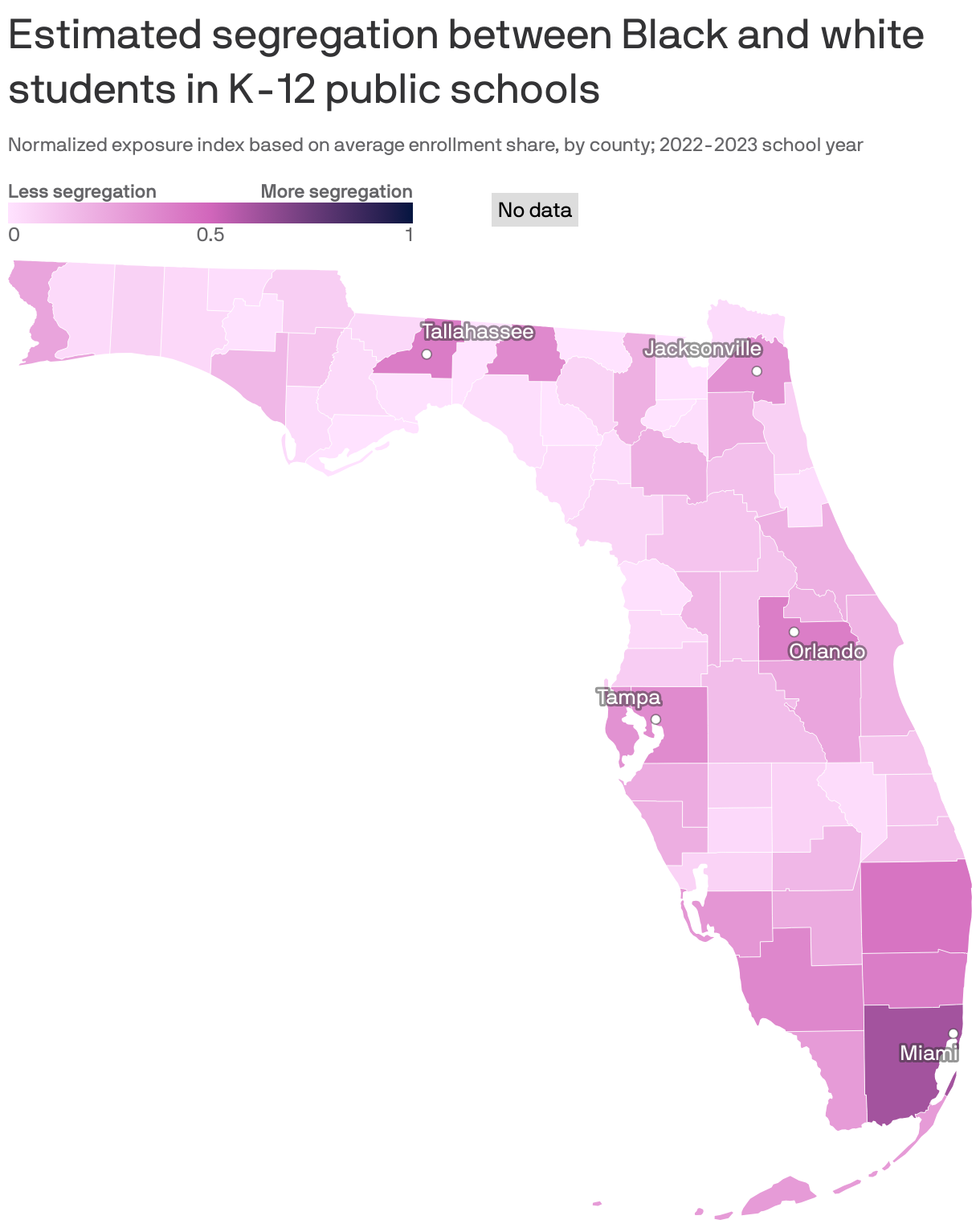
Racial segregation in schools has increased dramatically over the last three decades, according to two new reports and an Axios review of federal data.
Why it matters: Friday was the 70th anniversary of the landmark Brown v. Board of Education ruling, and American public schools are growing more separate and unequal even though the country is more racially and ethnically diverse than ever.
- Decades after Brown and the 1964 Civil Rights Act, the U.S. has moved toward policies that increased the isolation of Black and Latino students by race and poverty.
- Segregated schools disproportionately hurt Black and Latino students since those schools tend to have fewer resources, more teacher shortages, higher student-to-school counselor ratios, and fewer AP class options.
The big picture: The resegregation of America's public schools coincides with the rise of charter schools and school choice options, and as civil rights groups have turned away from desegregation battles.
- Florida has been at the forefront of the push for school choice, with Gov. Ron DeSantis championing one of the country's largest universal voucher programs last year.
State of play: Analyzing data from U.S. public schools going back to 1967, a Stanford and the University of Southern California study found segregation between white and Black students has increased by 64 percent since 1988 in the 100 largest districts.
- Florida is home to four of the largest 10 school districts in the country: Miami-Dade, Broward, Hillsborough and Palm Beach counties.
The state had some of the largest increases in integration after the 1960s but has had large declines as programs were dissolved since a peak in the early 1980s, according to the UCLA study of federal data.
By the numbers: Across the state, segregation has risen in the last two decades between Black and white students, data show, increasing from 36% in 1991 to 42% in 2022.
- Segregation between white and Hispanic students, however, fell during the same time period, from 47% to 35%.
Between the lines: Segregation in the data looks at student enrollment, with the number of intensely segregated schools defined as schools that are 90-100% nonwhite students.
Zoom in: In the Tampa Bay metro area, segregation between white and Black students has more than doubled since the early 90s — from 14% in 1991 to 36%.
- The increase between white and Hispanic students was less drastic, moving from 16% to 21% in the same time period, data show.
What they're saying: "I'm not surprised by the data at all," Daniella Pierre, president of the Miami-Dade chapter of the NAACP, tells Axios.
- Some of the factors at play, she argued, included some Black students being regulated to certain schools or traveling elsewhere to participate in specific programs offered outside of their neighborhood.
- Another consideration is the housing crisis, she says, which has impacted certain communities more than others.