Holocaust historian sees parallels in today's anti-LGBTQ+ laws

Add Axios as your preferred source to
see more of our stories on Google.
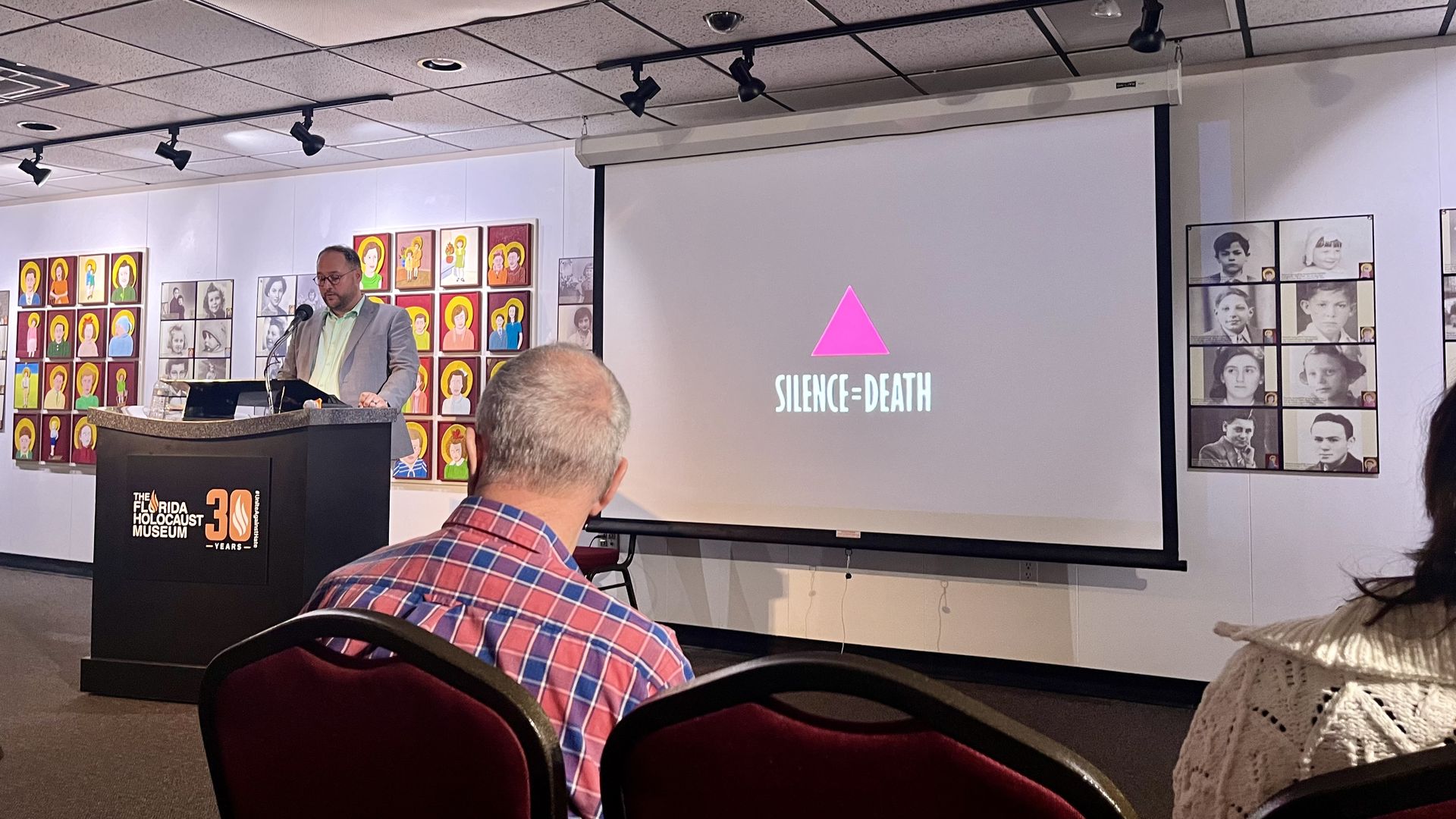
Historian Jake Newsome shows how the pink triangle was used by ACT UP, a protest movement founded in the 1980s to stop the AIDS epidemic. Photo: Kathryn Varn/Axios
In 1920s Germany, a burgeoning Nazi Party looking to unite the political right targeted a group that party leaders knew was a common enemy: queer people.
- They ramped up a propaganda campaign, banning publications by and about LGBTQ+ people and telling Germans the "homosexual lifestyle" posed a danger to their children and the country's values.
"Sound familiar?" historian Jake Newsome asked the audience of about 50 people, several of whom hummed in agreement.
What's happening: Newsome, a Plant City native, spoke last week at the Florida Holocaust Museum in St. Petersburg about his 2022 book, "Pink Triangle Legacies: Coming Out in the Shadow of the Holocaust."
- It's a historical deep dive into the persecution of queer people in Nazi Germany and how the badge that identified gay men and trans women in concentration camps became a symbol of queer resistance.
Why it matters: "In today's era of the Republican Party's 'Don't Say Gay' bills," Newsome said, referring to a nickname used by critics for Florida's Parental Rights in Education law and others like it, "we need the pink triangle more than ever."
Catch up quick: Along with barring classroom instruction on gender and sexuality, Florida and other GOP-led states have recently passed legislation restricting health care, bathroom use and public expression for transgender and gay people.
- Republican leaders have, without evidence, defended such policies as needed to protect children from LGBTQ indoctrination or "grooming," a term typically associated with sexual abuse.
The big picture: Critics, some of whom have drawn similar historical parallels as Newsome, say the laws seek to dehumanize queer people as a way to stoke fear and win political points.
The other side: Bryan Griffin, a spokesperson for Gov. Ron DeSantis, said the criticism was based on "lies," citing a settlement last week that left the Parental Rights in Education law intact but clarified its scope.
Stunning stat: Nazis arrested 100,000 queer people and imprisoned as many as 10,000 from 1933 to 1945 under Paragraph 175, a German law that prohibited man-on-man "indecency."
- Even after World War II, gay prisoners were forced to serve the rest of their sentences. They weren't recognized as official victims of the Nazi regime until 2002, Newsome said.
- Another 100,000 were arrested in the years after the war as the Nazi version of Paragraph 175 lingered on the books. They didn't gain recognition until 2016.
- Those numbers don't include lesbian women and many gender non-conforming people, who were arrested under a hodgepodge of other laws.
Zoom in: The pink triangle remained associated with the Nazi regime until the 1970s, when a gay concentration camp survivor published "The Men with the Pink Triangle," thrusting the symbol into the spotlight.
- A leftist group in Frankfurt, Germany, reclaimed the triangle as a badge of pride and it later was used by ACT UP, a protest movement founded in 1987 to end the AIDS epidemic.
The latest: While the rainbow has become the more ubiquitous LGBTQ+ symbol, "it's not just enough to be here and mark our presence," said Newsome, who sees the pink triangle as a needed reminder against complacency.
- This year, he launched the Pink Triangle Legacies Project to further queer advocacy and honor the history explored in his book.
- The final slide of his presentation last week left audience members with this message: "Remembering must have consequences."