How Florida contributed to a national homelessness spike



Add Axios as your preferred source to
see more of our stories on Google.
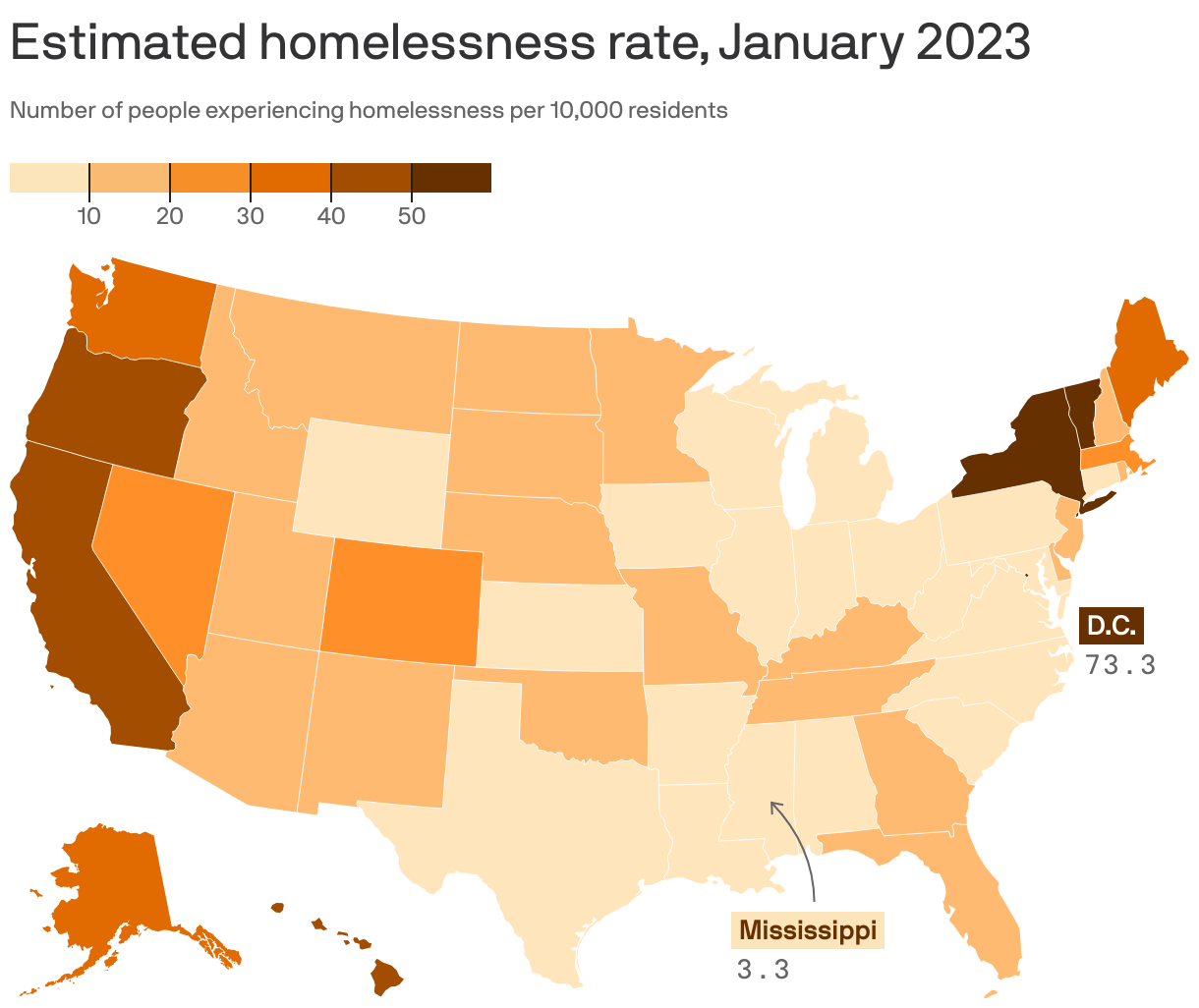
Homelessness in the U.S. reached a record high last year, driven in part by an increase in unhoused Floridians.
Driving the news: More than half of all Americans experiencing homelessness — sheltered and unsheltered — were concentrated in four states including Florida.
- That's according to an annual report from the U.S. Department of Housing and Urban Development (HUD).
- Meanwhile, the report shows the state had the second highest rate of unsheltered homeless people, behind California.
What's happening: The report attempts to estimate the number of people experiencing homelessness on a single night — in late January 2023 — to offer a snapshot useful to policymakers, advocates, researchers and others.
- Yes, but: Some advocates believe point-in-time counts can be misleading and may drastically underestimate the true number of houseless individuals, as Axios Portland has reported.
The big picture: About 653,100 people experienced homelessness in the U.S. last year, Axios' April Rubin reports.
- Homelessness increased by about 12% nationwide between 2022 and 2023, per HUD's report.
Threat level: The 2023 figure "is the highest number of people reported as experiencing homelessness on a single night since reporting began in 2007," per HUD.
By the numbers: In the 2023 count, Florida reported 15,482 unsheltered people or 6% of the national total of people living in places not meant for human habitation.
- The state also had some of the nation's largest increases of families with children and veterans experiencing homelessness between 2022-2023.
- At least 60% of Floridians experiencing chronic homelessness didn't have shelter on the January 2023 night, per the report.
- Hendry, Hardy and Highlands counties near Lake Okeechobee had some of the nation's worst statistics for a rural area — an 88% rate of unsheltered homelessness in the point-in-time count.
But: While the state saw a 17% rise in its homelessness rate between 2022 and 2023, its rate has decreased by 30% since 2007.
Between the lines: The report attributes Florida's recent increase to the expiration of pandemic-era social safety net programs — such as income protections and eviction moratoriums.
- Central Florida communities reported extreme housing cost increases and growing evictions from 2022 to 2023.
- Miami, meanwhile, reported that it struggled to house and support more than 200,000 people from other countries who arrived in the last year.
Of note: Hurricane Ian, which hit the state's southwest coast hardest in 2022, happened a few months before the point-in-time count.