Tampa Bay trees tamp down harsh climate change effects

Add Axios as your preferred source to
see more of our stories on Google.
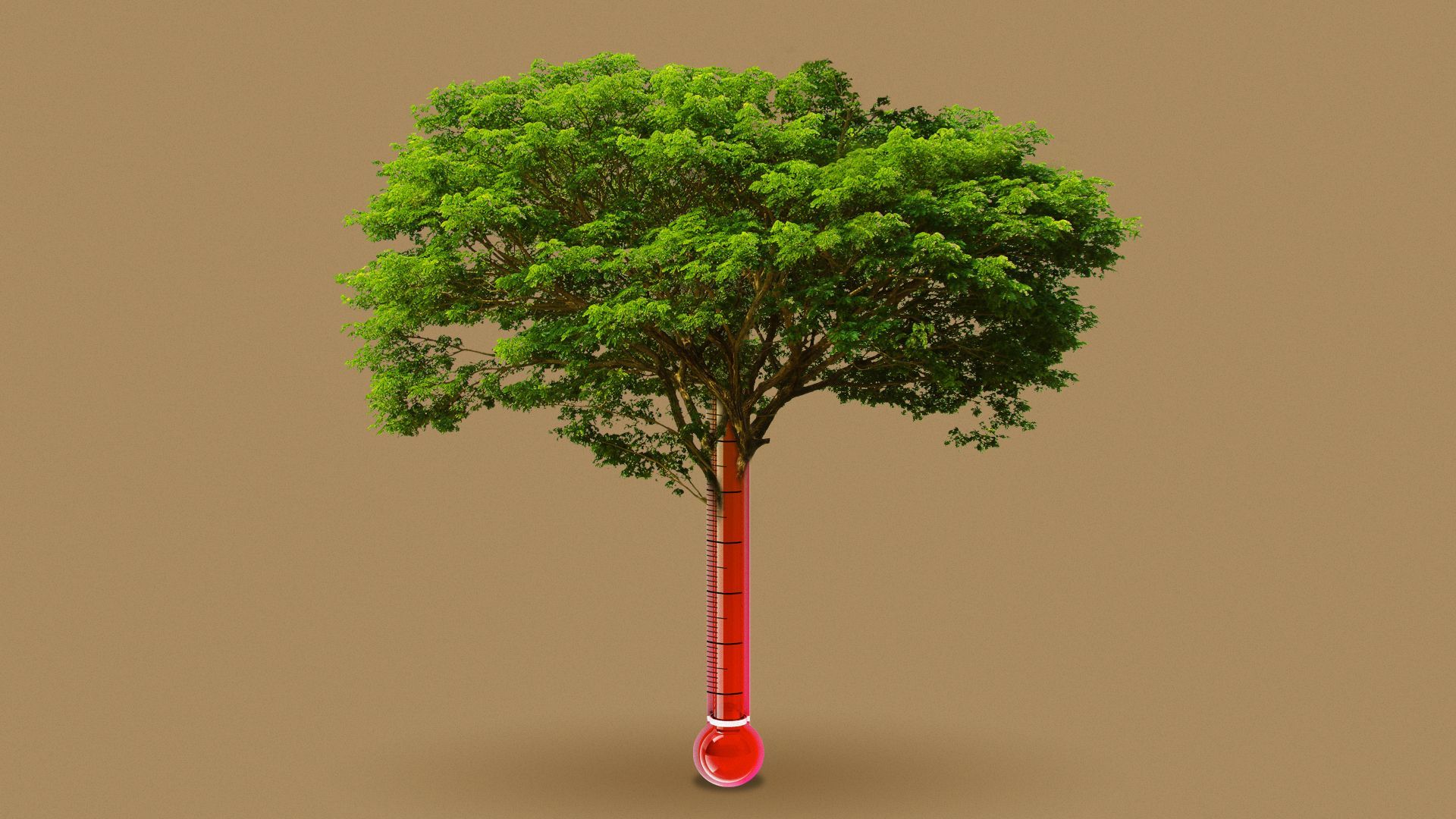
Illustration: Megan Robinson/Axios
Be-leaf it or not, trees are doing some of the hardest work in Tampa Bay.
Driving the news: Hillsborough and Sarasota counties ranked high in Climate Central's recent nationwide analysis of urban trees.
Why it matters: Urban tree coverage helps reduce the impacts of extreme heat, prevents stormwater runoff, mitigates air pollution exposure and can even sequester carbon, Axios' Ayurella Horn-Muller and Simran Parwani report.
- Urban heat islands are created when developers replace natural landscapes with "dense concentrations of pavement, buildings, and other surfaces that absorb and retain heat," per the EPA.
- A tree's leaves can also absorb pollutants like ozone and nitrogen dioxide, the report noted.
By the numbers: Hillsborough County avoided more than 2.1 billion gallons of stormwater runoff, ranking 12th in the list of 243 urban markets. Sarasota has avoided 1.3 billion gallons, ranking 28th.
- Hillsborough's trees also absorbed 1.5 million tons of carbon dioxide, ranking 20th in the nation.
What's ahead: After Tampa's tree numbers dipped, Mayor Jane Castor set a goal in April for the city to plant 30,000 trees by 2030.
- A city assessment found that citywide tree canopy coverage dropped by 2.3% since 2016, making canopy coverage of 30% of the city’s total land area — its lowest point in 26 years.
- The city blamed a law passed last year restricting the ability to regulate trees on private property, development and the age of canopy as part of the reason for the decline.
Yes, but: "Tree for tree, [urban] trees are potentially doing a lot. But it's not going to offset the fossil fuels which are also concentrated in cities," says Lucy Hutyra, professor of earth and environment at Boston University.
- From planting to maintenance, she notes the costliness of urban trees, as well as cities' different growing environments, which produce varying ecosystem services and benefits.
The bottom line: "Trees are part of the solution," Hutyra tells Axios. "But they are not the whole solution."