St. Petersburg's public parks outrank Tampa's


Add Axios as your preferred source to
see more of our stories on Google.
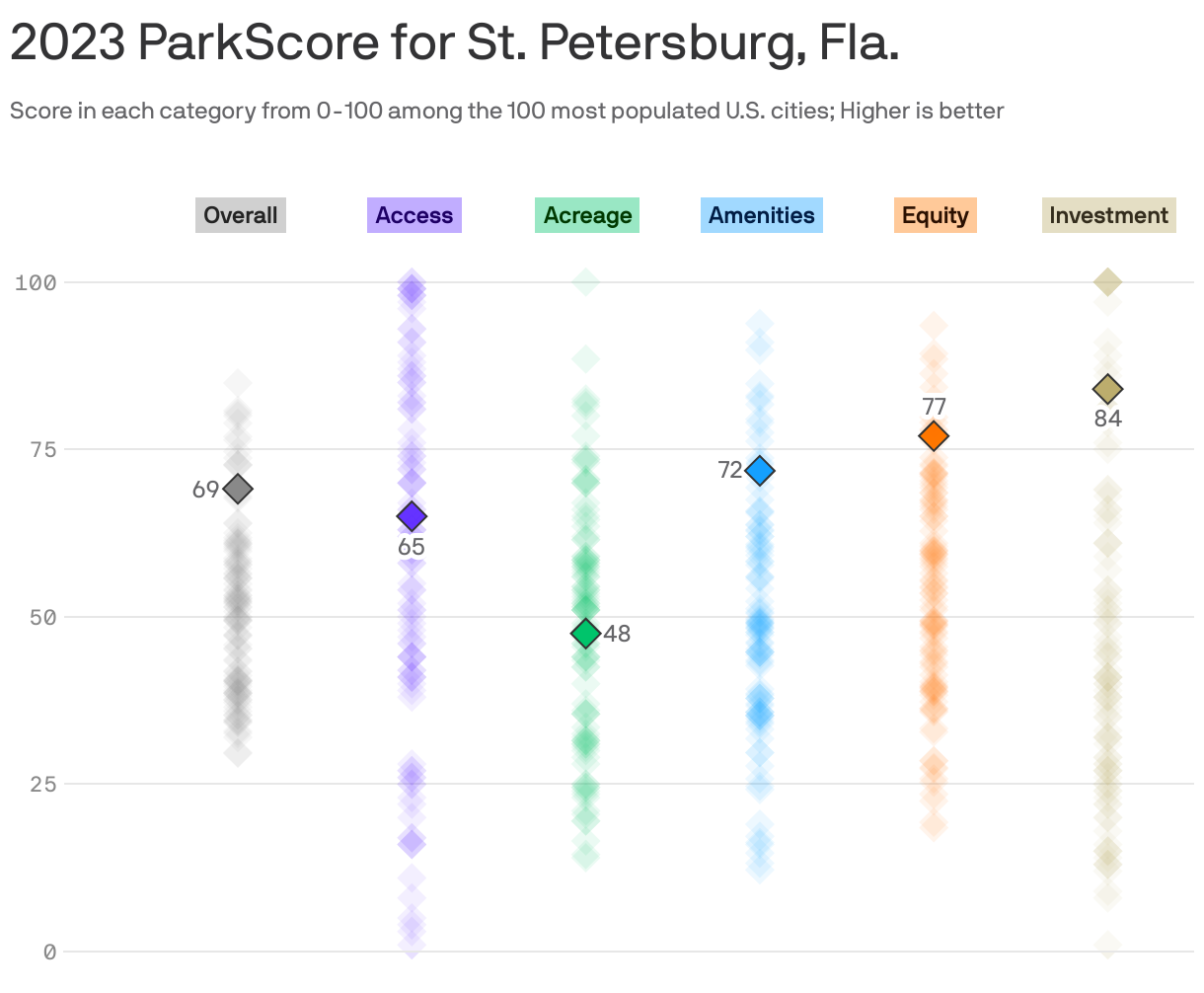
St. Petersburg ranks higher among the 100 largest U.S. cities for its public parks than Tampa, per the latest report from the Trust for Public Land (TPL), a pro-parks nonprofit.
Why it matters: Parks confer a wealth of benefits — including, as TPL points out in its latest annual report, significant health boosts.
- Parks offer spaces for physical activity and social gatherings, improve visitors' moods, and provide city dwellers a reprieve from noise, air pollution and the effects of climate change.
How it works: The group rates cities on a variety of metrics, including the percentage of residents who live near a park, the share of city land reserved for parks, parks investment and more; cities are then awarded a "ParkScore."
Zoom in: St. Petersburg is ranked 15 for its parks. It earned 65 out of 100 for access, 48 for acreage, 84 for investment, 72 for amenities and 77 for equity.
- Meanwhile, Tampa scored 46 out of 100 for access, 34 for acreage, 40 for investment, 79 for amenities and 68 for equity. It's ranked 43 overall.
Of note: St. Petersburg residents in neighborhoods of color have access to 42% more park space per person than in white neighborhoods. In Tampa, however, that contrast is less stark.
The big picture: At a national level, parks spending still hasn't recovered to pre-Great Recession levels, Linda Hwang, TPL senior director for strategy and innovation, said. But that's largely driven by the country's biggest cities.
- In St. Pete, total per capita park spending is around $186 per person, which TPL says is above average. In Tampa, it's closer to the average, at around $103 per person.
What they're saying: Cities increasingly view their parks and parks departments through a public health lens, said Howard Frumkin, TPL senior vice president and director of the Land and People Lab.
- "Simply defining parks as part of the public health infrastructure of a community, and then steering some health dollars towards the parks because they're healthy, is a really interesting innovation," he added.