Older Bay Area renters surge amid housing squeeze


Add Axios as your preferred source to
see more of our stories on Google.
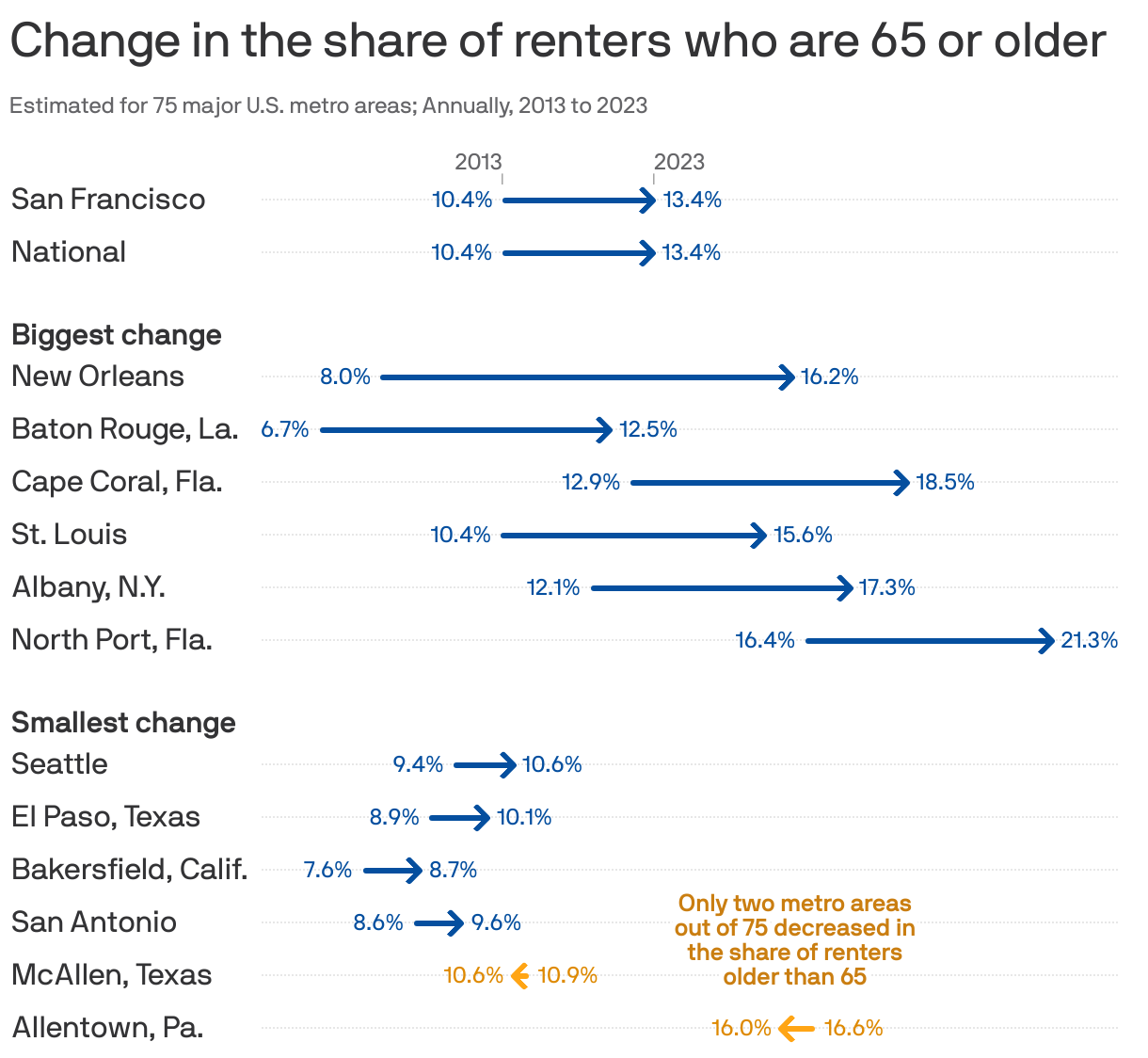
More older adults in the Bay Area are renting — and fast.
Why it matters: Rising rents and stagnant incomes are squeezing senior renters, and it's likely to continue as our aging population increases rapidly.
By the numbers: More than 13% of San Francisco metro area renters were 65 or older in 2023, up from about 10% a decade earlier, according to a report by rental listing site Point2Homes.
- Renters 65 or older jumped from nearly 157,000 in 2013 to more than 163,500 in 2023.
- The population of renters 55-64 years old also increased by more than 8,000 people.
- Meanwhile, the number of renters in the age groups 18-24, 25-34, 35-44 and 45-54 all fell.
The big picture: The share of overall U.S. renters 65 or older had a similar trajectory, rising to 13.4% in 2023 from 10.4% in 2013.
- That age group saw the biggest jump of any, adding 2.4 million renters over the decade, researchers found.
- Just two of 75 major U.S. metro areas posted a decline in the share of renters 65 or older.
Between the lines: Many older adults are on fixed incomes and stay in their homes because they're mortgage-free or have a low interest rate.
- But others are renting for less upkeep, to be closer to family, or for walkable neighborhoods.
Zoom in: Residents aged 60 or older are the fastest-growing age group in San Francisco proper, according to a March report from the San Francisco Human Services Agency (SFHSA).
- The city's housing affordability crisis is especially challenging for older residents, "who tend to live on lower fixed incomes relative to the overall population," the SFHSA report said.
- As a result, they sometimes face harassment or legal battles related to evictions and rent increases. These cases have led to elder abuse charges and a $2.4 million penalty against one particular landlord.
The intrigue: "Active adult" rental communities (think: resort pools and yoga gardens) are expanding quickly as a lower-cost option for those who want to downsize but don't need traditional independent living services, according to the National Investment Center for Seniors Housing & Care.
What we're watching: "With record numbers turning 65, the shift not only echoes the broader aging of the nation, but also may signal a new approach to housing," Point2Homes researchers wrote.