Social Security shake-up could rattle aging safety net for San Franciscans


Add Axios as your preferred source to
see more of our stories on Google.
The Elon Musk-led effort to cut down on alleged fraud at the Social Security Administration (SSA) is threatening the agency's ability to execute its core mission and the financial stability of millions of people across the country.
Why it matters: What the richest person in the world has called the "biggest Ponzi scheme of all time" is a lifeline for some of the nation's most vulnerable residents, especially with every Bay Area county aging faster than the country.
Stunning stat: As of December 2024, roughly nine in 10 Americans over age 65 and millions of people with disabilities receive benefits from the system.
- The average payment was around $1,900 for retired workers and $1,580 for disabled people, according to the SSA.
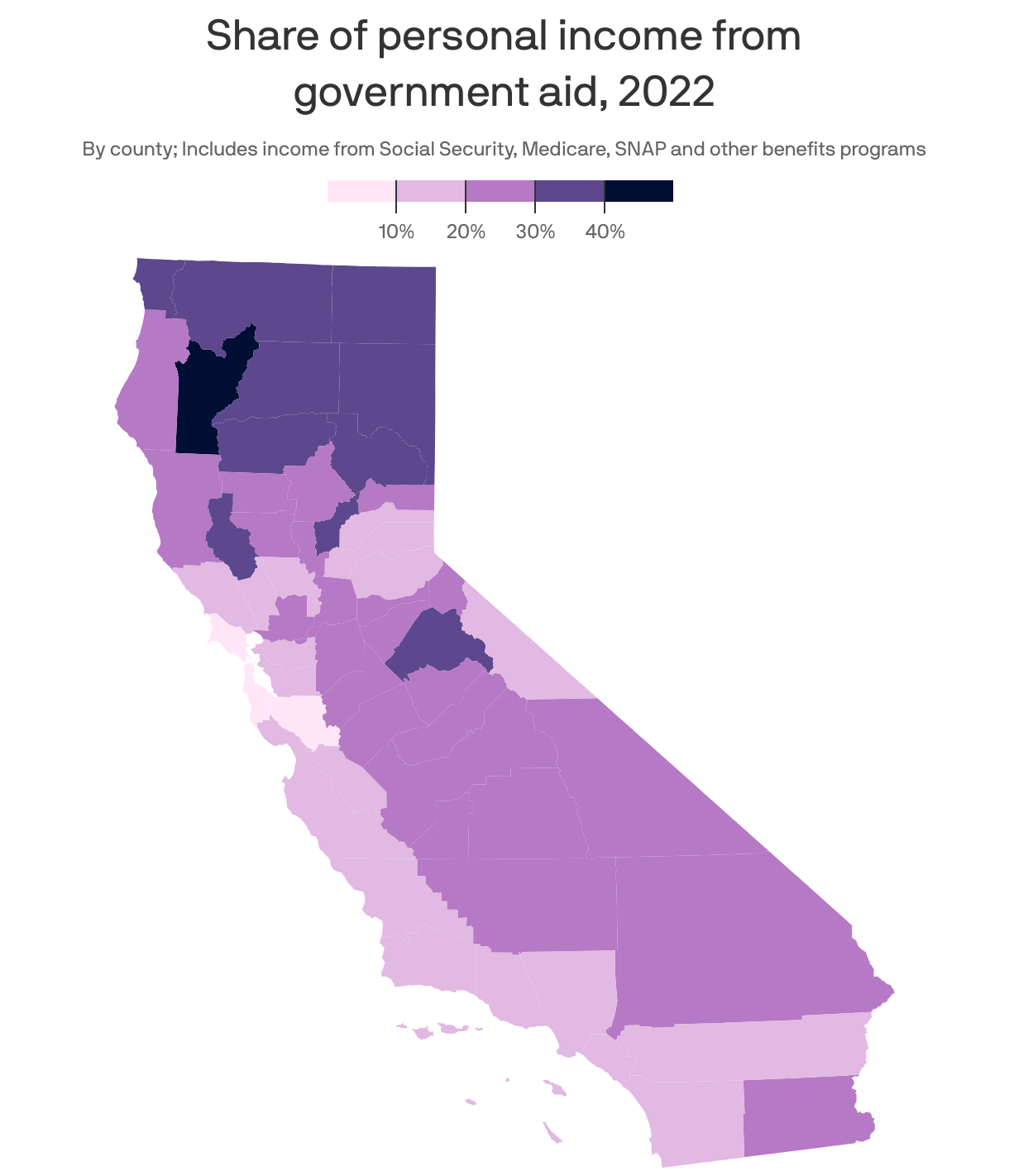
Zoom in: While the share of personal income from government aid in San Francisco stayed steady at around 8% from 2002 to 2022, neighboring counties such as Alameda, Contra Costa and Sonoma recorded upticks across the same time period.
- Solano County in particular saw that figure jump from about 11% in 2002 to over 20% in 2022.
Between the lines: The Bay Area, like the U.S. as a whole, is expected to grow significantly older in the next few decades.
- The share of people 65 and older is anticipated to grow from 14% of the region's total population in 2015 to 23% in 2050, per a 2021 forecast by the Association of Bay Area Governments.
- For this population, Social Security "matters a ton," Stanford economist Mark Duggan told Axios.
- San Francisco's older residents are already more likely to live on lower fixed incomes relative to the overall population, with rent often costing more than 30% of their monthly income, a 2024 SFHSA report found.
How it works: Social Security uses a 90-32-15 formula and the average of your highest 35 years of earnings (AIME), adjusted for inflation, to calculate your monthly benefit.
- That amounts to 90% of the lowest portion of your AIME, 32% of the middle portion and 15% of the highest portion.
- You can start receiving Social Security benefits as early as 62, but your monthly amount increases substantially if you wait until age 70.
What they're saying: "For most people in this country, when they retire or if they become disabled ... Social Security is their biggest source of income," Duggan said.
- While the Trump administration hasn't touched the formula, reducing SSA's employee headcount could delay distribution of benefits and make it harder for people to manage their finances.
- "Because of the aging population, more and more people are claiming Social Security benefits every month," he noted. Having fewer employees while that share of people increases could "cause some problems."
State of play: The Trump administration announced in February that it would cut SSA's workforce by about 7,000 employees — 12% of its staff — and close six of 10 regional offices, though it's unclear which ones would be impacted.
- Cuts to phone services that would typically take two years to implement have been rushed at the White House's request, acting commissioner Leland Dudek told Social Security advocates in a recent meeting.
- Meanwhile, customer calls have surged, prompting long wait times for callers dialing into strained offices.
Be smart: Duggan advises everyone to get familiar with how Social Security works and set up an account regardless of your age.
- "For a lot of people, it's a little bit of a mystery," Duggan added. By educating yourself, you might be able to maximize gains ahead of the Trump administration's next steps.