5 Asian American legal battles that shaped U.S. civil rights

Add Axios as your preferred source to
see more of our stories on Google.
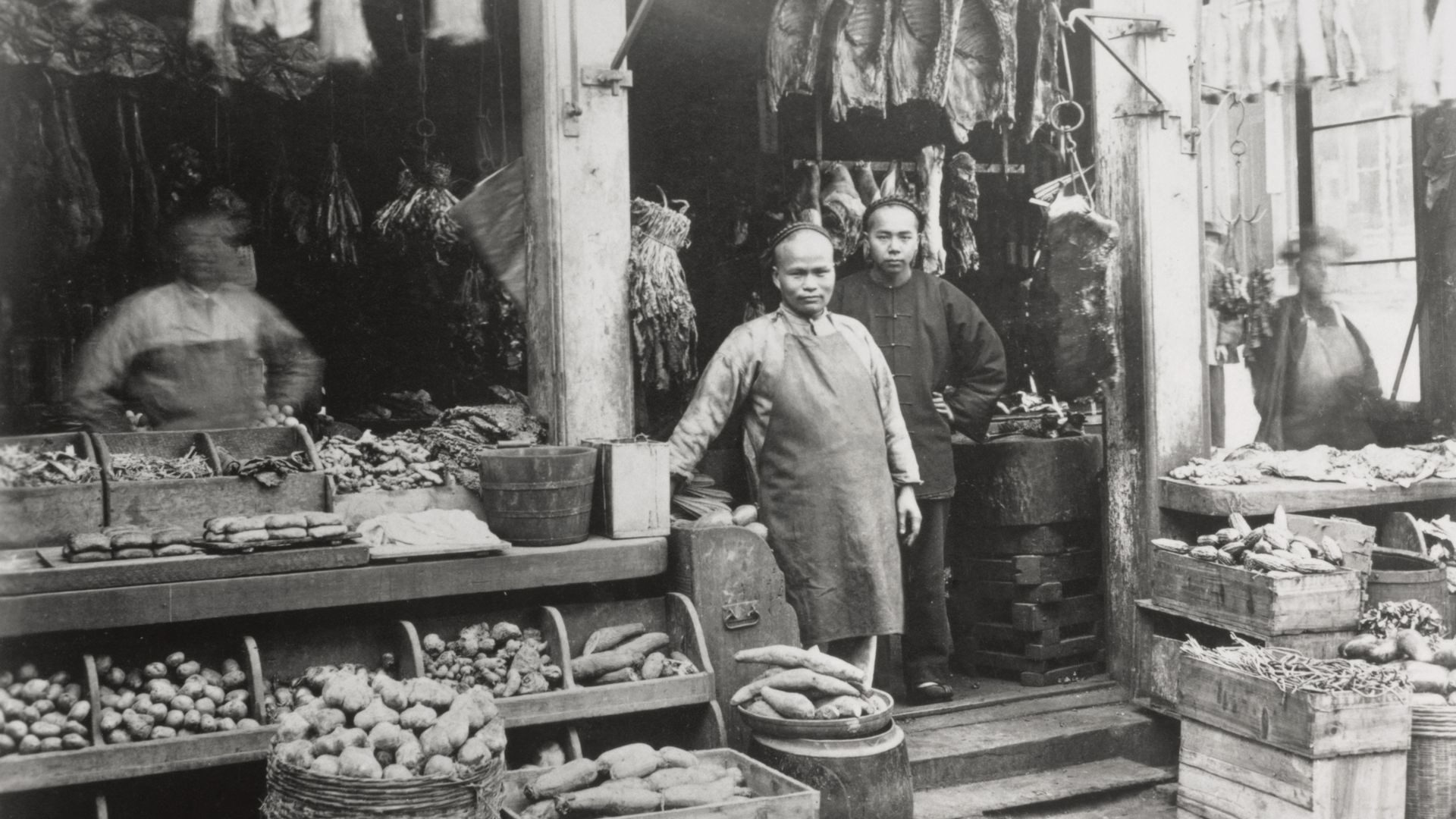
A grocery store in San Francisco's Chinatown, circa 1885. Photo: Bettmann Archive via Getty Images
California is well-known as a hub for Asian food, culture and experiences. Less visible are the civil rights struggles its Asian American community fought to attain.
State of play: Though figures like Wong Kim Ark have received more attention in recent years, there are still a plethora who remain in obscurity.
Flashback: Asian Americans have been in the U.S. as far back as the 1500s, when Filipinos landed in California.
Yes, but: They were largely treated as subhuman and even lynched across the U.S.
Here are five legal challenges that proved pivotal in demanding equality.
Chy Lung v. Freeman (1876)
The first U.S. Supreme Court case to feature a Chinese litigant involved 22 women from China, including Chy Lung, who arrived in San Francisco in 1875 via boat.
- The California immigration commissioner deemed the women "lewd and debauched." They were barred from landing and detained instead.
- Facing deportation, Lung and the others sued, challenging the statute used to deny them entry.
- The nation's highest court ordered their release, ruling that the federal government controls immigration policy and criticizing the lack of due process afforded in the commissioner's assessment of the women.
Yick Wo v. Hopkins (1886)
By the 1880s, most of San Francisco's laundry businesses were operated by Chinese people, yet the city refused to issue permits for Chinese-owned laundromats.
- Yick Wo and Wo Lee both operated laundry businesses without a permit and were arrested after refusing to pay the fine. They sued, arguing that discriminatory enforcement of the ordinance violated their rights.
- SCOTUS ruled in their favor, establishing equal protections even for non-citizens.
Tape v. Hurley (1885)
When Chinese immigrants Joseph and Mary Tape tried to enroll their American-born daughter Mamie at the all-white Spring Valley Primary in 1884, the principal refused because of her race.
- The Tapes took their case to the California Supreme Court, where San Francisco school officials argued that Chinese people were "dangerous to the well-being of the state."
- The court ruled that their daughter was protected by the 14th amendment, but the victory led the state to enact a law allowing public school systems to build separate schools for Chinese and other "Mongolian" children.
- Her case nevertheless paved the way for the landmark Brown v. Board of Education.
Roldan v. Los Angeles County (1933)
Filipino immigrant Salvador Roldan and Majorie Rogers, a white woman, sought to marry in Los Angeles County but were denied due to a California law barring "all marriages of White persons with Negroes, Mulattos, and Mongolians."
- The decision hinged on now-outdated theories of racial anthropology, with a lower court granting the license based on the belief that Filipinos were "Malay" and not "Mongoloid."
- The California Supreme Court declined to review the case in 1933. Within months, the state enacted an amendment adding "members of the Malay race" to the law against interracial marriage.
Lau v. Nichols (1976)
As the San Francisco public school district integrated its classes, it absorbed over 2,856 students of Chinese ancestry who were not proficient in English.
- Even though classes were taught in English only, the school system only gave about 1,000 students supplemental materials to help them learn English.
- Kinney Kinmon Lau and other students who lacked access to supplemental English courses filed a class action lawsuit against the district.
- The U.S. Supreme Court ruled in their favor, stating "there is no equality of treatment merely by providing students with the same facilities, textbooks, teachers, and curriculum."
- The decision led to the adoption of bilingual programs like ESL.