FEMA cuts could hurt an already fragile disaster response in California


Add Axios as your preferred source to
see more of our stories on Google.
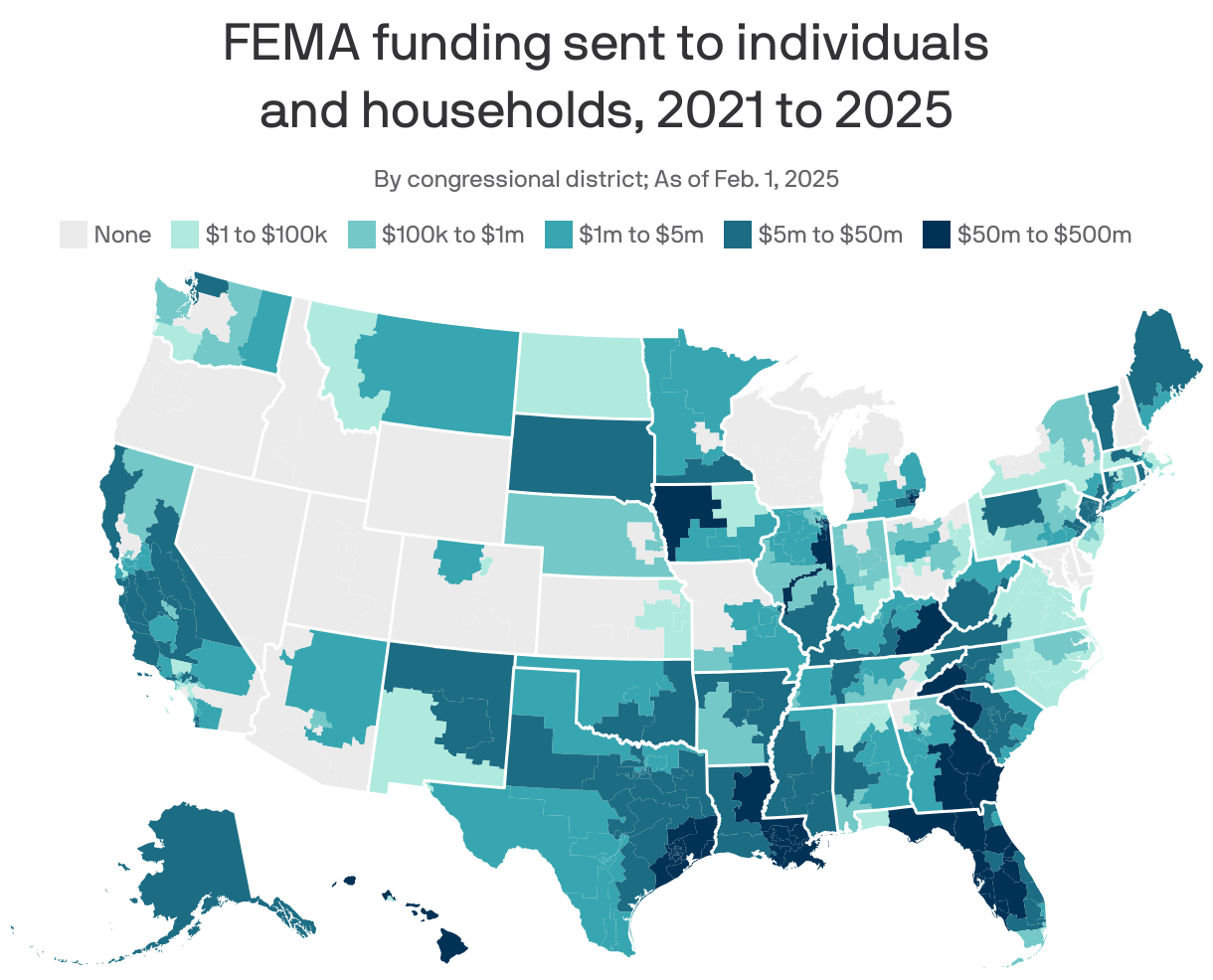
California, which some risk assessments cite as the worst state for climate disasters, could face greater financial burdens in a world with less federal relief assistance, a new analysis finds.
Why it matters: President Trump earlier this year floated "fundamentally overhauling or reforming" FEMA, or "maybe getting rid" of it entirely — fueling concerns that U.S. disaster relief could be thrown into chaos even as California continues to grapple with its home insurance crisis.
Driving the news: Trump is reportedly mulling an executive order empowering state and local governments to handle disaster readiness and relief, and he has already created a "FEMA review council."
- FEMA and other federal agencies, including the Department of Housing and Urban Development (HUD), already funnel billions of dollars to individuals and communities affected by disasters, ranging from building and infrastructure assistance to financial and direct services for households.
- It's unclear how or whether Trump's order could change that.
- Part of FEMA's utility is also overseeing people, including relief experts who can be dispatched to states as needed after disaster strikes.
By the numbers: Certain states would be hit especially hard by reductions in federal relief funding, per a new analysis from the Carnegie Disaster Dollar Database.
- California received an average of about $639 million annually in FEMA and HUD relief funding from 2015 to 2024, covering 24 disasters.
- That's equal to 0.23% of the state's approximately $274 billion in overall spending in fiscal year 2023.
What they're saying: "Up to now, when there is a disaster, the government responds. They clean up the debris, they rebuild the schools, they run shelters, they clean the drinking water," says Sarah Labowitz of the Carnegie Endowment for International Peace, who led this analysis.
- "All of that is supported by a federal disaster relief ecosystem that spreads the risk around the country, spreads the costs around the country. And if we stop spreading the costs around the country, then it's going to fall on states, and it's going to fall on states really unevenly."
Zoom in: San Francisco officials have warned that with climate disasters expected to multiply in intensity and frequency, federal resources at any given point will be even more scarce.
- "I think it would be impossible for any jurisdiction, city or county, to be able to have the amount of resources you would need," Mary Ellen Carroll, executive director of the San Francisco Department of Emergency Management, told Axios while referring to the Los Angeles fires.
- "Such a circumstance would be beyond what any municipal budget could handle," Carroll noted. "We have to plan ... to a level that takes into account as much risk as possible. But to have that level of resource for every emergency at the worst case is just impossible."
Threat level: The Bay Area is already estimated to lose $4.6 billion to climate and weather events this year, according to homeowners insurance resource ClaimGuide's risk assessment. That covers impacts on buildings, people and agriculture.
- Several counties also made ClaimGuide's list of top 50 least-prepared places, including San Francisco.
Yes, but: The Trump administration is already using disaster relief as leverage to extract political concessions.
- Trump previously threatened to withhold fire rescue aid if Gov. Gavin Newsom doesn't back his policies.
- HUD Secretary Scott Turner also recently blasted Asheville, North Carolina's draft proposal for Hurricane Helene relief, which included language about prioritizing assistance for minority- and women-owned businesses.
- Meanwhile, Newsom's request for $40 billion in federal funding to deal with fallout from January's climate-fueled fires remains in limbo as Congress moves to avert a government shutdown.
The big picture: Concern over potential FEMA cuts comes as insurance companies continue to remain apprehensive about risk exposure in California.
- Since 2022, seven of the 12 largest insurers have reduced or restricted coverage in the state.
- As a result, the average homeowner had to dip into their pocket to help cover the cost of January's wildfires.