California sees small drop in Black med school students

Add Axios as your preferred source to
see more of our stories on Google.
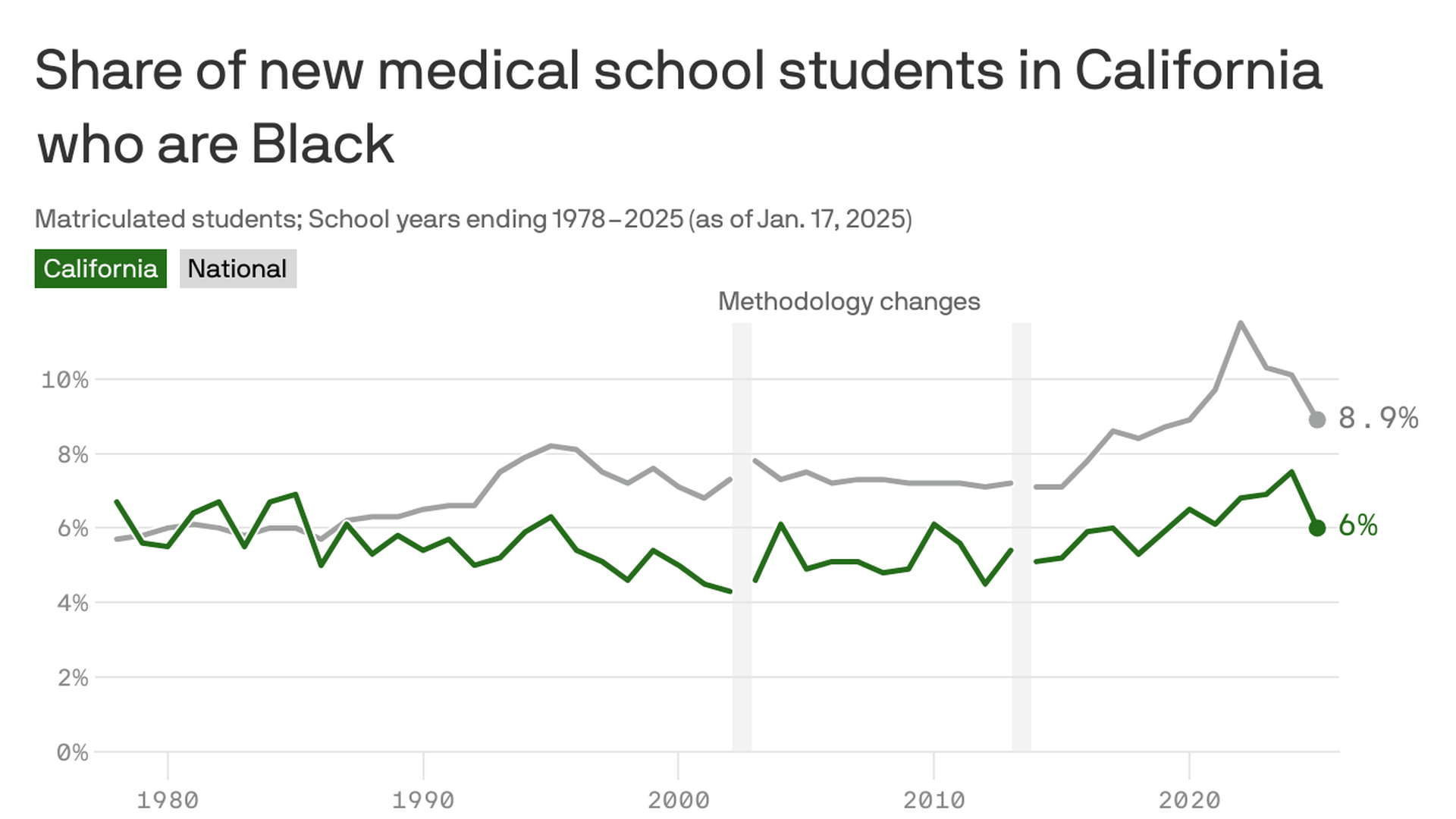
Data: Association of American Medical Colleges; Note: Students could select just one race before 2002, multiple races plus Hispanic origin from 2003 to 2013, and any combination of race/ethnicity after 2013; Chart: Kavya Beheraj/Axios
The number of enrolled first-year Black medical students has slightly fallen in California, new data shows.
Why it matters: "Having Black physicians is good for everybody's health," says Norma Poll-Hunter, senior director of the Association of American Medical Colleges' human capital portfolio.
By the numbers: In 1978, 6.7% of new medical students in California identified as Black. The share decreased to 6% in 2025, according to the Association of American Medical Colleges (AAMC).
- Nationally, just 5% of doctors in America are Black — compared with 14% of the general population.
Between the lines: The data accounts for students who identified as Black or African American.
Zoom in: California banned affirmative action in higher education in 1996 when voters approved Proposition 209, before the U.S. Supreme Court struck down race-conscious admissions in 2023.
- The recent national dip, however, follows the SCOTUS decision.
- The declines are "much larger than we would expect," even taking the high court decision into account, Poll-Hunter tells Axios.
Friction point: A federal lawsuit accuses the University of California system of illegally using race in the admissions process because the acceptance gap between Black and Latino applicants and all students has narrowed over time.
- The plaintiff — Students Against Racial Discrimination — is represented by lawyers from America First Legal, the conservative group founded by Stephen Miller, President Trump's deputy chief of staff for policy, the LA Times reports.
Zoom out: Over the years, factors that may have affected Black med school student admission rates include:
- The influential 1910 Flexner Report included vast medical education reforms that led to the closure of medical schools that primarily trained Black students. Without it, 29% more African American physicians would've graduated in 2019 alone, one JAMA study projects.
- The 1972 federal Health Careers Opportunity Program, which led to a 70% increase in minority students in health professions between its launch and 1980, according to CDC data.
- The COVID-19 pandemic cast a national spotlight on the Black Lives Matter movement and racism in medical institutions. Disparities in health care received widespread attention and there was a reduction in med school admission costs. The next year, there was an uptick in the number of Black med school students.
The intrigue: Black physicians having a positive impact on patients is more than anecdotal.
- When African American men in Oakland were treated by Black male doctors, they were more likely to opt for more preventive services, according to an NBER study.
- Researchers projected that a workforce with more Black doctors could result in a 19% reduction in the racial gap in deaths from heart conditions.