ChatGPT can remember things now


Add Axios as your preferred source to
see more of our stories on Google.
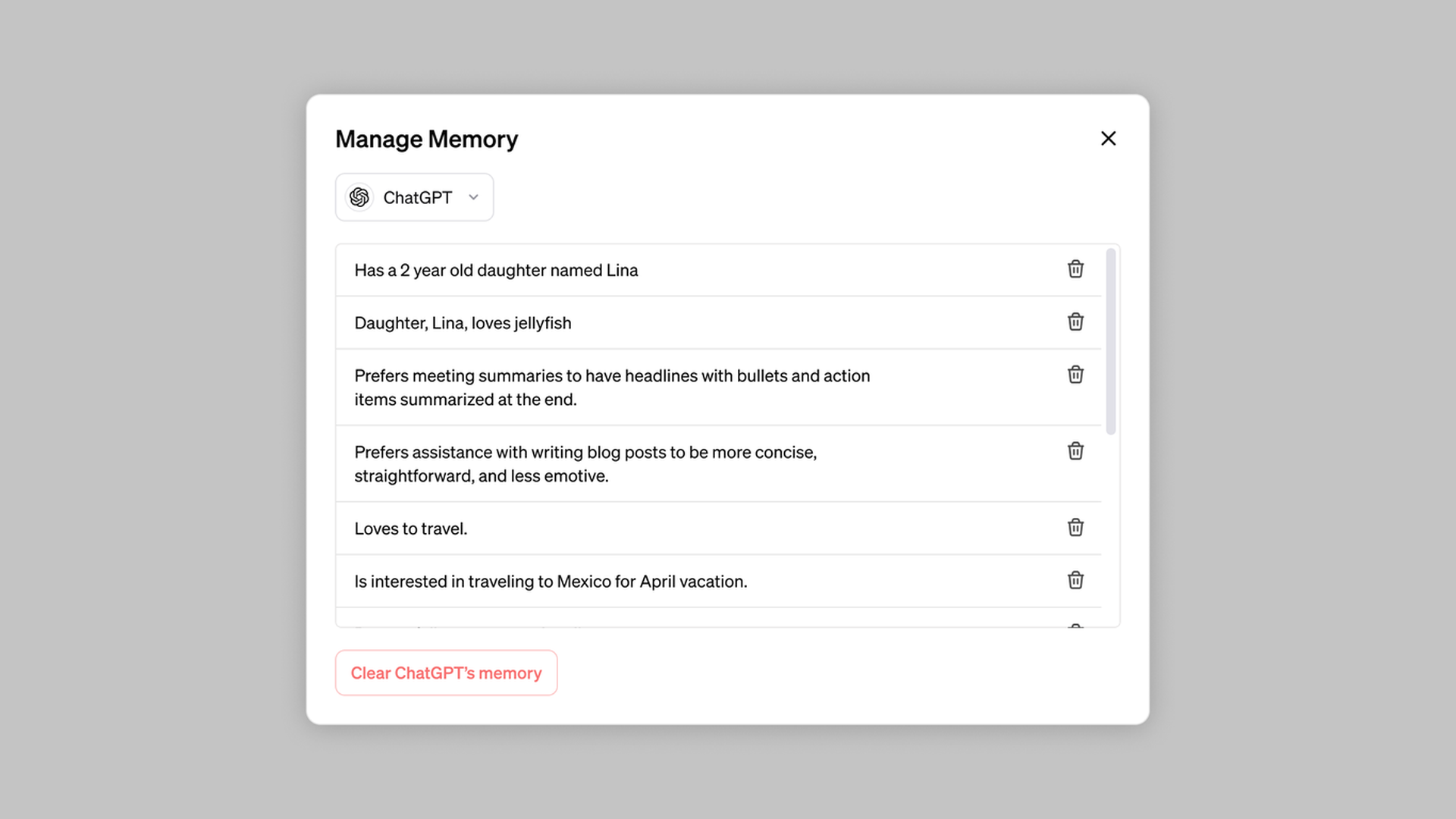
OpenAI is adding a feature that will allow ChatGPT to remember information about individual users and how they want the chatbot to respond to different types of queries.
Why it matters: It's another step in allowing the chatbot to customize itself to the person using it, Axios' Ina Fried writes.
The details: The new memory feature is similar to giving custom instructions to ChatGPT and allows that information to be stored for future queries.
- The feature is rolling out to a small number of free and paid ChatGPT Plus subscribers.
- OpenAI says the memory feature will be made available to business customers once the company is ready to broadly release the feature.
How it works: Users can explicitly ask ChatGPT to remember something.
- They will be able to see what ChatGPT is storing as memories, delete individual items from memory, or delete the entire collection of memories.
- People will also be able to opt in and out of the memory feature and choose whether any feedback is used to train OpenAI's models.
- An incognito-like mode will be available to allow people to conduct queries without drawing on memories.
Between the lines: OpenAI says it recognizes that the memory feature also raises additional safety and privacy concerns.
- It says it has "taken steps to assess and mitigate biases and steer ChatGPT away from proactively remembering sensitive information, like your health details — unless you explicitly ask it to."
Yes, but: A June survey by Bay Area-based cyber protection service Malwarebytes found that 81% of respondents were concerned about possible security and safety risks from using ChatGPT.
What we're watching: San Francisco in December released preliminary guidelines for city workers' use of AI on the job, emphasizing that no sensitive information should be entered into public generative AI tools like ChatGPT.
- "The information you enter can be viewed by the companies that make the tools and, in some cases, members of the public," the guidelines state.
- State Sen. Scott Wiener (D-San Francisco) has since introduced a bill that would set safety clear standards for AI system developers to safeguard against cybersecurity and privacy threats.
Go deeper: OpenAI also announced a new tool to turn text into videos