San Antonio gained college grads but trails the rest of the U.S.


Add Axios as your preferred source to
see more of our stories on Google.
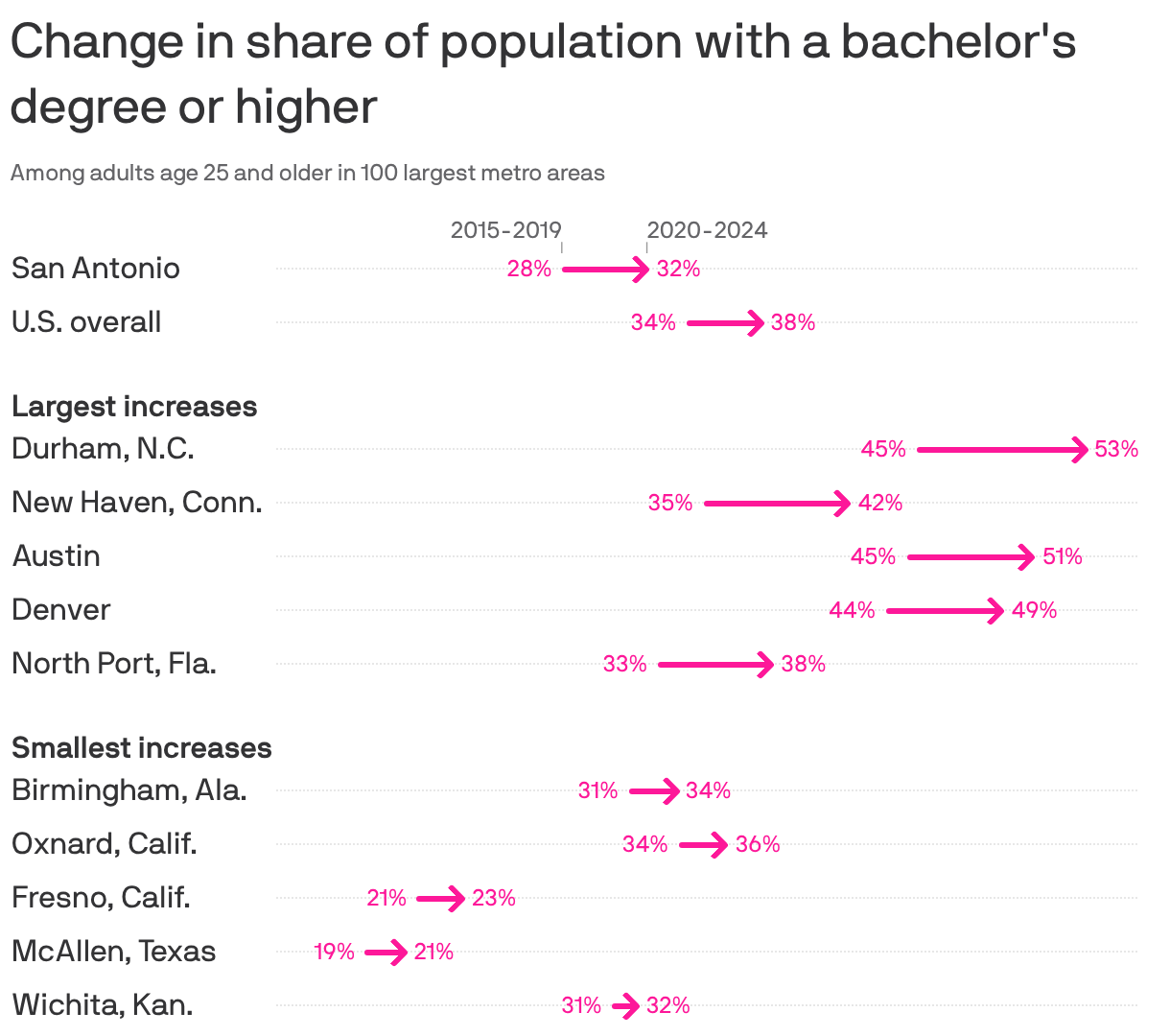
The percentage of adults with a bachelor's degree or higher is growing in the San Antonio area, but still lags national figures, recent Census Bureau data shows.
Why it matters: A rising share of college-educated adults can reshape the area's workforce and build economic muscle. A highly educated population can also be attractive to companies looking to relocate.
- Education is also one of the most effective ways for people to lift their lifetime earnings.
By the numbers: The share of San Antonio metro residents 25 and older with a bachelor's degree or higher rose from about 28% to 32% between the 2015–2019 and 2020–2024 periods.
- Nationally, it rose from about 34% to 38% in the same time periods.
- Our neighbors in Austin saw some of the biggest gains in educational attainment among the 100 largest metro areas, rising from 45% to 51%.
Between the lines: While the region falls behind national figures, the rate at which the share of our educated residents is growing matches that of the country.
How it works: That's based on the Census Bureau's latest 5-year American Community Survey estimates.
- A city's share can increase if more residents get their degrees — or if more people with degrees move into town.
Reality check: San Antonio remains one of the nation's least educated major cities in terms of bachelor's degrees. We're one of the poorest big cities, too.
Zoom in: Local higher education leaders last month pledged to increase the area's educational attainment as part of the Momentum 2030 strategy from Greater SATX, the region's economic development nonprofit.
- The effort is focused on the percentage of the population 25 and older with an associate's degree or higher. That's currently about 41%, and the goal is to increase it to 45% by 2030.
- "Each percentage point of educational attainment represents roughly 27,000 members of our community, underscoring how transformational this shared goal can be," Sarah Carabias Rush, president and CEO of Greater SATX, said in a statement. "Talent is the number one driver of economic competitiveness."
State of play: Texas A&M University-San Antonio officials said last month they're looking to grow degree offerings in engineering and health sciences in order to better align students with the area's workforce needs.
What they're saying: "As a university serving many first-generation and working students, we understand that completion and workforce alignment are essential to upward mobility," Hector Ochoa, president of Texas A&M University–San Antonio, said in a statement.