Texas businesses could be up for a tariff refund


Add Axios as your preferred source to
see more of our stories on Google.
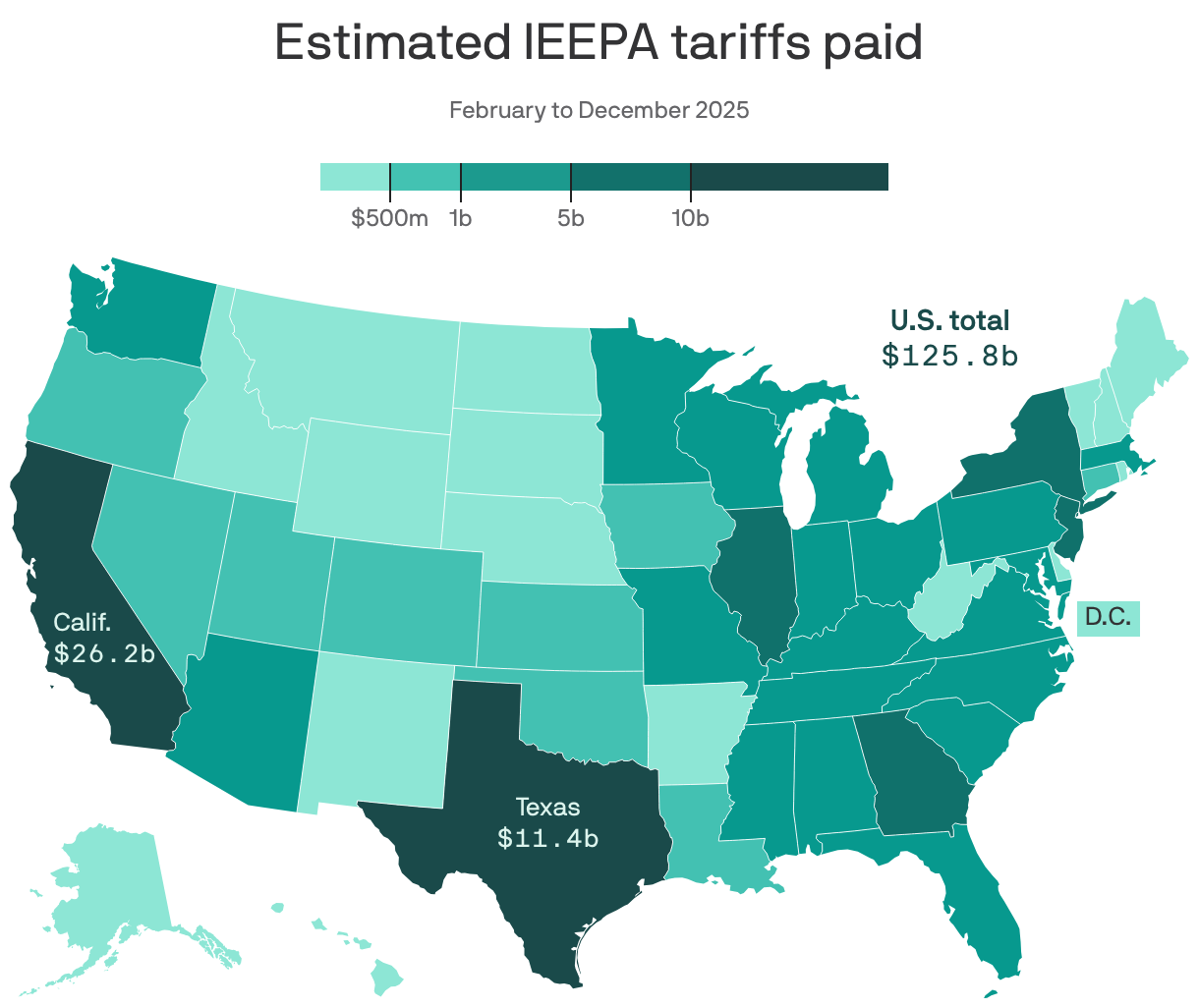
Texas businesses were some of the hardest hit under President Trump's tariffs, but now they could be among the biggest winners after the U.S. Supreme Court struck down a swath of the tariffs on Friday.
Why it matters: Roughly $126 billion is now potentially up for grabs nationwide. But the ruling could lead to a chaotic refund process — and it's unclear who gets to pocket that cash.
- The Supreme Court ultimately left that question to the Trump administration. "The Court says nothing today about whether, and if so how, the government should go about returning the billions of dollars that it has collected from importers," Justice Brett Kavanaugh wrote in his dissent.
Catch up quick: More than a dozen Texas businesses sued the Trump administration over the negative impacts of tariffs, including the marketing arm of San Antonio-based Valero Energy Corp. and Austin-based jewelry brand Kendra Scott, the Express-News reported.
The big picture: Texas spent more on imported goods than any other state except California in December, per recent U.S. Census Bureau data.
- Texas was also the No. 1 originating location for U.S. exports in December.
By the numbers: Texas businesses paid $11.4 billion in tariffs instituted under the International Emergency Economic Powers Act (IEEPA), based on trade from February to December 2025, per the economic research firm Trade Partnership Worldwide.
- The impact was largest for some of the biggest states, with California leading the way with $26 billion paid in IEEPA tariffs. Georgia ($7.1 billion), Illinois ($6.7 billion) and New York ($6.7 billion) also paid large sums.
What they're saying: "We rely heavily on imports and these tariffs were having a significant effect," Raymond Robertson, director of the Mosbacher Institute for Trade, Economics and Public Policy at Texas A&M University, told the Express-News.
- "I think it's going to help businesses breathe a little bit, and this could help the labor market as well, because businesses were holding back."
Case in point: The Federal Reserve Bank of Dallas also suggested in a Friday report that Texas employment is expected to grow modestly this year after staying flat in 2025, in part due to high tariffs.
The intrigue: That same report found that Texas businesses had not fully passed on tariff-related price increases to consumers. Companies said they could not raise prices due to weak demand or competition.
What's next: Economists at TD Securities estimate the refund process could take up to 18 months as cases make their way through the federal court system.