Texas congressional map favoring GOP blocked by court


Add Axios as your preferred source to
see more of our stories on Google.
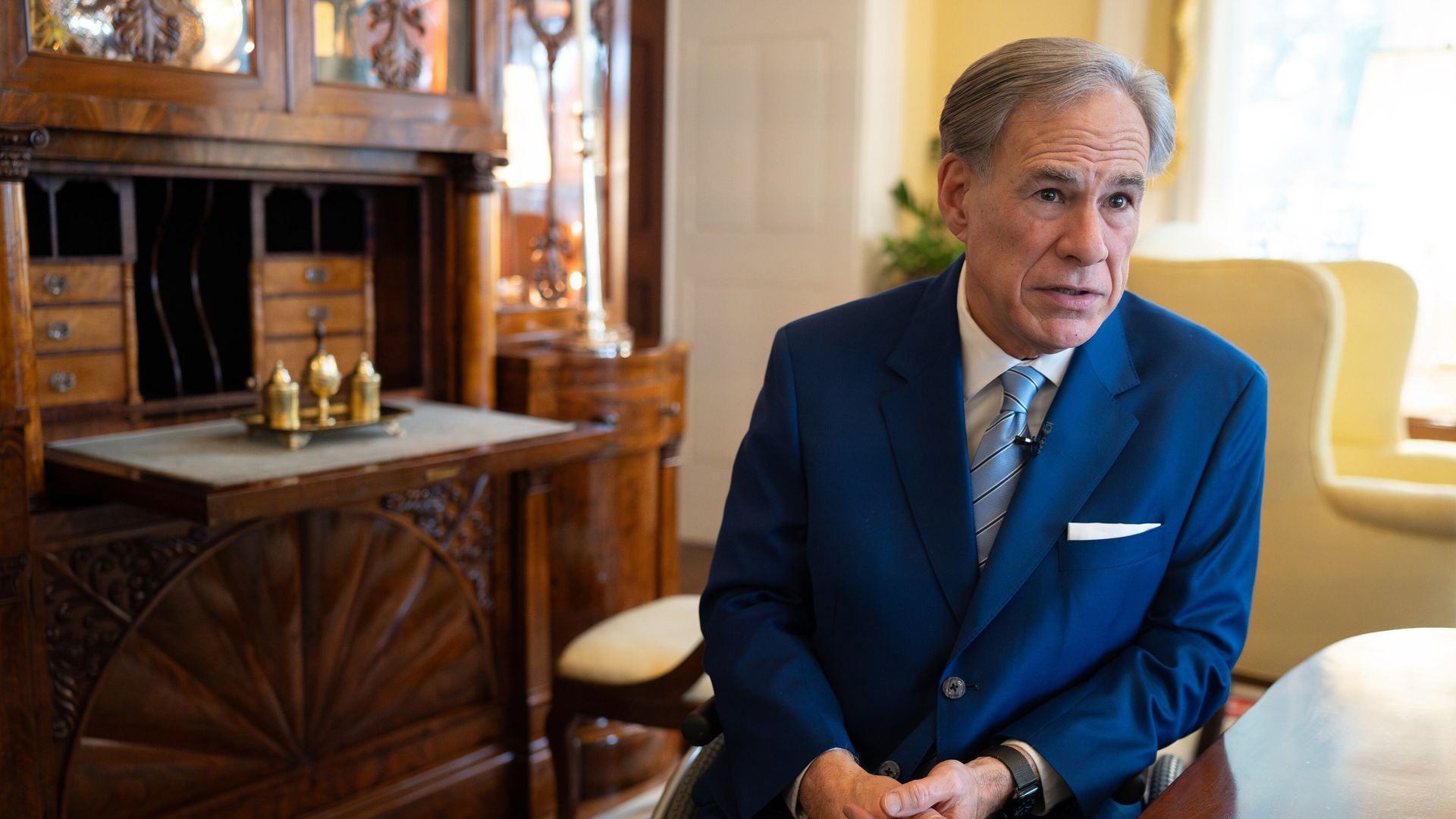
Gov. Greg Abbott at the Texas Governor's Mansion earlier this year. Photo: Azul Sordo/The Dallas Morning News/Tribune News Service via Getty Images
A panel of three federal judges on Tuesday temporarily blocked a new congressional map from going into effect in Texas, saying there is "substantial evidence" it is "racially gerrymandered."
Why it matters: Republicans were expected to pick up five GOP seats in the U.S. House from their newly drawn map in Texas, a move that sparked redistricting efforts in other states.
- The court ordered Texas to use its 2021 map — the boundaries that were in place for the last election.
The latest: Gov. Greg Abbott and state officials on Tuesday appealed the ruling to the U.S. Supreme Court.
Catch up quick: Texas began this summer's unusual mid-decade redistricting effort after pressure from President Trump to give the GOP more House seats and protect its majority.
- That kicked off a partisan competition, with California voters passing a proposition in November that allows the state to replace maps drawn by its independent commission with new lines that could give Democrats as many as five additional House seats.
- Four other states have redrawn their congressional maps, and others are considering doing so.
The order comes after several lawsuits, including one filed by the League of United Latin American Citizens, challenged the new Texas map on the basis that it was racially discriminatory.
What they're saying: "A federal court just stopped one of the most brazen attempts to steal our democracy that Texas has ever seen," Texas House Minority Leader Rep. Gene Wu (D-Houston) said in a statement.
The other side: "The Legislature redrew our congressional maps to better reflect Texans' conservative voting preferences — and for no other reason," Abbott said in a statement. "Any claim that these maps are discriminatory is absurd."
How it works: The Justice Department sent a letter to Texas this summer saying that four of its 38 congressional districts in the previous map were unconstitutional because there was no single racial majority. The letter targeted the majority non-white districts typically known as coalition districts.
- The idea that those districts are unconstitutional is "legally incorrect," Trump-appointed Judge Jeffrey Brown wrote in the order.
- When Texas drew a new map based on that letter, it redistricted based on racial makeup — not on politics alone, the order says.
- Redistricting based on politics is legal, but racial gerrymandering is not.
Flashback: Heavily outnumbered Texas House Democrats briefly held up the redistricting plan as they left for other states this summer, depriving the chamber of the quorum necessary for a vote.
- But they returned saying they would challenge the new districts in court.
Between the lines: After Republicans left just one Austin Democratic-leaning district in the new map, U.S. Rep. Lloyd Doggett (D-Austin) said he would retire rather than run a competitive primary against U.S. Rep. Greg Casar (D-Austin) — but only if the new map stood.
- "To borrow from Mark Twain, the reports of my death, politically, are greatly exaggerated," Doggett said in a statement Tuesday. "This federal court order means that I have a renewed opportunity to continue serving the only town I have ever called home."
Zoom in: Other Democrats who were targeted in Texas' redistricting, and could keep their seats under the old map, are:
- 9th District, Al Green
- 28th District, Henry Cuellar
- 32nd District, Julie Johnson
- 34th District, Vicente Gonzalez
What's next: Dec. 8 is the deadline in Texas to file for candidacy in the U.S. House.
- Primary election day in Texas is March 3.
Editor's note: This story has been updated with new information.