What's changed in San Antonio five years after Floyd's murder


Add Axios as your preferred source to
see more of our stories on Google.
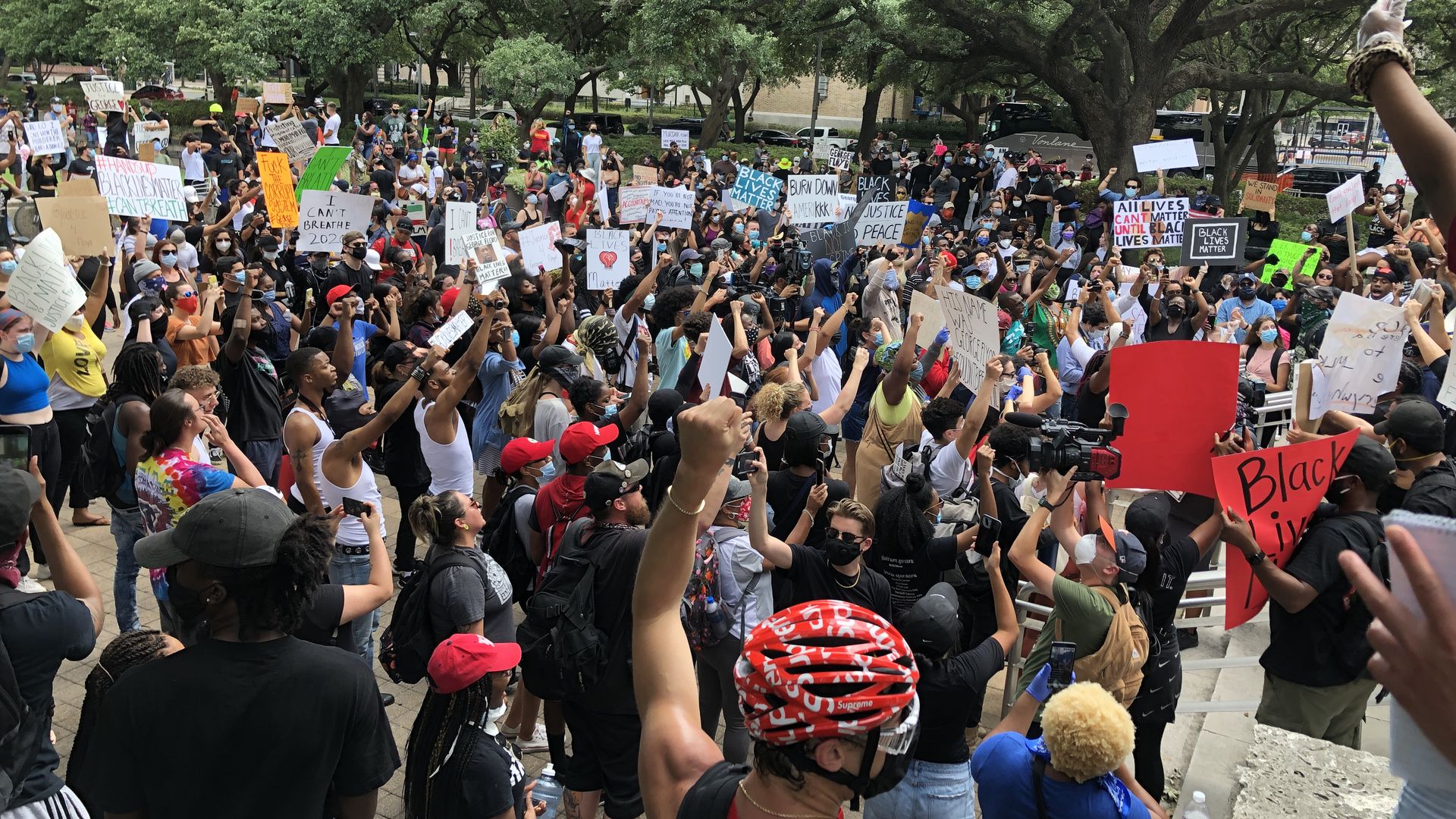
A Black Lives Matter Houston protest in 2020. Photo: Karen Warren/Houston Chronicle via Getty Images
A vast majority of Americans say in a new Pew Research Center survey that the increased focus on racial inequality after George Floyd's killing didn't lead to changes that improved the lives of Black Americans.
Why it matters: Floyd's 2020 murder by Minneapolis officer Derek Chauvin kneeling on his neck sparked international protests and calls to tackle systemic racism, but five years later, that momentum appears all but gone.
Zoom in: Protesters gathered across the state, including in San Antonio, to call for an end to police brutality and, in some cases, demanded local police departments be abolished.
- In August 2020, spurred on by the summer protests, the San Antonio City Council passed a resolution that declared racism a public health crisis.
- It called for reviewing city policies with the aim of eliminating implicit and explicit racial bias; organizing health data by race, ethnicity and income; and working to lessen segregation caused by housing and job loss, among other measures.
Plus: The San Antonio Police Department clarified its policies in 2020 to explicitly say officers could not use chokeholds or no-knock warrants (the warrant used by the officers who shot and killed Louisville resident Breonna Taylor in her home in 2020).
- Last year, the city created an office to examine how programs and policies outside the police department impact crime, a move aimed at expanding its public safety approach beyond traditional police work.
Yes, but: In 2021, San Antonio voters narrowly turned down a charter amendment that would have stripped the police union of its right to collectively bargain with the city, amid national criticism of the unions for holding back police reform measures.
- Still, local advocates said they were encouraged that the vote was close — 51%-49%.
Zoom out: Last year, Gov. Greg Abbott pardoned Daniel Perry, who was convicted of killing Black Lives Matter (BLM) protester Garrett Foster in Austin in 2020.
The big picture: The BLM movement persuaded companies to commit to diversity, equity and inclusion (DEI) initiatives, but President Trump's anti-DEI executive orders have now forced many corporations to abandon those promises.
By the numbers: Five years later, 72% of Americans say the increased focus on racial inequality didn't lead to significant changes that helped Black people, per the Pew survey.
- Now 52% of Americans express support for the BLM movement, a 15 percentage point drop from June 2020.
- In addition, 49% doubt that Black Americans will ever have equal rights with white Americans, up from 39% in 2020.
What they're saying: Sunny Slaughter, a law enforcement expert and CourtTV legal analyst, says she understands why so many Americans feel like the racial reckoning didn't lead to lasting change.
- "People feel exhausted. The momentum of 2020 doesn't look the same — and I get that."
- "We've gone from reform to reframing — and now, to recalibration," Slaughter said. "We're not where we hoped we'd be. But we're not where we were either."