Manufacturing jobs are making a comeback in Texas


Add Axios as your preferred source to
see more of our stories on Google.
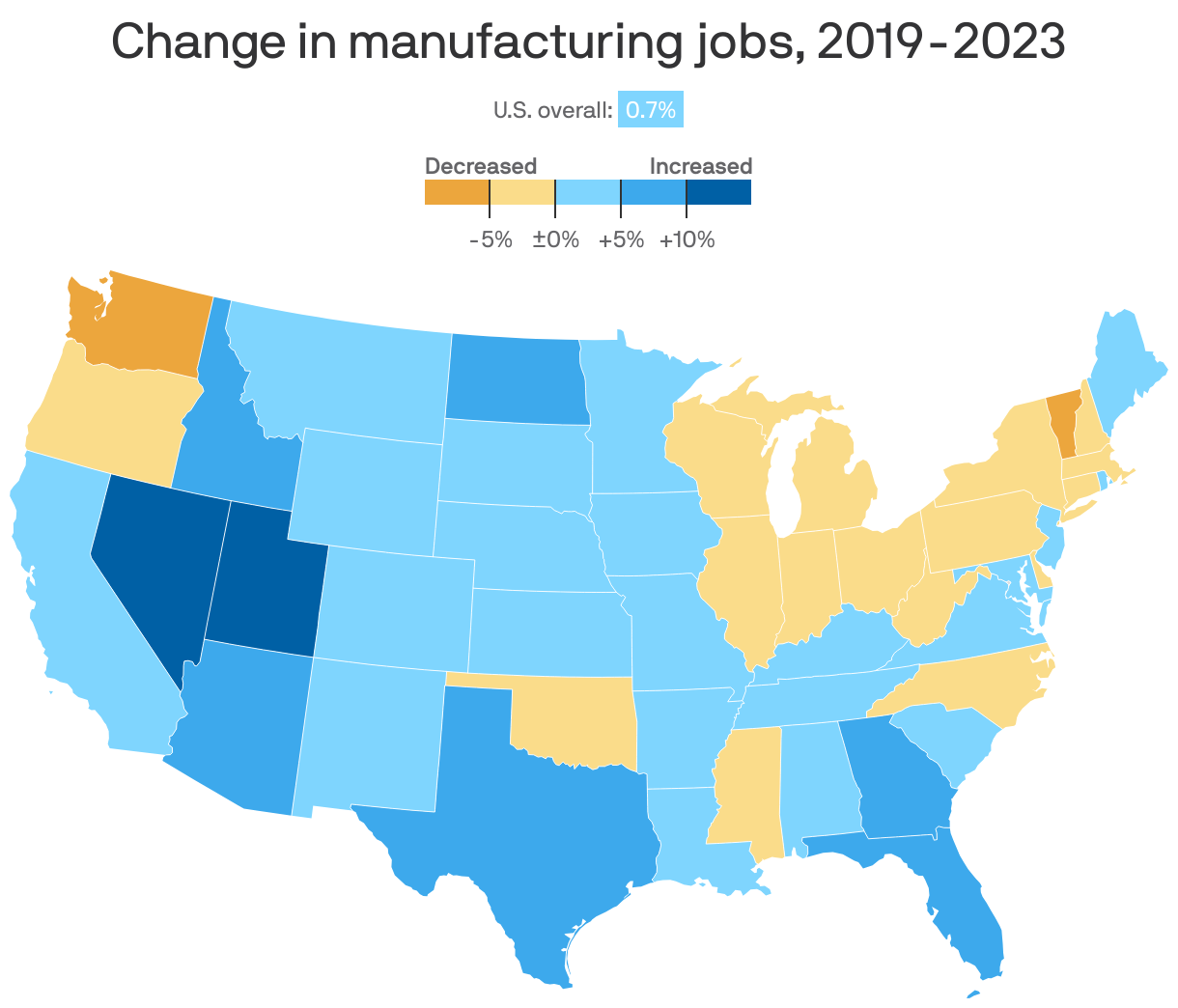
Manufacturing jobs are so back: Employment nationwide is now slightly above pre-pandemic levels, and Texas is leading the way.
Why it matters: It's the first time since the 1970s that the manufacturing industry has recovered all the jobs lost during a recession, per an analysis of government data out this month from the Economic Innovation Group, a centrist think tank.
By the numbers: The number of Texas manufacturing jobs grew from 906,000 in 2019 to 955,000 in 2023, representing 5.5% growth.
- That's one of the highest growth rates over the four-year period.
Zoom in: There are more than 1,600 manufacturers in San Antonio that employ more than 61,000 people, per greater:SATX, the region's economic development nonprofit.
- That contributes to a $13.5 billion GDP regionally, according to the organization.
What they're saying: "San Antonio's advanced manufacturing sector is a key engine of our region's economic growth, fueling our expanding bi-national megaregion and manufacturing corridor," Jenna Saucedo-Herrera, CEO of greater:SATX, said in a statement this month.
- Local manufacturing industries include automotive, aerospace and food and beverage, she said.
Where it stands: The recovery nationwide has been uneven and fairly concentrated.
- Just five states accounted for two-thirds of the sector's job growth: Texas, Florida, Georgia, Arizona and Utah.
Zoom out: Though manufacturing grabs a lot of attention politically, it's not a big piece of the overall job market anymore.
- In 1970, manufacturing jobs made up 31% of private employment. In 2023, that share was down to 9.7%, notes EIG.
What's next: Toyota, which has been in San Antonio for about two decades, announced this year it would expand locally with a $531 million production facility expected to bring more than 400 new jobs.
- British equipment maker JCB broke ground in June on a $500 million manufacturing plant on the city's South Side.
- It's expected to create 1,500 new jobs over five years and start production in 2026.