Why some San Antonio school districts are shrinking while others grow

Add Axios as your preferred source to
see more of our stories on Google.
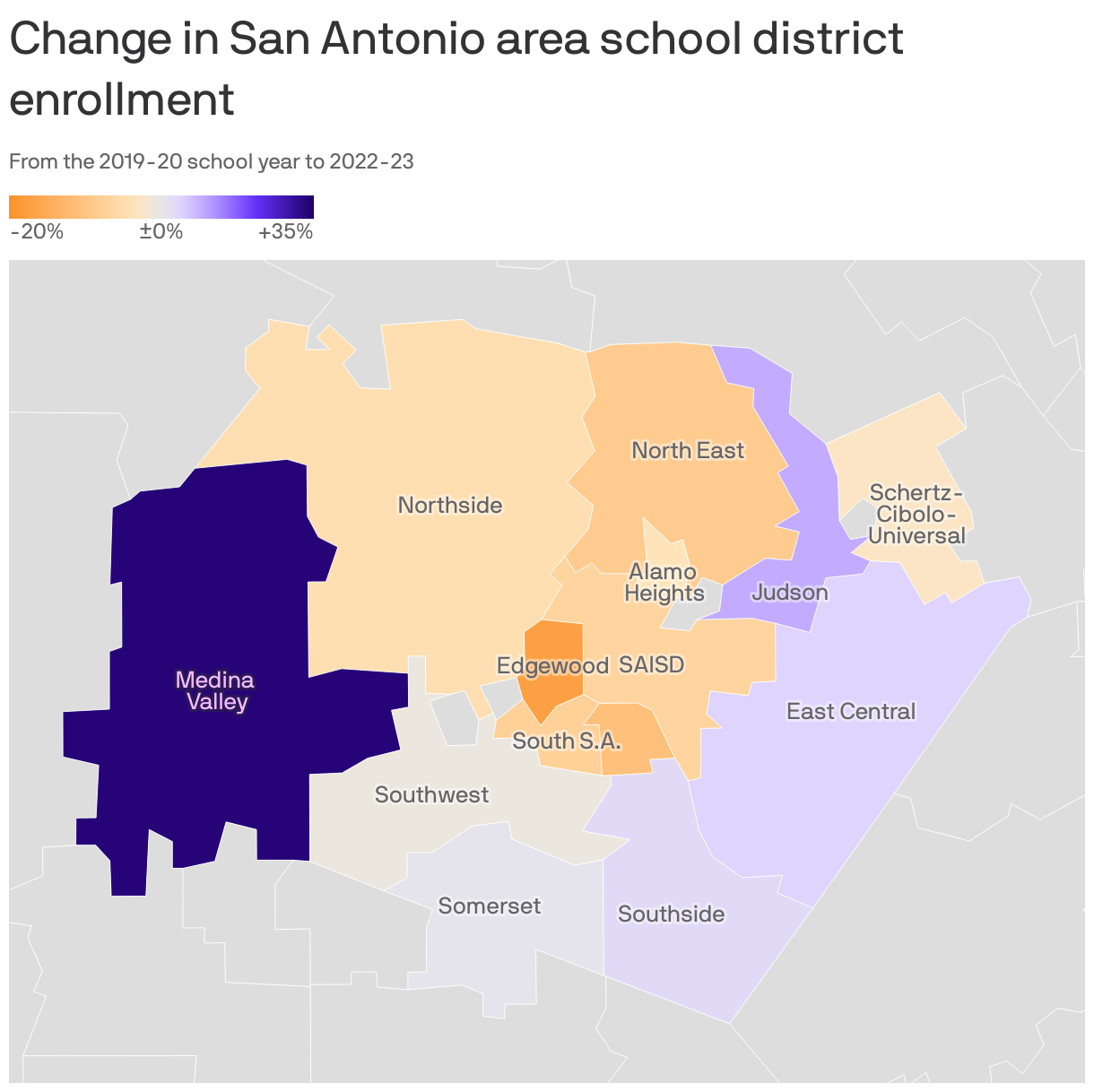
As the school year begins for some San Antonio students Tuesday, many will start in new buildings — some because their prior campus has closed, others because they have a newly built one.
Why it matters: Despite its status as one of the fastest-growing cities in the country, many urban San Antonio districts struggle to retain their student bodies as birth rates fall and housing development continues to explode in suburban areas.
- The region's fractured school district system, with more than a dozen districts in the area, contributes to vastly different challenges dependent on location.
State of play: In Medina Valley ISD, west of the city, classrooms are bursting at the seams. Voters there have approved bond money to build new schools. The new Silos Elementary opens to students Tuesday.
- About 25 miles away on the city's near West Side, Edgewood ISD has more classrooms than it needs. Its school board voted to close two schools at the end of the last academic year.
What they're saying: Areas with new housing developments are where school districts are seeing enrollment growth, Texas state demographer and UTSA demography professor Lloyd Potter tells Axios.
- Falling birth rates, especially among the Hispanic population, are hurting enrollment in more urban areas that aren't seeing a surge in new housing, he says.
- "If Bexar County had one school district, you'd probably see it overall growing," Potter says.
By the numbers: Enrollment at Edgewood ISD fell from 9,887 in the 2019-20 school year to 8,177 in the 2022-23 year — a more than 17% drop — per the most recent data from the Texas Education Agency. That's the largest decrease among San Antonio area districts.
- In the same timeframe, enrollment at Medina Valley ISD grew more than 33% — from 5,868 students to 7,823, the largest increase in the area.
- Northside ISD, the largest in the San Antonio area, saw its enrollment fall nearly 5% in those years. San Antonio ISD's fell nearly 7% as it closed campuses.
- Judson (9%), East Central (5%), Southside (3%) and Somerset (1%) ISDs are all growing. East Central ISD opened a new elementary school this year.
Between the lines: Edgewood ISD's enrollment has also taken a hit as the number of charter schools in the area rises, Myrna Martinez, the district's assistant superintendent of business operations, tells Axios.
- The public district has tried to compete by offering Innovation Zones to personalize education in areas like fine arts, public service, dual language and more.
- It has also had to up its investment in marketing.
- "Words like marketing weren't part of our vocabulary" before, Martinez says. "It's definitely put us on our toes."
The intrigue: As Medina Valley ISD grows, the district wants to expand its dual language program, superintendent Scott Caloss tells Axios.
- "We know that this is an area that is going to continue to grow, and we want to make sure that we are providing those kids with the best education possible," Caloss says.
What's next: Medina Valley ISD expects to enroll more than 13,200 students by the 2028-29 school year, and more than 18,700 by 2033-34, per its demography report. It's currently building a new high school.
- Edgewood ISD anticipates losing 175 to 275 students every year for the next five years, Martinez says.
The bottom line: Both districts are figuring out how to face their own challenges.