Education Brief
Virginia's future college student pool is shrinking


Add Axios as your preferred source to
see more of our stories on Google.
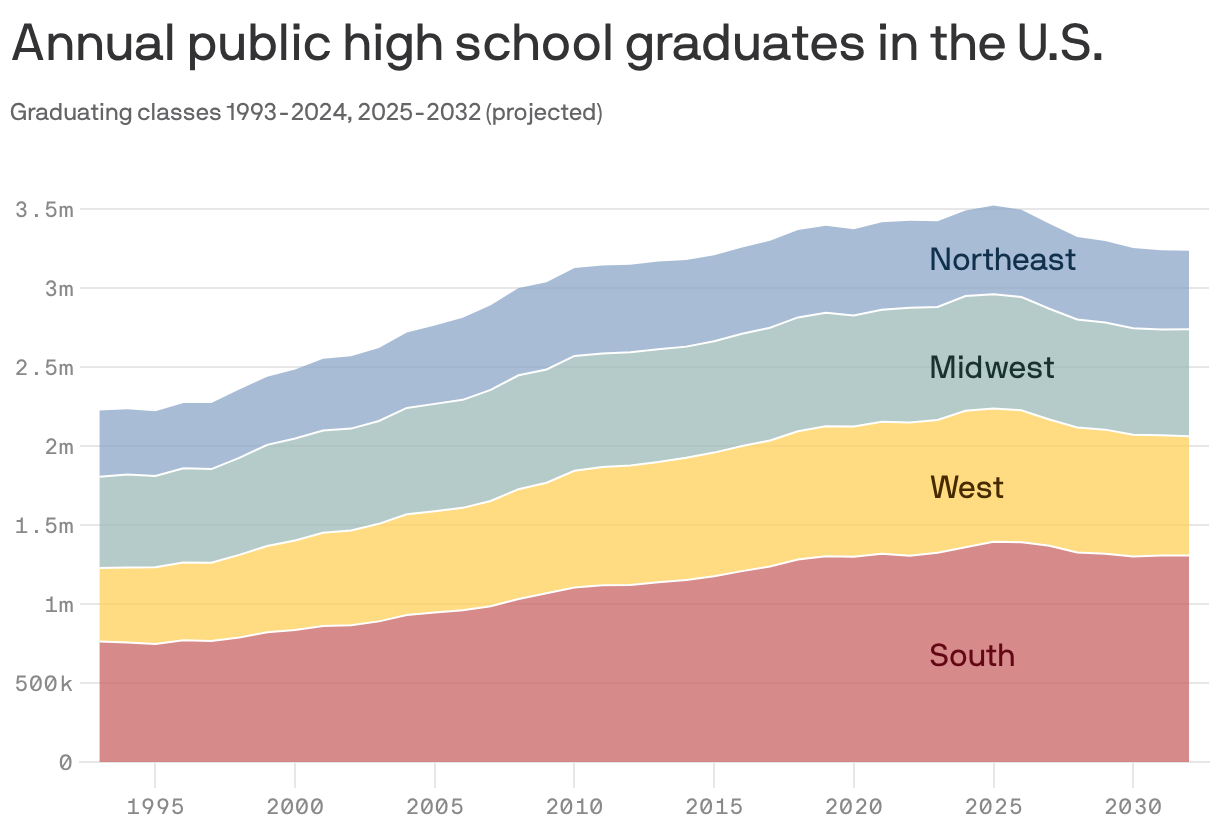
America's future college pipeline is growing in the South, but Virginia is bucking the trend.
Why it matters: Colleges in shrinking markets will face a fierce fight for students, while those in growing regions will have to adapt to serve an expanding, more diverse student body.
- The nation's student pipeline is also becoming less white, more Latino, more first-generation and more cost-conscious.
By the numbers: The number of U.S. high school graduates is projected to peak in 2025 and then fall 13% by 2041, per the Western Interstate Commission for Higher Education (WICHE).
- The decline is especially steep in major college markets: California is projected to lose 29% of its high school graduates, New York 27% and Pennsylvania 17%.
- The South is projected to grow 3%.
Zoom in: Virginia, however, is projected to lose 6% of its high school graduates over that same period.
- In its most recent enrollment projections, state higher-ed officials noted that Virginia's high school graduate count is projected to decline through 2033, tick back up in 2034, then continue falling.
What they're saying: "The schools in the South do tend to have sort of healthier enrollment trends right now," Andrew Gillen, a Cato Institute research fellow, told Axios.
- But regional universities are far more exposed to what happens nearby: "You're really concerned about the local demographic," Gillen said.
Between the lines: Brand-name schools can recruit nationally. Regional universities and less-selective private colleges are much more dependent on the shrinking pool of students around them.
What we're watching: Colleges in declining markets may cut jobs, humanities programs and low-enrollment majors to stay afloat.