VMFA makes historic restitution of enslaved artist's work

Add Axios as your preferred source to
see more of our stories on Google.
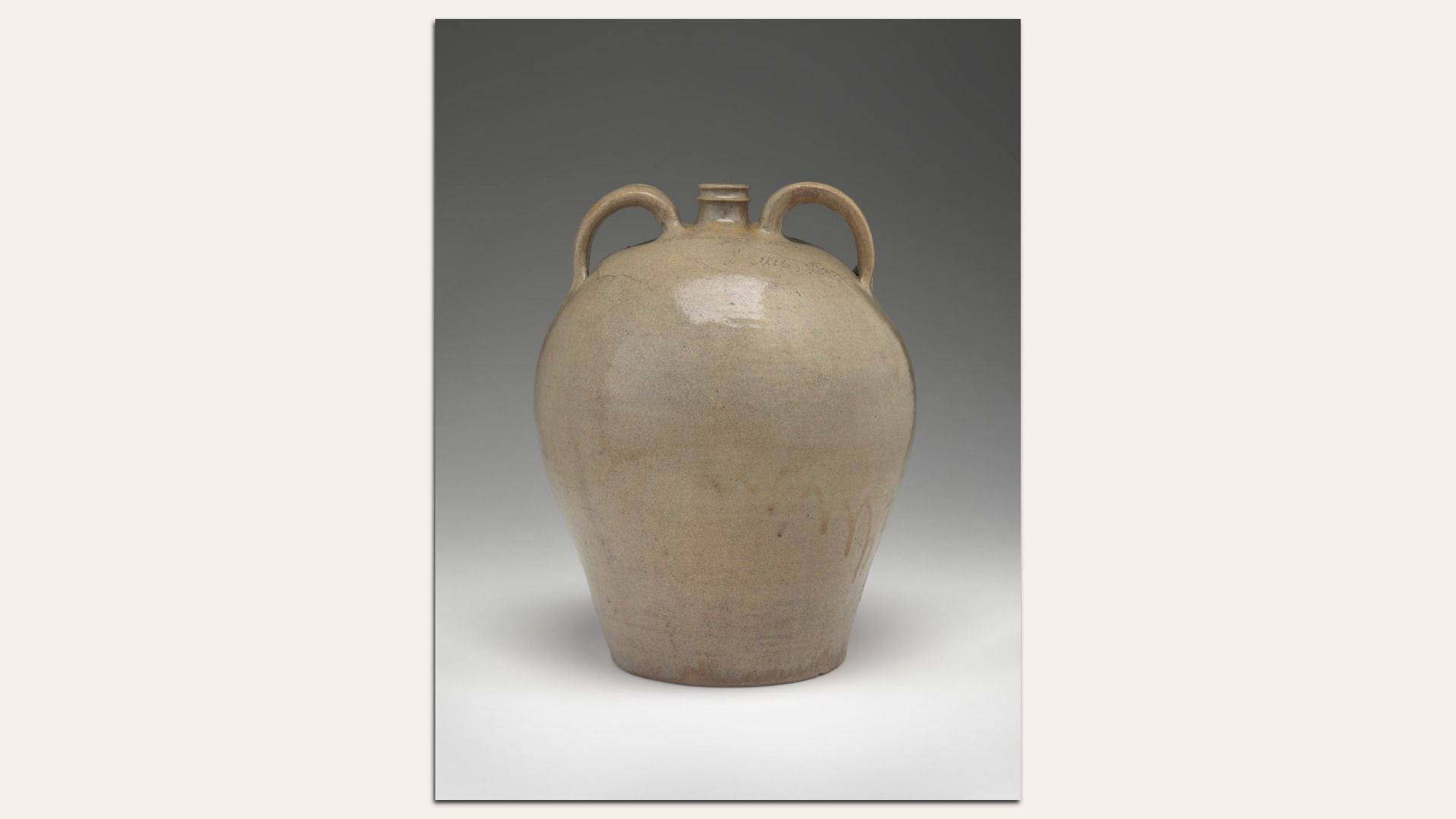
Double-handled Jug, 1840, David Drake (American, ca. 1800-ca. 1870), stoneware with alkaline glaze. Image: Courtesy of VMFA
The Virginia Museum of Fine Arts restored ownership of a stoneware jug in its collection to the descendants of the enslaved artist who created it nearly 200 years ago, the museum announced this week.
Why it matters: David Drake couldn't own or profit from the pottery he created while enslaved. Nearly two centuries later, VMFA is recognizing his descendants as the jug's rightful owners — and paying them to reacquire it.
- It's the first time in VMFA's history that it has recognized the descendants of an enslaved person as the rightful owners of a work.
- It's also one of only a handful of times that any American museum has done so.
State of play: The piece in question is a double-handled stoneware jug created by potter David Drake in 1840 at the South Carolina pottery operation of Lewis J. Miles, who enslaved him.
- The jug passed through multiple collectors in the Deep South before VMFA acquired it in September 2017, per the museum.
- Earlier this year, Drake's descendants — who have been working for years to restore rightful ownership of his works — contacted VMFA about ownership of the jug.
- VMFA agreed to recognize the family's ownership and then repurchased the jug from Drake's descendants in "recognition of Drake's remarkable artistic achievements and honor his dignity and memory," VMFA director and CEO Alex Nyerges said in a statement.
- The purchase was made using the museum's privately funded endowment. VMFA declined to share the purchase price.
Zoom in: Such jugs were common in the Deep South because of their storage capacity, but Drake's work stands out in part because the "perfect symmetry" of the handles shows the artist's "immense skills as a ceramicist," per VMFA.
- This specific jug is also notable because it's his first known vessel signed and inscribed with a poem.
- Drake inscribed his verse — "Ladys & gentlemens Shoes = / sell all you can: & nothing you'll loose." — on Jan. 29, 1840, six years after South Carolina outlawed teaching enslaved people to read or write.
- The two-handled jug at VMFA is one of just 40 known "poem vessels" created by Drake and was likely inspired by the nearby tannery also owned by his enslaver.
Scholars have described Drake's inscribed poetry and signatures as a form of resistance and an extraordinary assertion of authorship by a man whose freedom, labor and legal identity were controlled by others, per Smithsonian magazine.
The intrigue: Drake continued making pottery after emancipation, but no known vessels from his years as a free man bear the signatures, dates or poetry that distinguish his enslaved-era work. Scholars don't know why.
Zoom out: VMFA joins a small but growing group of museums restoring ownership of Drake's work to his descendants, following similar agreements involving museums in Boston, Georgia and Milwaukee over the past year.
What they're saying: "For our family, this agreement goes far beyond ownership of this vessel. It honors David Drake as our ancestor, whose voice, skill and creativity have endured for more than 175 years," Drake's fourth-great-grandson, Yaba Baker, said in a statement.
If you go: Drake's "Double-handled Jug" is on display in VMFA's American Art Galleries.