Richmond's Amtrak trains are fuller — and slower

Add Axios as your preferred source to
see more of our stories on Google.
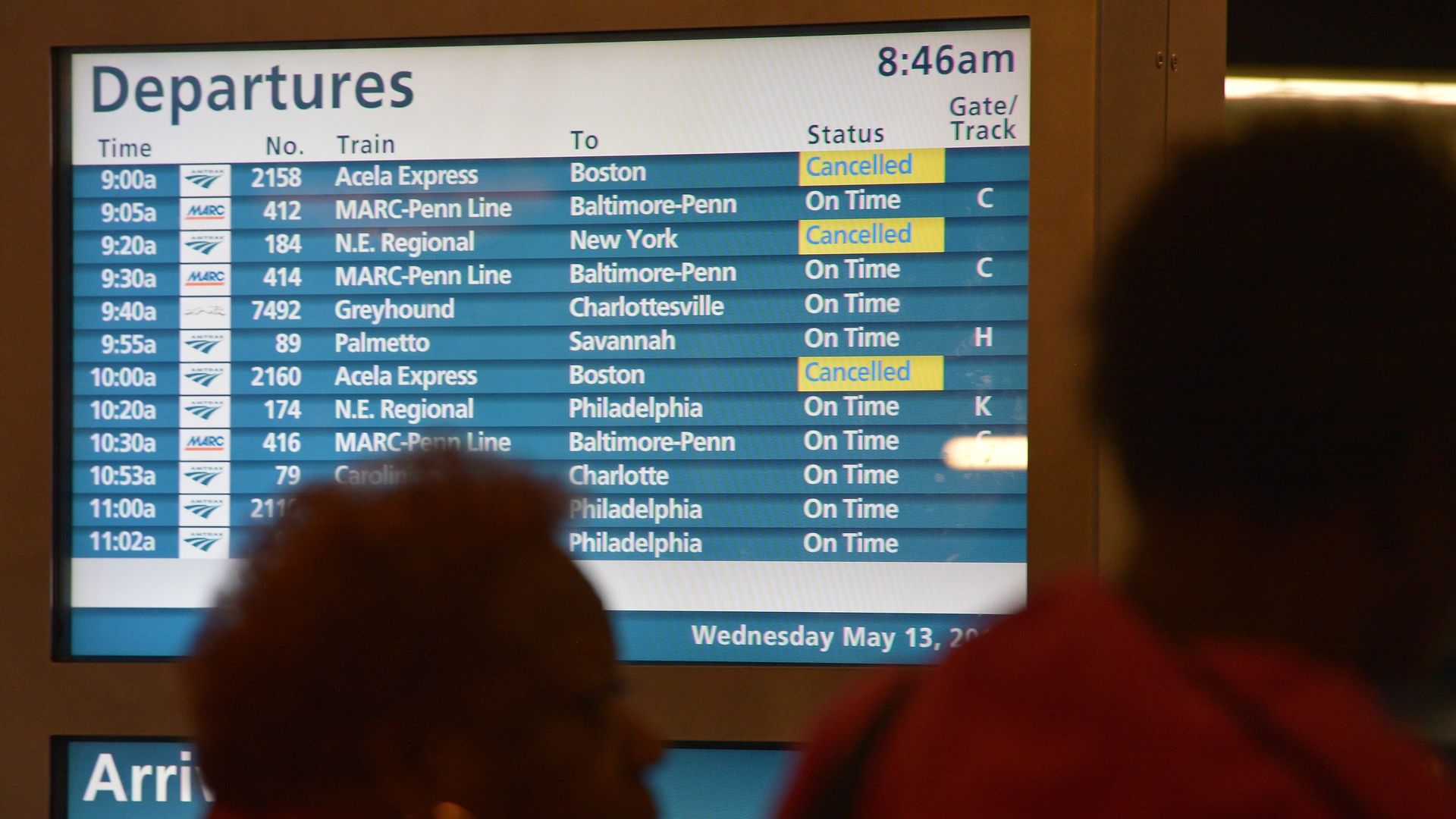
According to the latest stats, the Richmond airport has a better on-time rate than trains in Virginia. Photo: Mandel Ngan/AFP via Getty Images
While more people than ever are hopping aboard an Amtrak train in Virginia, train delays in the state seem to be getting worse.
Why it matters: The on-time performance (OTP) rate for trains along the Northeast Regional line in Virginia — the line that runs through Richmond — is down 10% from fiscal year 2019, according to an Axios review of rail stats.
The big picture: Like many travel sectors, Amtrak has been experiencing a post-pandemic surge in ridership.
- Last year, the rail company set an all-time ridership record nationwide with 32.8 million passengers hopping aboard a train in the last fiscal year.
- But its OTP has been ticking down overall, dropping from 80% in 2020 to 74% in 2022 and 2023, according to the most recent stats from the Bureau of Transportation Statistics.
Zoom in: The Richmond corridor's OTP has been closer to 70% in recent years, slightly higher than the 69% for the whole Northeast Regional line, per Virginia Passenger Rail Authority data.
- That OTP comes as the Virginia Amtrak routes just set another all-time ridership record, this time for April.
By the numbers: Thus far this year, Richmond's OTP is 65.4%, lower than the 71.9% for all Virginia Amtrak routes.
- In 2024, Richmond's OTP was 71% vs. 72.3% on all Virginia routes.
- In 2023, Richmond's OTP was 75.6%. The state's: 74.3%.
✈️ For comparison, the Richmond airport's on-time rate for departures is at 79% thus far this year, per the latest Bureau of Transportation Statistics data.
- It was 80% or higher for the previous five years.
The fine print: The Richmond corridor includes all trains between D.C. and Richmond, Karina Romero with VPRA tells Axios.
- VPRA tracks OTP by the calendar year, while Amtrak does it by fiscal year.
- And according to both, OTP represents the percentage of stations where a train arrives within 15 minutes of its scheduled arrival time, Romero says.
Between the lines: There are multiple reasons trains end up running late, including accommodating more riders, but the most common in Virginia tends to be heat restrictions, Romero says.
- That's because hot weather and the rail's steel lines do not mix well.
- Other issues that can delay trains include winter weather and, critically, interference from freight trains, which share tracks with Amtrak. In Virginia, two big freight lines, CSX and Norfolk Southern, also happen to own most of the tracks, too.
- Plus, there can be a domino effect. If a train is delayed heading south out of D.C., which is often where the Virginia bottleneck starts, it'll be delayed the rest of the way through Richmond.
Yes, but: There's hope to speed up those trains.
- VPRA is working on a series of yearslong capital projects to upgrade rail lines in Virginia, including separating passenger and freight lines.
- "By separating the two, we will improve the on-time performance of both," Romero says.
- That project should be done by 2030.