Report: Richmond's public parks are some of the best in the country


Add Axios as your preferred source to
see more of our stories on Google.
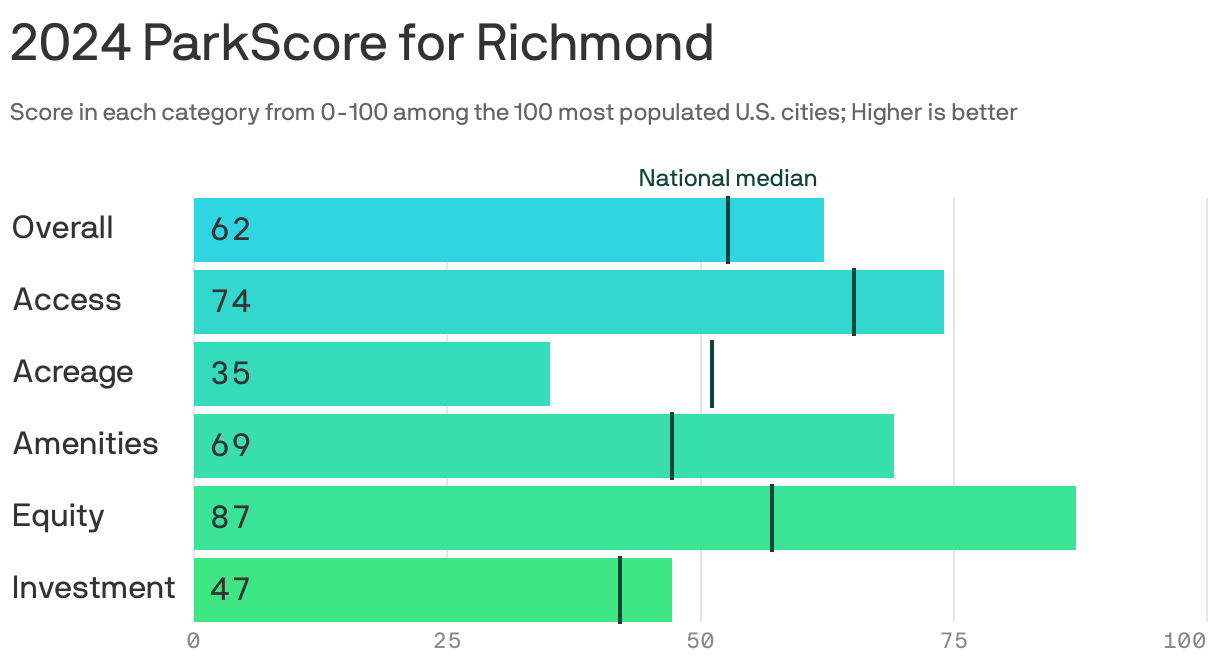
Richmond's public park system is the 22nd best in the country out of the 100 most populous cities, according to a new report by the pro-park nonprofit Trust for Public Land.
Why it matters: Residents in high-scoring cities are more socially connected with their neighbors, per the report, including those from other socioeconomic groups, with whom they might not otherwise commingle.
- Plus, Richmond's ranking is way up from its No. 39 place last year.
How it works: The Trust for Public Land (TPL) annually scores major cities' park systems based on access, acreage, amenities, equity and investment.
- Each city is awarded a certain number of points based on those factors, and is then given an overall "ParkScore" of up to 100.
- See more about the methodology here.
What they found: Richmond scored best for equity with 87 out of 100 points
- Low-income residents in Richmond are more likely (83%) to be 10 minutes from a park than high-income ones (82%).
- Residents in city neighborhoods with the highest concentration of people of color have access to 223% more total park space than those in areas with the highest concentration of white residents.
Zoom in: Richmond scored 74 out of 100 for access, 35 for acreage, 47 for investment, 69 for amenities.
- Richmond's saw the biggest improvement over its 2023 score in amenities and investment.
- In amenities, Richmond parks got perfect scores for its number of bathrooms and rec centers and nearly perfect (95 out of 100) for the number of basketball hoops.
- On investments, Richmond spends $135 per capita on parks, more than the $124 average among the 100 most populous U.S. cities and way up for the $99 per capita it spent last year.
Zoom out: Washington, D.C. — where 99% of residents live within a 10-minute walk from a park — was given only 55 points out of 100 for acreage, but scored well enough in the other categories to take top honors.
- Coming in last place was Port St. Lucie, Florida, which suffers from relatively poor park access, amenities and investment.
- "What we're seeing this year is that the budgeting is moving in a positive direction nationally in almost every city," TPL senior vice president Howard Frumkin tells Axios.
The bottom line: Support for public parks is that rare issue that cuts across ideological lines as we barrel toward a "polarized election," Frumkin says.