Where people with felony convictions can vote in the U.S.

Add Axios as your preferred source to
see more of our stories on Google.
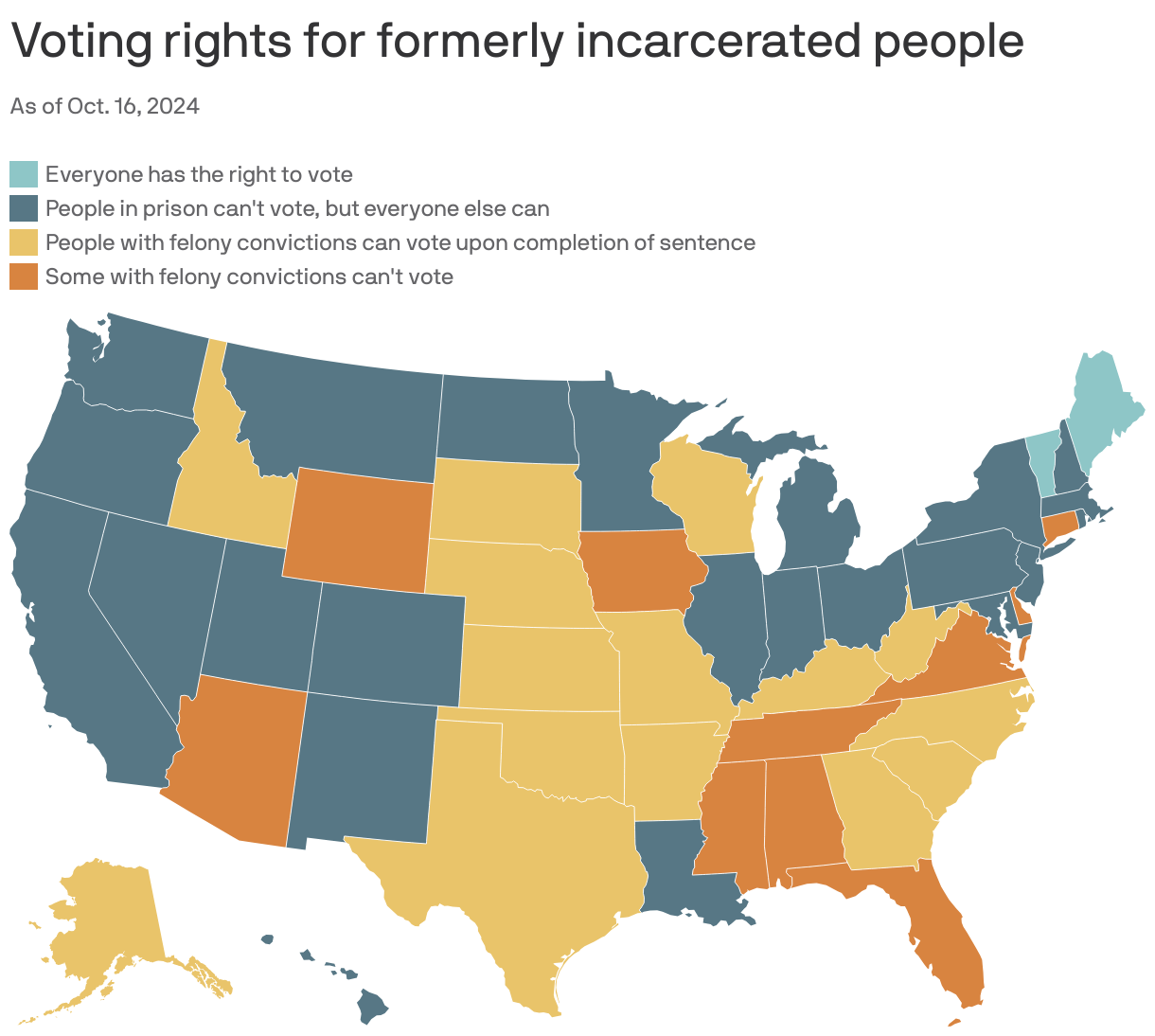
Virginia is one of 10 states that don't allow some people with felony convictions to vote.
Why it matters: Following former President Trump's guilty verdict, Google search traffic skyrocketed for "can convicted felons vote?" So we're here with answers.
The big picture: In Virginia, anyone convicted of a felony immediately loses their right to vote, serve on a jury or run for office.
- They can only gain those rights back if they're no longer incarcerated and apply to have their rights restored.
- But that's still up to the discretion of the governor.
Between the lines: Virginia is the only state that bars the restoration of voting rights to anyone with a felony conviction without the governor's intervention.
- Some states, like Florida, Alabama and Delaware, only require an application to the governor for certain violent felony charges like murder.
- In 39 states, people with felony convictions can vote upon completing their sentence.
- In D.C., Vermont and Maine, a person never loses their right to vote.
State of play: Last year, Gov. Youngkin ended a program spearheaded by former Republican Gov. Bob McDonnell in 2013 that automatically restored those voting rights for Virginians with nonviolent felonies.
- This reinstated the application requirement.
- The number of Virginians with felony convictions who got their voting rights restored dropped for the second year, reported the Times-Dispatch.
What's next: A proposal to start the constitutional amendment process to automatically restore those voting rights, which Virginia Republicans have blocked from moving forward in recent years, was pushed to next year's session.