Home value disparities are displacing residents of Richmond's Black neighborhoods

Add Axios as your preferred source to
see more of our stories on Google.
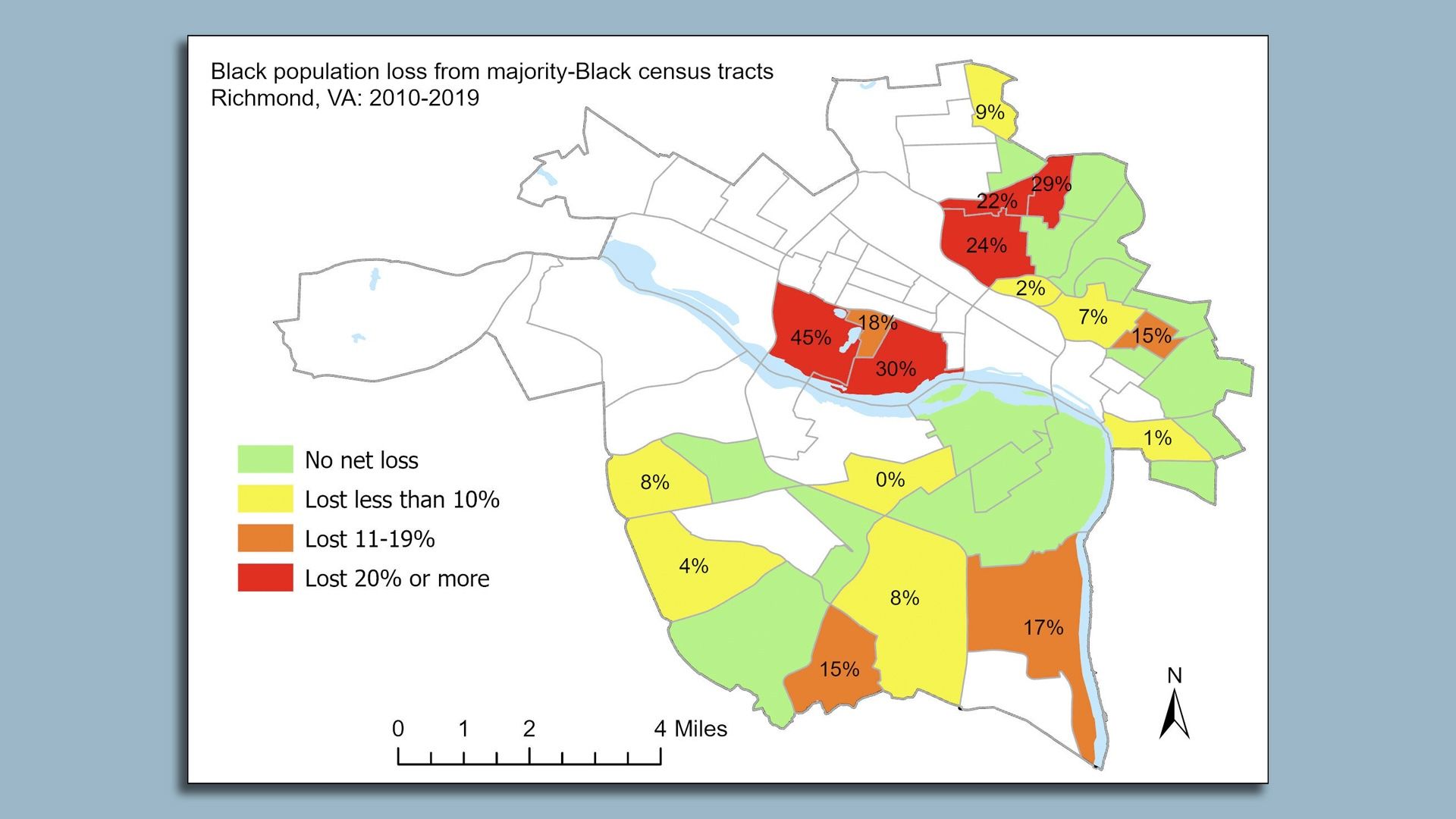
HOME found major losses of Black residents in neighborhoods including City Stadium, Carillon, Byrd Park, Maymont, Randolph, Brookland Park, Ginter Park Terrace and Northern Barton Heights. Image: Courtesy of HOME of VA
Some Richmond neighborhoods lost between 18% and 45% of their Black residents in the last decade due to rising housing costs and gentrification, according to a new report out Thursday.
Why it matters: Decades of racist homelending policies and present-day bias in home appraisal have undervalued many Black Richmonders' homes. That's now pushing some longterm residents out of their communities.
The big picture: The report studying disparities in home value is from Richmond-based nonprofit Housing Opportunities Made Equal of Virginia, which used metro-area research from the Brookings Institute, city tax assessment data and American Community Survey demographics census stats.
- Sixth District city councilwoman Ellen Robertson commissioned the report and HOME, along with Virginia Community Voice, also interviewed 50 Richmond homeowners in majority-Black neighborhoods to get their take.
What they found: Richmond home values are overwhelmingly racially biased. Houses in neighborhoods with 30% or more Black residents are worth 17% less on average than those in neighborhoods where Black residents are 30% or less.
- In fact, HOME's research showed that the racial composition of a neighborhood in Richmond is a better predictor of a home's value than the size, condition or style of the house. That was true even when factoring for neighborhood amenities, like sidewalks and access to restaurants and transit.
Threat level: The undervaluing of homes directly contributes to their owners being at risk for displacement, per the report.
- That's because the owners have less equity that can tap for needed home repairs and maintenance.
- These homeowners are more vulnerable to significant market swings and less able to keep up with real estate tax increases driven by them, which has characterized the local real estate market for the past five years.
- And these are exactly the homes, neighborhoods and homeowners that aggressive house flippers and institutional investors target with lowball offers that border on "harassment," according to one local interviewed.
Zoom in: HOME found nearly a dozen majority-Black Richmond neighborhoods saw significant losses of Black residents between 2010 and 2019.
- Those include parts of City Stadium and Maymont, which saw a 45% decline in Black residents for that census tract, HOME director of research Bryan Moorefield tells Axios.
- Parts of Randolph and Northern Barton Heights lost around 30% of Black residents.
Worth noting: The displacement study did not include population changes since 2020, when many neighborhoods saw "substantial increases" in residents' displacement risk.
- The study indicates longtime residents are at risk for potential displacement in multiple neighborhoods, including parts of the Northside, East End, South Richmond, more of Randolph, Manchester and Swansboro.
Context: Redlining and historic housing discrimination contribute to the 21st century undervaluing, as does persistent issues with racial bias in home appraisals, the report found.
- Since home appraisers tend to be overwhelmingly white (89% of all appraisers, per the report) and appraisals are subjective estimates, some pros may bring bias, possibly even unconsciously, to the process.
- Plus, when looking for comparable homes as part of the appraisal, research has shown appraisers "frequently" overlook similar homes in neighborhoods with different racial demographics and instead choose less similar home comps in neighborhoods with matching racial makeup.
- That equates to the average Richmond home in neighborhood where people of color are 30% or more of residents appraising at $256,310 versus $436,168 as the average appraised value of a home in a primary white neighborhood, per the report.
What we're watching: The report recommended policies the state and city could adopt to ensure longtime residents can stay in their communities, including the city tracking neighborhoods' displacement risk and state legislators offering more options for real estate tax relief.