Richmond's growing AI job landscape


Add Axios as your preferred source to
see more of our stories on Google.
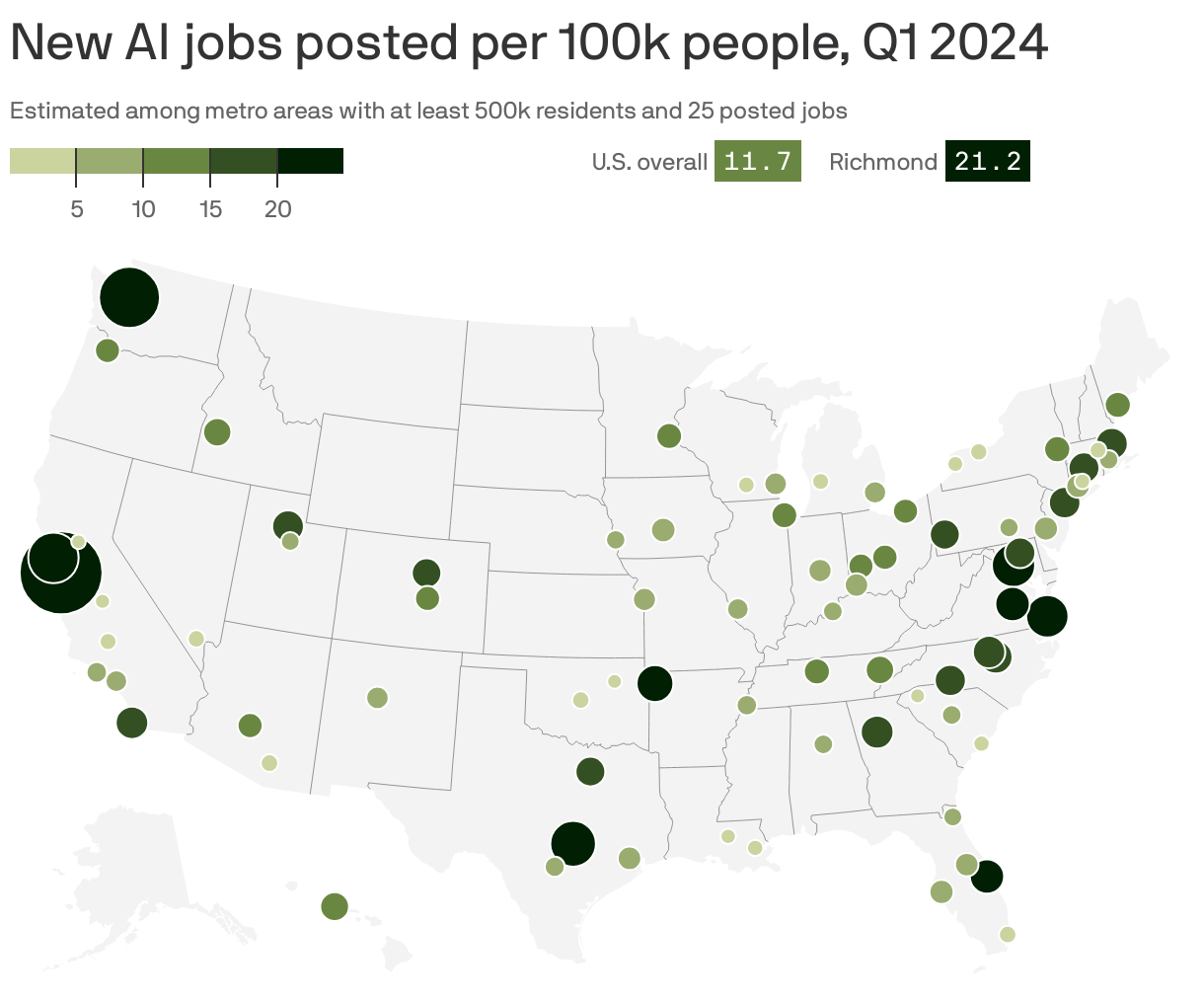
Richmond is one of the country's AI job hotspots, according to a new analysis by UMD-LinkUp.
Why it matters: As AI emerges as the hottest new thing in tech, cities outside Silicon Valley have a chance to get in on the action — and reap the potentially lucrative economic rewards.
Zoom in: San Jose (142.4 new AI jobs listed per 100,000 residents), Seattle (74.4) and San Francisco (49.3) led the way in the first quarter of 2024 among cities with at least 500,000 residents and 25 newly posted jobs.
- In those cities, AI jobs accounted for about 7.5%, 4% and 3.2% of all new Q1 job listings, respectively.
- For comparison, there were 11.7 AI-related jobs posted for every 100,000 residents nationally in Q1.
Yes, but: Richmond ranks in the top 10 cities for new AI jobs in the first quarter of of this year, with 21.5 new AI jobs listed per 100,000 residents or 279 total AI jobs for the first-quarter of this year.
- Last year, Richmond saw 634 new AI jobs — way up from the 169 for all 2018, back when AI was still the stuff of sci-fi flicks for most people.
- Austin (39.9), Washington, D.C. (35.3) and Northwest Arkansas (24.7) also had strong showings, as did Raleigh (19.7) and Atlanta (19).
Some recent local job postings for AI positions include a Principal Engineer, Artificial Intelligence at CarMax and an AI/Automation Accounting Consultant at Deloitte.
How it works: The estimates come by way of UMD-LinkUp, a collaboration between the University of Maryland, job listings platform LinkUp and consultancy/executive firm Outrigger Group.
- The researchers are using AI language models to sift through LinkUp job listings for AI jobs, defined as those that require technical skills to either create or use AI models.
- Their use of AI significantly enhances their accuracy compared to traditional keyword filtering, the researchers say.
Between the lines: The defense industry's urgent interest in AI is likely driving D.C.'s numbers, says Anil Gupta, a UMD professor who's co-leading the project.