School segregation in Virginia is increasing 70 years after Brown v. Board ruling

Add Axios as your preferred source to
see more of our stories on Google.
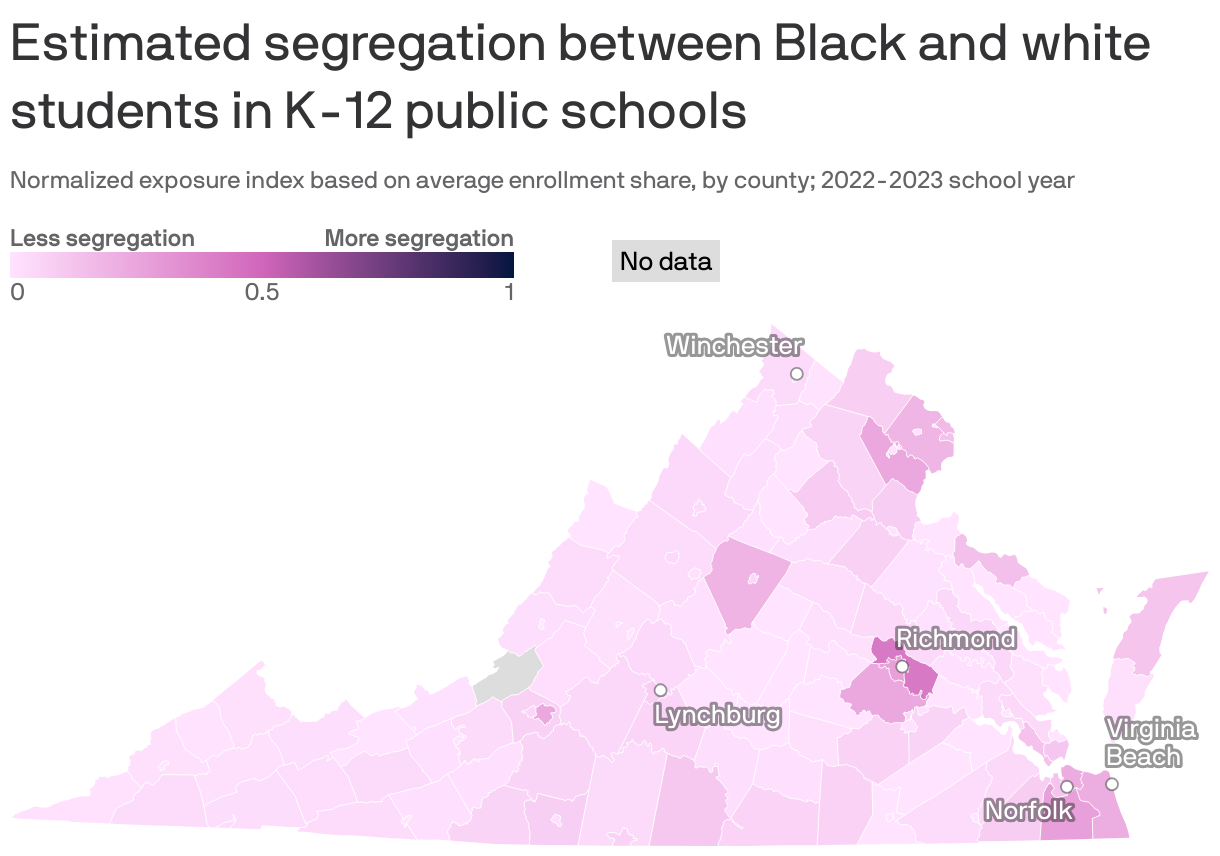
Racial segregation in Virginia's public schools has increased over the last three decades, according to an Axios review of federal data.
Why it matters: Segregated schools disproportionately hurt Black and Latino students because schools where they're the majority often have fewer resources, more teacher shortages, higher student-to-school counselor ratios and greater suspension rates — all of which impacts quality of education.
The big picture: Seventy years after the Brown v. Board of Education ruling, which declared racially divided schools as unconstitutional, Virginia's population is the most diverse it's ever been.
- But "our metropolitan communities were engineered deliberately to create segregation … and we continue to make decisions that aren't helping the situation," Genevieve Siegel-Hawley, an associate professor at VCU who researches school segregation, told Axios.
- That means the state continues to reel from decades of policies that further isolated Black and Latino students by race and poverty.
Some linger from the era of the Brown decision:
- 1930s housing policies that declared Black neighborhoods as "hazardous" and blocked Black families from buying homes.
- Massive Resistance, Virginia's 1956 policy to defy desegregation, which led to some schools not integrating until the early 1970s.
- White flight, when white families fled the cities for the suburbs to avoid integration.
- Limited federal oversight for school desegregation.
Others are more recent, and have exacerbated the divisions since the 1990s, Siegel-Hawley said:
- Explosion of school choice without civil rights protections.
- The growing affordable housing crisis limits the neighborhood options — and, as a result, schooling options — for non-wealthy families.
The impact is seen in the Richmond-area: the second-most segregated region in Virginia behind the DMV, per the Segregation Explorer from Stanford University looking at demographic changes between 1991 and 2022.
- Segregation has mostly worsened or remained the same in Richmond Public Schools since 1992, even as white and Black students account for a smaller percentage of the district.
Examples in RPS
Mary Munford Elementary:
- 1991: 37% white, 62% Black, 0.5% Hispanic, 63% nonwhite.
- 2022: 76% white, 9% Black, 6% Hispanic, 16% nonwhite.
Elizabeth Redd Elementary (five miles from Mary Munford in Southside):
- 1991: 10% white, 88% Black, 0.4% Hispanic, 90% nonwhite.
- 2022: 6% white, 57% Black, 34% Hispanic, 91% nonwhite.
In Henrico
Tuckahoe Elementary in the West End:
- 1991: 97% white, 1% Black, 0.1% Hispanic, 3% nonwhite.
- 2022: 90% white, 2% Black, 4% Hispanic, 7% nonwhite.
Laburnum Elementary in the East End:
- 1991: 3% white, 95% Black, 0% Hispanic, 97% nonwhite.
- 2022: 5% white, 84% Black, 7% Hispanic, 92% nonwhite.
In Chesterfield
Falling Creek Elementary
- 1991: 65% white, 24% Black, 1% Hispanic, 35% nonwhite.
- 2022: 6% white, 36% Black, 53% Hispanic, 92% nonwhite.
Gordon Elementary on the other side of Chesterfield
- 1991: 96% white, 3% Black, 0.1% Hispanic, 4% nonwhite.
- 2022: 76% white, 7% Black, 8% Hispanic, 19% nonwhite.
The bottom line: "A lot of people say desegregation didn't work," said Janel George, an associate professor at Georgetown Law focused on education inequality. "We didn't give it a chance to work."
Go deeper: School segregation surges 70 years after Brown v. Board ruling.