Virginia new moms are older compared to rest of U.S.


Add Axios as your preferred source to
see more of our stories on Google.
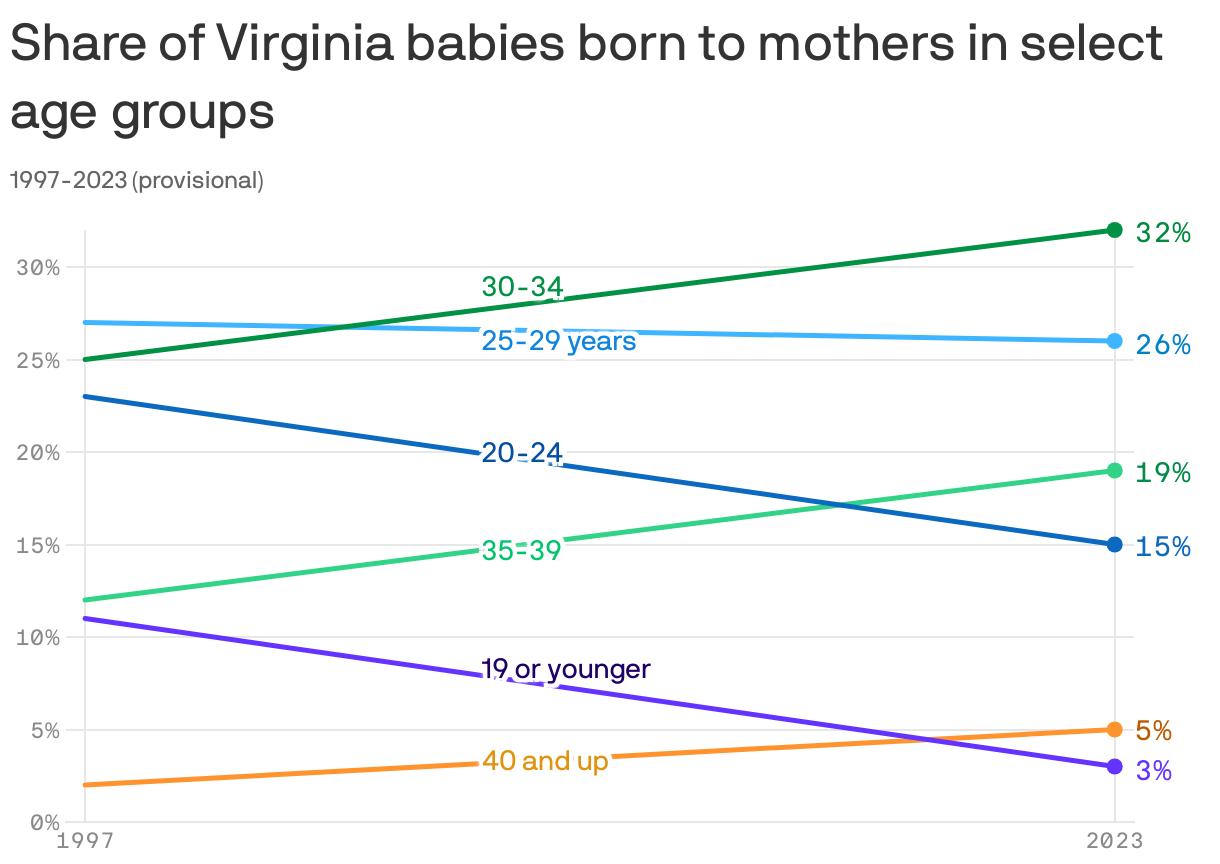
More than half of babies born in Virginia in 2023 had birth mothers in their 30s and older, according to provisional CDC data.
Why it matters: In the last few years, age 35 has gone from the start of "geriatric pregnancy" to potentially a maternal-age sweet spot.
By the numbers: Last year, 55% of babies born in Virginia were to moms 30 or older, compared to 39% in 1997.
- 23% were born to women 35 or older in 2023.
- Today, 30.8 is the average age of a woman giving birth in Virginia.
Fun fact: Teen births have also dropped sharply since 1997, when 11% of babies born in the state were to women 19 or under.
- Last year, it was 3%.
Zoom in: Northeast states, including Connecticut, Massachusetts and New Jersey, have some of the highest average maternal ages in the nation at age 31.
- Southern states, including Mississippi, West Virginia and Arkansas, have the lowest at 27.5.
The intrigue: 35-year-olds received more prenatal monitoring and had a small decrease in prenatal mortality compared to even those a few months younger, according to a 2021 JAMA Health Forum study.
- And some research suggests that being 35+ and pregnant could lead to better brainpower after menopause and a smaller gender wage gap.
Catch up quick: 35 became the start of "advanced maternal age" decades ago, thanks to studies on the then-new invasive genetic test called an amniocentesis.
- Researchers determined that for a pregnant person 35+, the chances of carrying a baby with a genetic condition were greater than the risk of pregnancy loss as a result of getting an amniocentesis to test for that condition, Tiffany Pham, OB-GYN and Flo Health medical adviser tells Axios.
But that's a "dated paradigm," and "there's nothing really particularly magic" about age 35, says Alison Cahill, professor and associate dean of translation research at the University of Texas at Austin's Dell Medical School.
Reality check: Risks, including of miscarriage, increase much more after age 40, compared to 35.
- Insensitive wording has long added to the stigma around later-in-life pregnancy — but there's been some progress when it comes to maternal health terminology.