Homelessness is on the rise in Virginia



Add Axios as your preferred source to
see more of our stories on Google.
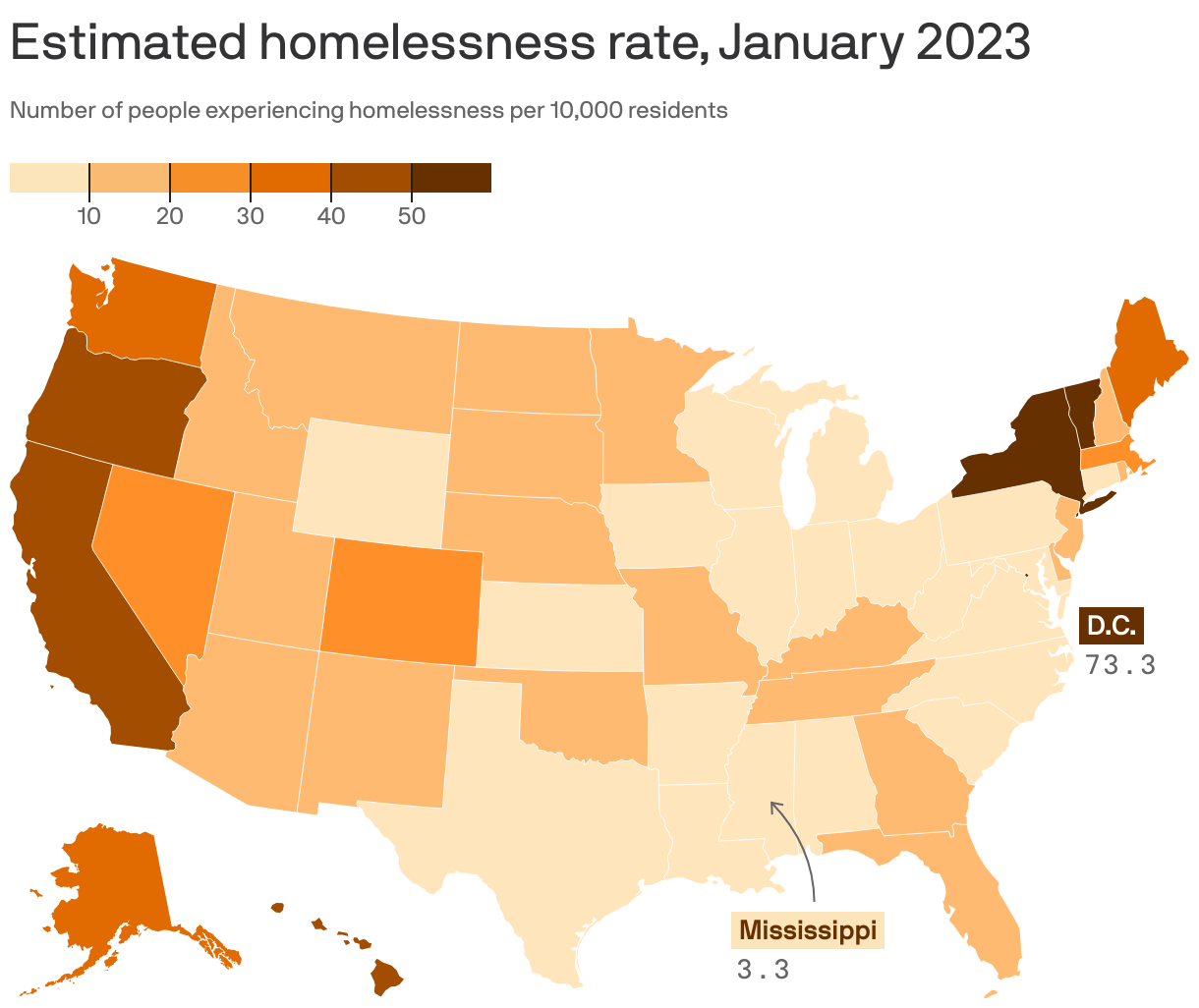
Nearly 1,000 more Virginians were experiencing homelessness at the start of last year versus before the pandemic.
What's happening: Virginia had 7.8 people experiencing homelessness per 10,000 people overall in 2023, per a recently released federal report.
- That's up from 6.8 per 10,000 people in 2019.
Details: The annual report, from the U.S. Department of Housing and Urban Development (HUD), attempts to estimate the number of people experiencing homelessness on a single night — in this case, in late January 2023 — to offer a snapshot useful to policymakers, advocates, researchers and others.
- Yes, but: Some advocates believe point-in-time counts can be misleading and may drastically underestimate the true number of houseless individuals, as Axios Portland has reported.
The big picture: U.S. homelessness reached a record high in 2023, Axios' April Rubin reports, with about 653,100 people experiencing homelessness.
- Homelessness increased by about 12% nationwide between 2022 and 2023, per HUD's report.
- The 2023 figure "is the highest number of people reported as experiencing homelessness on a single night since reporting began in 2007," per HUD.
Zoom in: In the Richmond region, there were 486 people experiencing homelessness as of July — an 8.7% increase over the previous year, per the latest point-in-time count conducted by Homeward on behalf of the Greater Richmond Continuum of Care.
Between the lines: Black and Indigenous people were overrepresented among those experiencing homelessness nationwide, as has been the case in previous years.
- Black people made up just 13% of the U.S. population in 2023, but 37% of all people experiencing homelessness and 50% of those in families with children.
Of note: As the report points out, many pandemic-era social safety net programs — such as income protections and eviction moratoriums — expired throughout the year.
- Shelters, meanwhile, largely went back to full capacity after capping admittance during the pandemic.
- Both factors complicate comparisons of 2023's numbers with those from pandemic years, the report warns — another example of the pandemic muddying data collection and analysis efforts.