Commute times dropped for Richmond workers

Add Axios as your preferred source to
see more of our stories on Google.
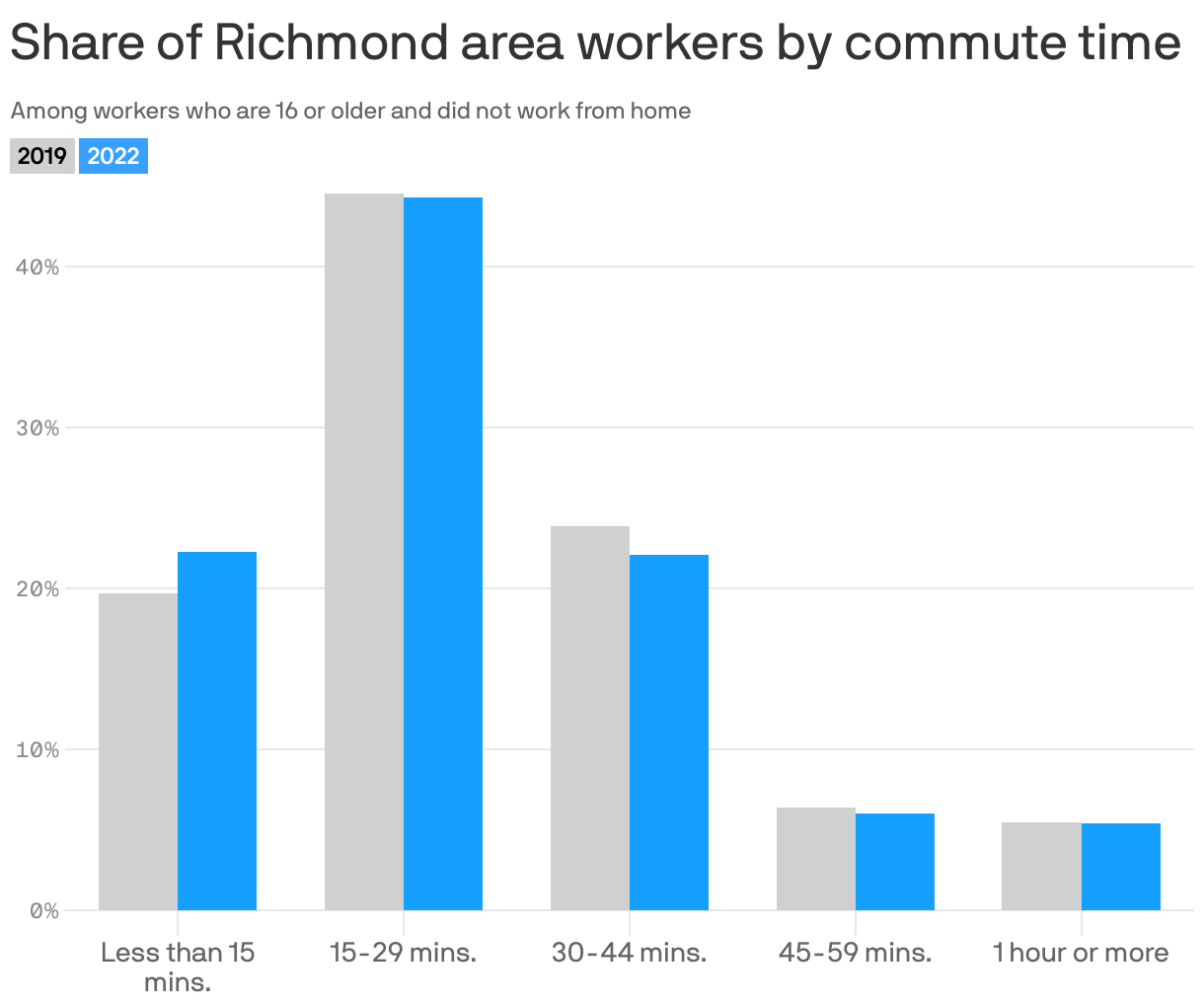
Richmonders' commutes are generally shorter than before the pandemic, according to a new Axios analysis of census data.
Why it matters: Quicker commutes are tied to better mental health, greater job satisfaction and several other personal benefits, Alex Fitzpatrick and Alice Feng report.
- Many people also commute via public transit. And the less time Americans spend in cars, the better for the environment.
By the numbers: The share of Richmond-area workers commuting between 30 and 44 minutes saw the steepest drop, with 22.1% of locals making those commutes last year, compared to 23.9% in 2019.
- The share of workers commuting between 15 and 29 minutes, 45 and 49 minutes and an hour or more fell too.
Yes, but: The share of locals with the shortest commute time — less than 15 minutes — went up between 2019 and 2022, from 19.7% pre-pandemic to 22.2% last year.
Worth noting: The share of Richmonders working remotely fell last year to 18.7% from its 2021 peak of 23%, according to census data (2020 numbers were not tracked).
The big picture: Nationally, commutes under 30 minutes became more commonplace between 2019 and 2022, while those 30 minutes and longer became rarer.
- 36.8% of U.S. workers had a commute of 15-29 minutes in 2022, up from 35.6% in 2019.
- Another 26% had a commute of less than 15 minutes, up from 24.8%.
Of note: These findings don't include employees who work from home, and thus have a commute time of zero — or maybe a minute or two, if you stop to pour a cup of coffee on your way to your home office setup.
Driving the news: There are a handful of potential factors at play here.
- The "Great Reshuffling" led many Americans to move and/or find new jobs, and some of those who enjoyed the benefits of pandemic-era remote work prioritized shorter commutes in favor of more personal or family time.
- Meanwhile, some degree of remote and hybrid work is persisting post-pandemic, leading to fewer cars on the road and so less traffic and faster commutes.
The bottom line: This data may not jive with your personal experience, as construction and other factors can mess with particular routes — but in the broad sense, more Americans are enjoying faster trips to work.