Beta Technologies eyes big N.C. expansion

Add Axios as your preferred source to
see more of our stories on Google.
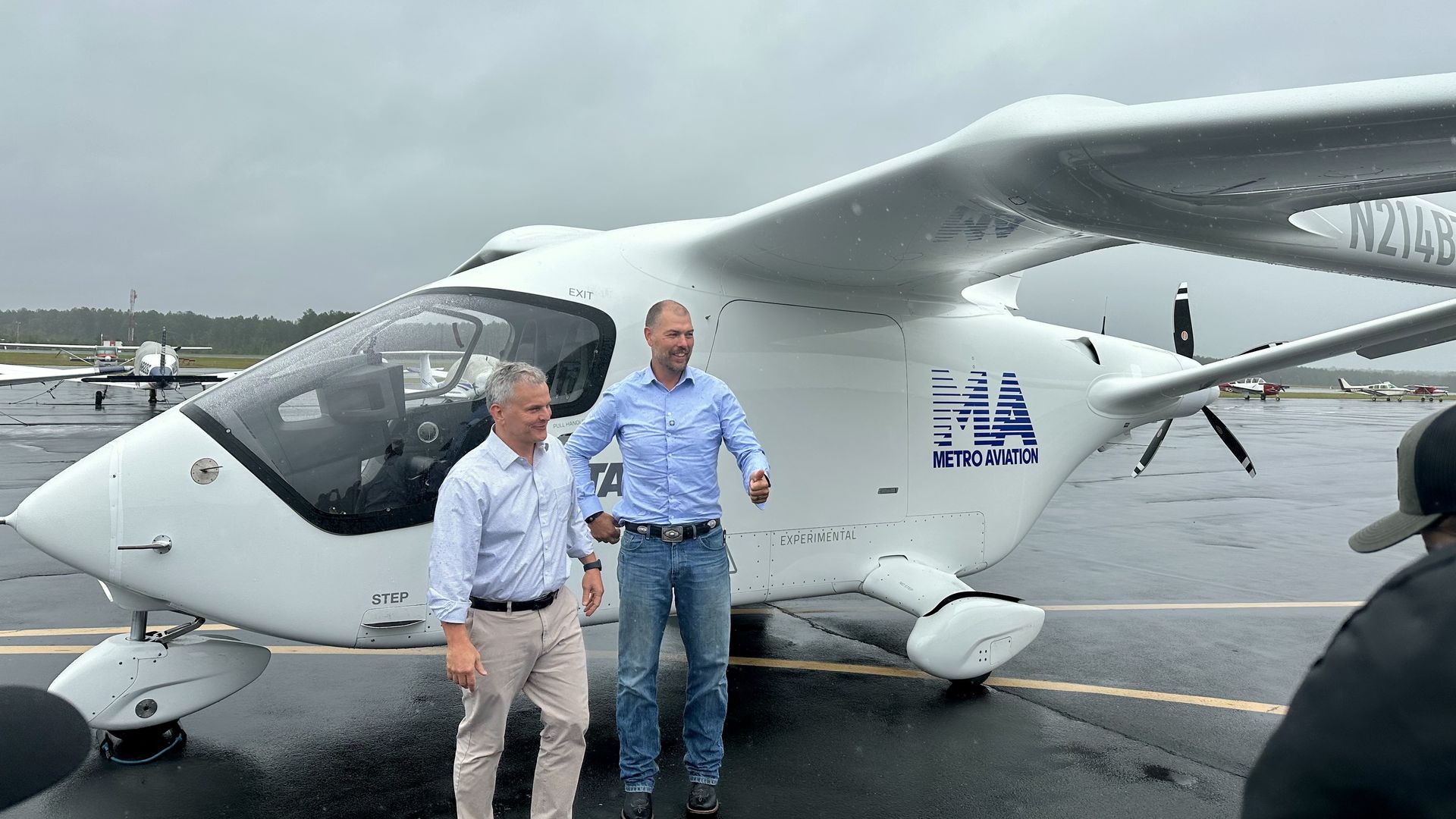
Gov. Josh Stein, left, and Kyle Clark, CEO of Beta Technologies, stand in front of one of Beta's electric airplanes. Photo: Zachery Eanes/Axios
Beta Technologies, a startup aviation company creating different types of electric aircraft, is considering North Carolina for a significant manufacturing expansion, the company's CEO Kyle Clark told Axios.
Why it matters: The Vermont-based company already has a significant presence in Morrisville, where it employs around 100 engineers working on the company's flight software.
- That gives North Carolina an edge, Clark said, but the company is still early in the process of site visits and determining the scale of a potential project. Other states could still come into play.
Driving the news: Clark's comments came at the Raleigh Executive Jetport in Sanford on Wednesday morning for an event marking the start of a pilot program with the Federal Aviation Administration and the N.C. Department of Transportation to test new forms of electric flight.
- Beta makes electric planes that both land traditionally as well as vertically and the company is working to certify the aircraft for commercial uses with the FAA. The pilot is meant to collect data to prove the technology.
- Beta currently operates a manufacturing facility in Vermont, but it recently raised up to $1 billion in financing to fund an expansion of its manufacturing capabilities.
State of play: Gov. Josh Stein was on hand to see the pilot and flew in Beta's electric plane with Clark, who did a lap in the air around the airport with the governor.
- North Carolina has invested significantly in wooing aviation jobs to the state in recent years, landing expansions from companies like JetZero, HondaJet, Boom Supersonic, Pratt & Whitney and GE Aerospace.
Zoom in: The FAA is interested in Beta and other electric plane startups' technology because of their ability to lower costs for delivering goods and taxiing people in rural areas. Joby Aviation, another startup, was also in attendance.
- Vertical landing, which was not demonstrated on Wednesday, could bring aircraft to harder-to-reach locations than planes that need a traditional runway.
Clark said fuel and engine maintenance are two of the biggest cost drivers in aviation and make it more expensive to routinely use helicopters or gas-powered airplanes in health care settings.
- Two of Beta's biggest potential customers are Metro Aviation, which works with health care networks like ECU Health, and United Therapeutics, which makes organs that need to be delivered to patients.
- Unlike helicopters, Clark added, Beta's planes could be certified to fly in icing conditions, which would help with flights during winter.
What they're saying: "We just opened up another section of our engineering office [in Morrisville], and we started exploring manufacturing here in North Carolina," Clark told Axios. "That's what I was talking to the governor about on stage."
- "North Carolina has been awesome to us to date, and we found that because of the people," He added. "Like incentives are great, all of the the facilities are great, the cities are great but … North Carolina is is a hotbed for aviation expertise, and that's why we're investing here."
What's next: Clark, a Vermont native, said that while he loves Vermont, the area's small population makes it harder for it to grow quickly there.
- He said that Beta hopes to have additional manufacturing starting somewhere in 24 months to 36 months.
- While the company is still exploring potential sites and determining what type of facility it needs, Clark said it would be "not small."