WakeMed's CEO makes his case for a merger with Atrium

Add Axios as your preferred source to
see more of our stories on Google.
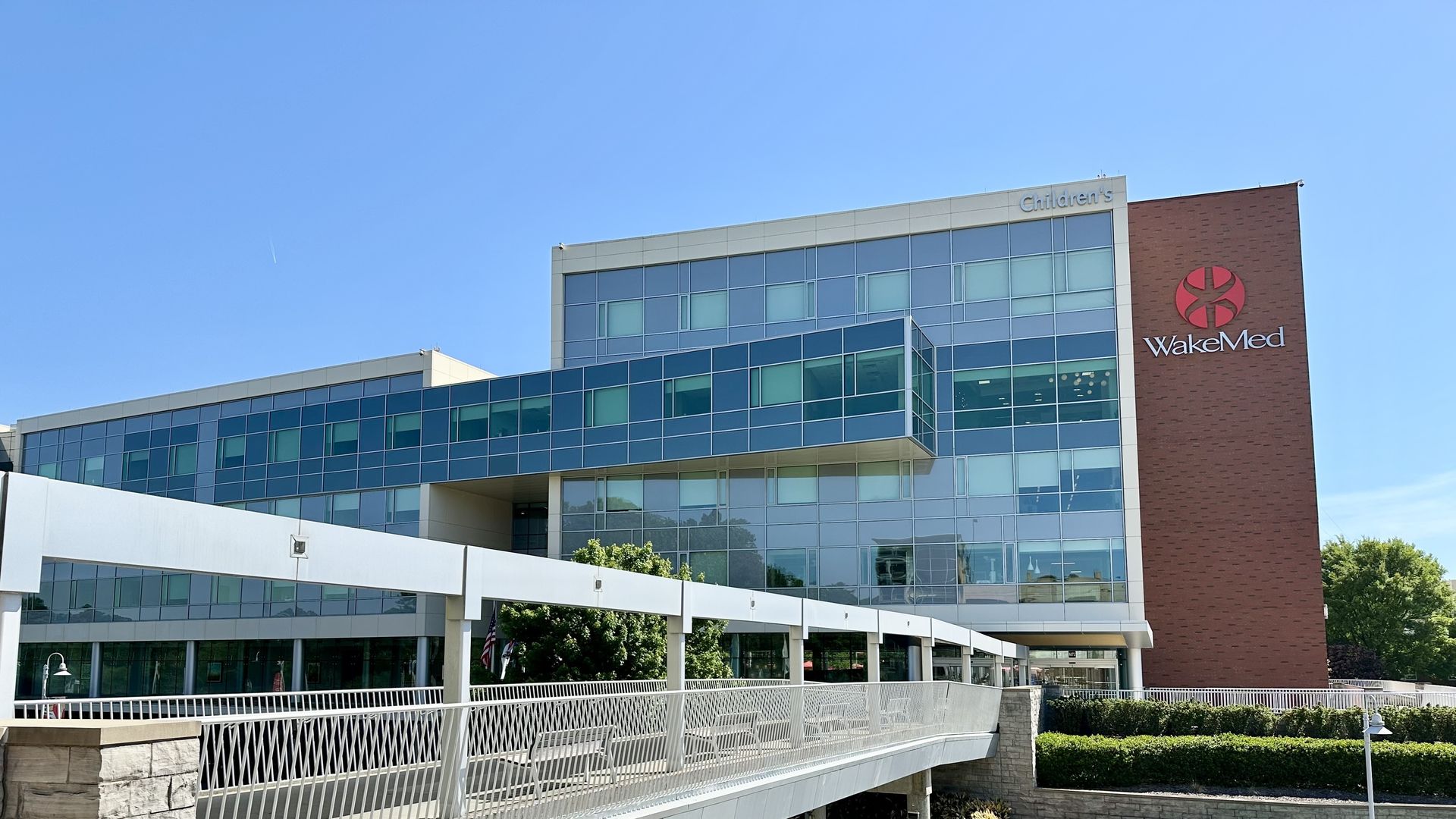
WakeMed's campus on New Bern Avenue in Raleigh. Photo: Zachery Eanes/Axios
WakeMed Health's leadership said Tuesday that a merger with Atrium Health is needed to ensure the Wake County-based hospital network will be thriving a decade from now.
Why it matters: Atrium's potential takeover of WakeMed, which was founded by Wake County in 1961 and is a safety-net provider, has been the talk of the town since it was announced last Friday afternoon.
- State and local officials, however, have raised strong opposition to the speed and the scope of the deal.
Driving the news: WakeMed hosted a press conference Tuesday for the first time since announcing the deal and after the Wake County Board of Commissioners delayed a potential vote that would have initiated Atrium's takeover.
- In comments to the media, WakeMed's CEO Donald Gintzig said he viewed this as a combination rather than a sale of WakeMed.
- The merger, which is two years in the making, calls for Atrium to invest $2 billion into WakeMed. The hospital's board would have a majority of members still approved by Wake County under the deal.
State of play: The deal, he believes, maintains WakeMed's influence in a way that might not be possible if its position weakens in the coming years due to Medicaid cuts and increased competition from Duke Health and UNC Health.
- But a more immediate concern is that its main campus on New Bern Avenue, originally built in the 1960s, needs at least a billion dollars worth of redevelopment.
What they're saying: "Do I think WakeMed will survive in the future [without this merger]? Yes. But I can see a world in which it doesn't thrive and that's really what this is about," Gintzig said.
- "I envision and see the challenges that we face to rebuild the [main] campus. Our finance folks have advised us it's unlikely we're going to have the financial capacity to rebuild the Raleigh campus ... and it needs to be rebuilt."
Between the lines: That is an argument that officials like state Treasurer Brad Briner have pushed back on, saying WakeMed has a strong enough bond rating to fund a renovation itself. Briner, for his part, is concerned that the consolidation will lead to higher prices for care for the State Health Plan.
- On Tuesday, Gintzig said he looked forward to sitting down with Briner and explaining the hospital's debt capacity.
- "I would welcome a $2 billion investment from the treasurer ... from the county and the state to make that happen," he said. But, "I don't see that happening without this combination."
Zoom in: Steve Smoot, Atrium's division president for North Carolina, said that in addition to a $2 billion investment and new jobs, the merger would boost WakeMed's virtual health care network and add more specialty care.
- He also said Atrium was committed to preserving WakeMed's charity care, and that it would raise the poverty level eligible for it.
- Those between 300% to 400% of the poverty level would be eligible for financial assistance — while those below 300%, which is under $100,000 for a family of four, would not get a bill.
What's next: WakeMed and Atrium need the Wake County Commissioners to approve a change to its articles of incorporation to file for the merger.
- That change has been delayed at least 90 days to give WakeMed more time to talk to the public about the merger.
- Once that happens, WakeMed and Atrium can file for regulatory approval from the Federal Trade Commission and Department of Justice.