As Lenovo Center grows, its transit options should too


Add Axios as your preferred source to
see more of our stories on Google.
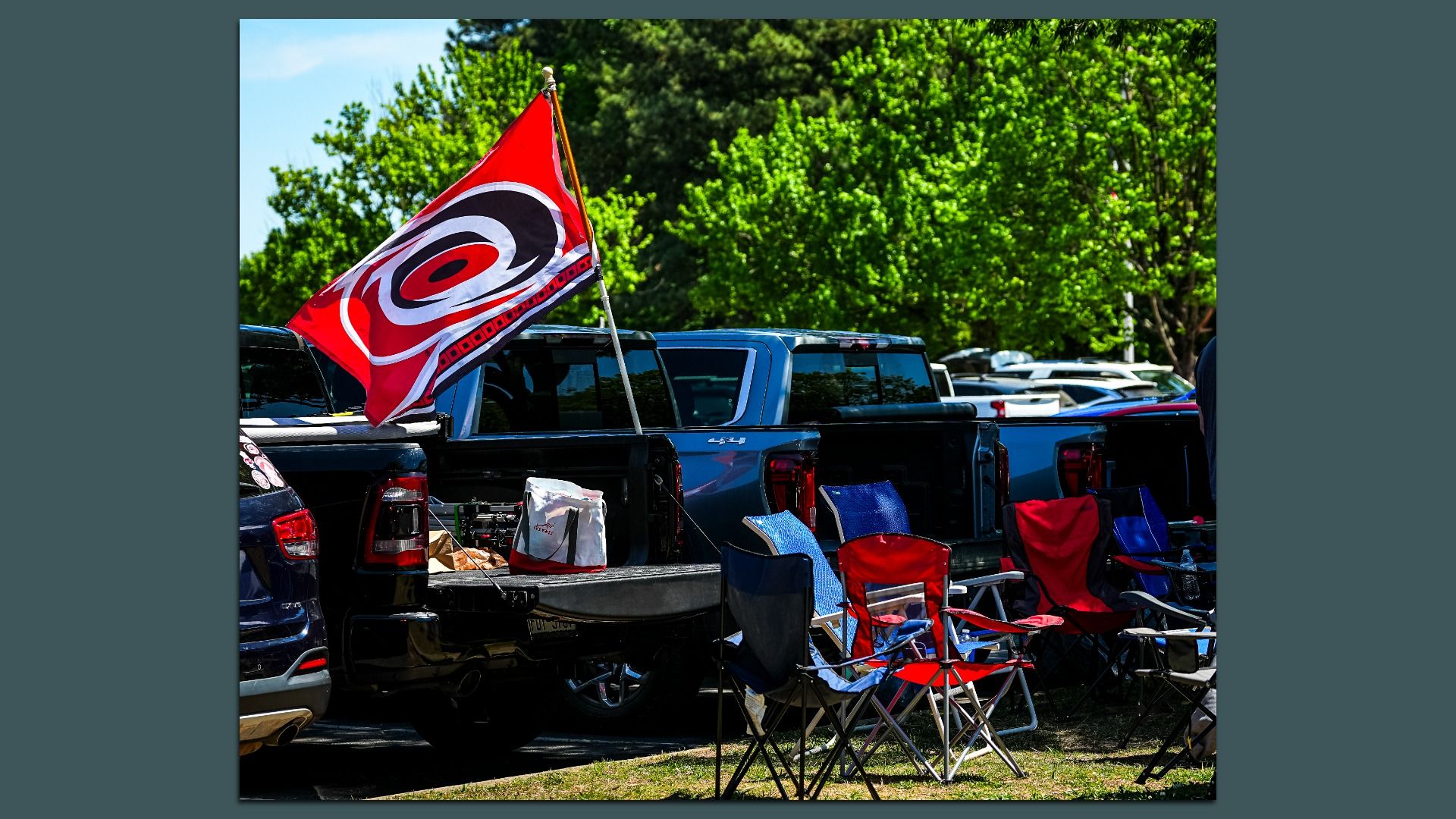
A Carolina Hurricanes flag is hung on a vehicle outside Lenovo Center on April 18. Photo: NHL Images/NHLI via Getty Images
The parking lots around Lenovo Center are packed again for a Stanley Cup playoff series, with thousands of cars paying $50 a spot and traffic on Wade Avenue and Edwards Mill Road grinding to a halt.
Why it matters: Avoiding the parking fee or easing the congestion is difficult, however, as only two direct buses stop nearby — and neither has the capacity to serve the arena during games or concerts.
How it works: GoRaleigh's 27L and GoCary's Route 2 buses both stop a short walk from Lenovo Center and Carter-Finley Stadium.
- But providing service for late games is tricky, since the buses run every 30 minutes during the day, but only once an hour after 7 or 8pm. The last GoRaleigh bus stops at 11pm. GoCary ends at 8 or 9pm, depending on the day.
- The Cary bus heads to the town center and Amtrak station.
- The Raleigh bus doesn't go downtown or connect to the main bus station. Instead, its main transfer points are Crabtree Valley Mall for Raleigh riders or Plaza West Shopping Center and Blue Ridge Road for connections to other cities.
What they're saying: "Providing large scale service for special events brings challenges that GoRaleigh cannot provide on a regular basis," city transportation spokesperson Andrea Epstein tells Axios by email, adding that 10 to 15 additional buses and drivers would be needed to service Lenovo Center or Carter-Finley Stadium during games and concerts.
The big picture: Growth around Lenovo Center is about to supercharge in the coming years as the city and the ownership of the Hurricanes invest billions of dollars into remaking Lenovo Center into a dense destination of apartments, offices, restaurants and shops.
- If that area is to ever reach its full potential as one of Raleigh's hubs of growth, it needs to be served by multi-modal options of transit, Raleigh City Council Member Mitchell Silver argues.
Between the lines: When he was Raleigh's planning director, Silver supported directing Raleigh's expansion around eight growth hubs, like downtown, North Hills and the area around Lenovo Center.
- He still supports that vision and wants to see Raleigh's transit format move from a hub-and-spoke model to one that prioritizes connections between its growth hubs, like North Hills or downtown.
- That idea has seen some momentum, especially in a recent uptick in proponents of re-thinking the downtown bus station as the center of gravity for the transit system.
State of play: Other options potentially exist for improving connections to Lenovo, whether it's for a concert, a game or whenever an office building goes up there.
- Raleigh is currently making a big investment to build four bus-rapid transit lines. While none of the proposed bus lines go directly to the stadium, the western leg comes the closest with stops on Western Boulevard.
- A high-frequency shuttle from one of those stops to Lenovo could be an option, some Raleigh officials believe, though that BRT line is many years away from reality.
Zoom in: Already, a train stop exists at the nearby State Fairgrounds, about a mile from the stadium, but trains only stop there during the State Fair each fall.
- Amtrak makes other special stops in Lexington for the BBQ Festival and Charlotte for Carolina Panthers games.
- The fairgrounds would have been a stop on a regional commuter rail line that is currently shelved due to a lack of funding interest from the federal government, but state investment could make it a viable stop for special events like concerts and Canes games.